
Nearly half of New York households are struggling to make ends meet despite earning incomes above the federal poverty line, according to a new report from the United Way of the Greater Capital Region.
The annual study reveals that 48% of households across the state now fall below the ALICE Threshold. ALICE — an acronym for Asset Limited, Income Constrained, Employed — represents individuals and families who are working but still cannot afford basic necessities such as rent, food and child care.
The crisis is particularly severe among the state’s most common professions. The report highlights that 52% of workers in New York’s 20 most common jobs earn less than the ALICE threshold.
In critical sectors such as home health and care aides, janitors and cashiers, more than half of all employed individuals do not earn enough to cover the basic cost of living. Advocates emphasize that this data disproves the notion that these families aren’t working hard enough; rather, wages and the cost of living have simply grown too far apart.
For those living below the threshold, daily life consists of impossible financial choices.
Community advocate Hayden Schwartz, a Social Security Disability recipient who falls under the ALICE threshold, describes the reality as a constant balancing act.
“There is no budget for anything; it’s just straight-up survival,” Schwartz said. “I have no ability to save, because I barely make enough to survive. How am I supposed to feed myself, pay my taxes, my utilities and still be able to put gas in my car?”
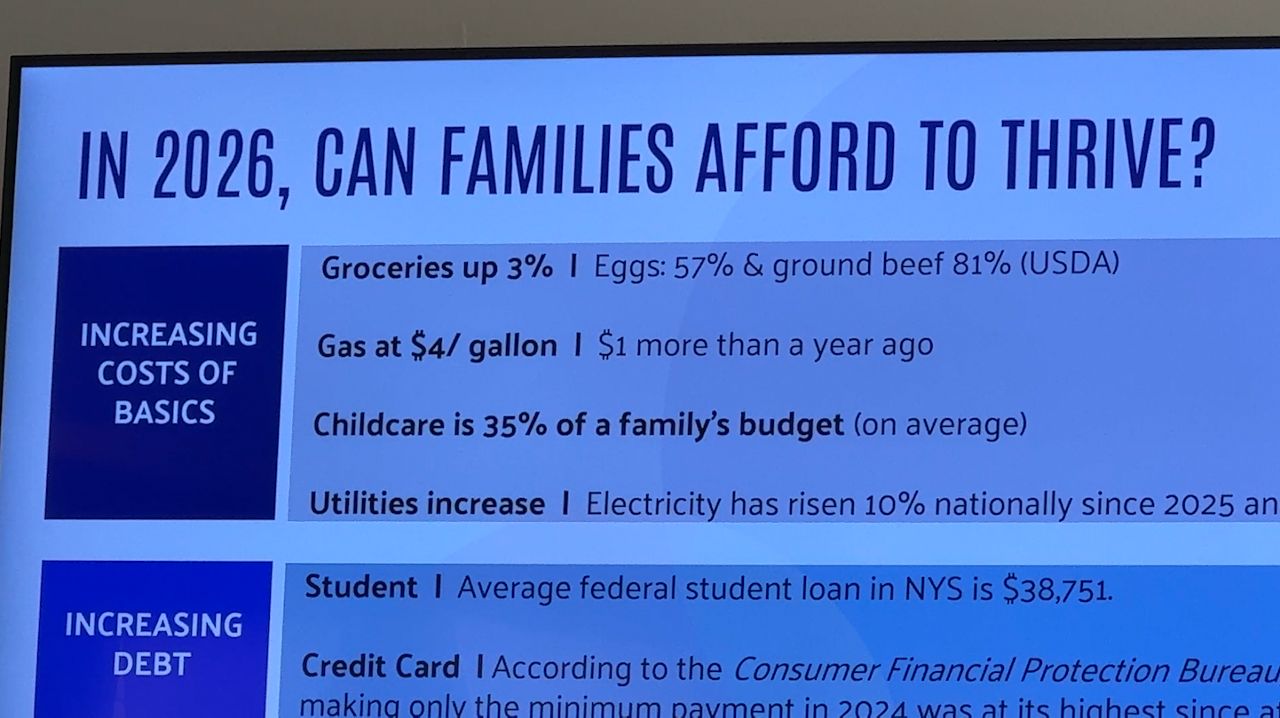
Researchers emphasize that while financial hardship is not a new challenge for New Yorkers, it is a rapidly growing one. The primary driver of the current crisis is the soaring cost of everyday items rather than a lack of employment.
“Income is actually increasing; it’s just not keeping pace with the inflation of the cost of everyday items,” said Peter Gannon, president and CEO of the United Way of the Greater Capital Region.
Claire Reid, chief impact officer for the organization, noted that addressing the crisis requires focusing on these surging costs.
“We also need to reduce household expenses. And those are rising really fast,” Reid said. “I think everyone already knows or is feeling that even in this past year alone, the cost of groceries is up, gas is up, utilities are up.”
A major hurdle for struggling families is the federal poverty level (FPL) itself. The United Way points out that the FPL has not been fundamentally updated since its creation in the 1960s and fails to account for how much the cost of living varies by location.
Because many government assistance programs use the outdated FPL to determine eligibility, a large number of ALICE households do not qualify for aid, despite being under the same level of financial distress as families living below the official poverty line.
United Way researchers argue the FPL must be updated or replaced entirely to accurately reflect modern economic realities and help shape better programs and policies. The Department of Health and Human Services, which is responsible for updating the guidelines annually, did not immediately respond to requests for comment regarding these concerns.