
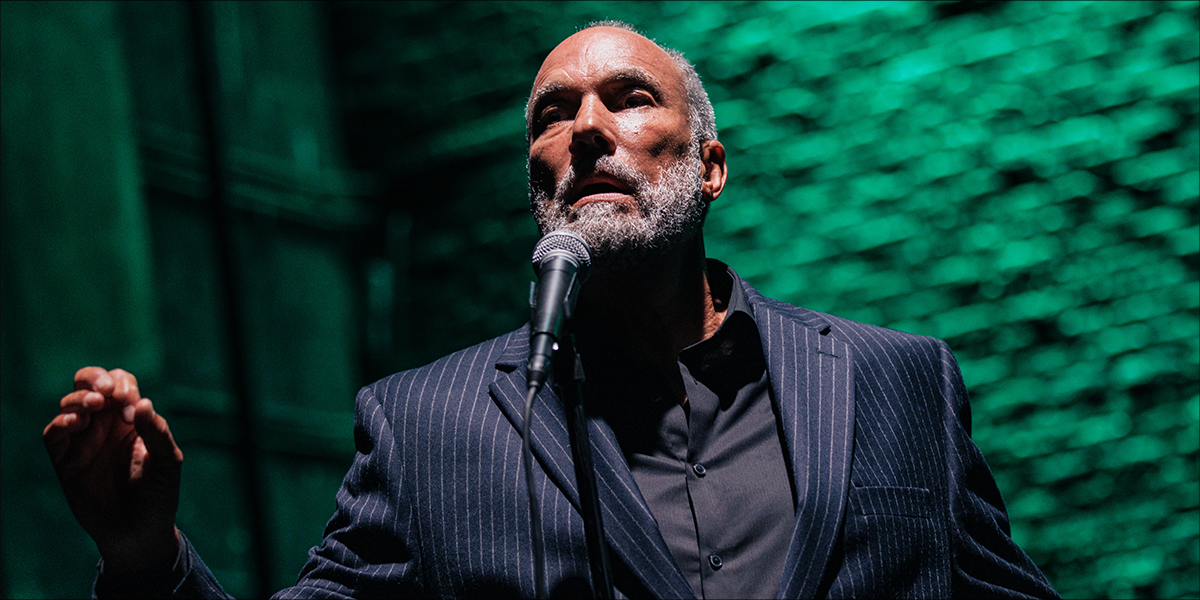
Read our review of In Honor of Jean-Michel Basquiat off Broadway, a solo show written and performed by Basquiat’s friend and collaborator Roger Guenveur Smith.
Roger Guenveur Smith opens In Honor of Jean-Michel Basquiat not by invoking the late artist of the title, but his own father. He wasn’t an artsy type — he worked as an elevator operator in D.C. — but he was the person who urged Smith to do a Basquiat tribute.
“You’ll never act yourself out of this coffin called the U.S. of A,” Smith’s father reminded him, even so. But what lies unspoken in Smith’s father’s statement is both a warning and an expression of hope. Maybe Smith can’t act his way out of his proverbial coffin, but he can briefly use his talents to resurrect a friend and visionary, gone too soon, out of his.
Smith’s monologue is not a plainspoken speech, but a kind of extended spoken-word poem that thrums with the energy of city streets, with grit and edge and rhythm. In a way, Smith’s script is a kind of verbal equivalent to Basquiat’s vibrant Neo-Expressionist style, shaped by his roots as a graffiti artist and further influenced by his Haitian and Puerto Rican heritage, his extensive time in both NYC and LA, and an ever-charged sociopolitical climate for Black men. Even in the moments when he isn’t explicitly talking about Basquiat, Smith honors him through form.
The pair met on the streets of LA and formed both a personal and artistic friendship that lasted until Basquiat’s death from an overdose at 27. Smith stuffs his 60-minute work with the names of jazz musicians and civil rights leaders and personal friends and fellow collaborators they encountered, separately and together — like Spike Lee, whose film Do the Right Thing features Smith as the Basquiat-inspired artist Smiley, and Andy Warhol, who was not responsible for Basquiat’s success, Smith passionately clarifies, despite being his most famous collaborator.
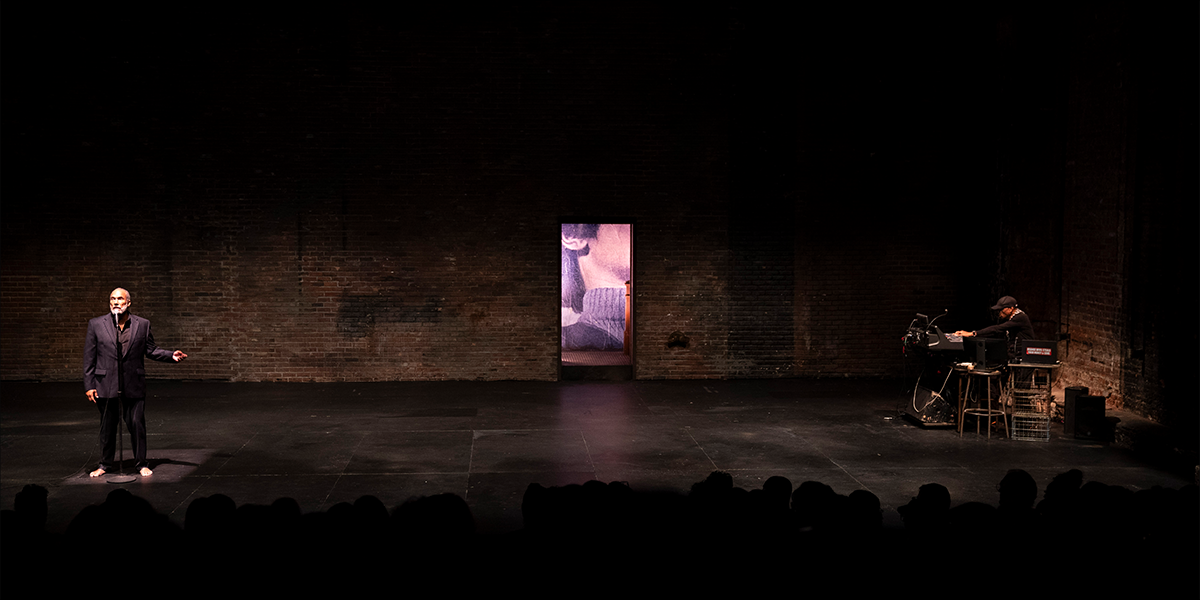
That moment is one of many that land as defiant, booming. That’s due in part to Marc Anthony Thompson, yet another longtime collaborator of Smith’s who here provides live sound design on stage. In Honor of Jean-Michel Basquiat is not really a solo show, nor is it merely a show about one person. Smith not only conjures their bond, but a whole community of artists and activists and strangers, both dead and alive, that shaped the pair in tandem. And so proverbial coffin comes slightly ajar. A little fresh air drifts in.

In Honor of Jean-Michel Basquiat summary
As Smith tells it, Jean-Michel Basquiat introduced himself to Roger Guenveur Smith on the streets of LA, when Smith was rapping as “Hollywatts” and Basquiat’s artistic star was on the rise. The pair became friends and collaborators until Basquiat’s premature death, and Smith pays tribute to both the late artist and to the wider artistic and sociopolitical landscape that shaped both their work and their personal bond.
In Honor of Jean-Michel Basquiat first ran at New York Theatre Workshop earlier this year as part of the annual Under the Radar Festival, and it returns there now. The venue is aptly located near a stretch of Great Jones Street christened Jean-Michel Basquiat Way.
What to expect at In Honor of Jean-Michel Basquiat
One way Smith’s production contrasts with Basquiat’s work is in its spareness. Smith spends the entire hour standing at a microphone, and the only other object on stage is Thompson’s DJ-esque sound setup. For most of the show, a mere three lights break through the darkness: one on Smith, one on Thompson, and one emanating from a door at the back of the stage, eerie and entrancing all at once as it suggests the link between the dead and the living.
In Honor of Jean-Michel Basquiat runs 60 minutes with no intermission, and there are brief, sudden loud noises throughout.
What audiences are saying about In Honor of Jean-Michel Basquiat
Across review-aggregating sites like Show-Score and Mezzanine, the audience response to In Honor of Jean-Michel Basquiat has been positive.
“Nice to hear a very personal perspective on Basquiat that only briefly mentioned his professional career. A lot more performance/movement art than I expected. Lots of name dropping and tangents that can be hard to follow at times, but glad to have seen this.” – Mezzanine user Jacque
“Mesmerizing storytelling […] Smith remarkably brings to life the people who were meaningful in Basquiat’s world. There is an intimacy and deeply moving quality to this production.” – Show-Score user Hara
Show-Score user Elisa 9119 called Smith “charismatic” and his production “a visceral revival of his friend’s spirit,” particularly praising the “evocative sound.”
Read more audience reviews of In Honor of Jean-Michel Basquiat on Show-Score.
Who should see In Honor of Jean-Michel Basquiat
Fans of Jean-Michel Basquiat’s career will want to see Smith excavate a different, more personal side of the artist from his firsthand memories.
Fans of rap, hip-hop, and spoken-word poetry will appreciate how Smith weaves the rhythms of these genres into his solo monologue.
Fans of Spike Lee’s 1989 film Do the Right Thing will be interested to hear the backstory of Smiley’s character, who was inspired by Basquiat. Smith also conjures a pivotal scene from the movie during in the show.
If you saw The Collaboration on Broadway, a fictionalized look into Basquiat’s creative sessions with Andy Warhol, you might be intrigued to hear Smith’s real-life account. Warhol plays a relatively small part alongside many other influential artists.
Learn more about In Honor of Jean-Michel Basquiat off Broadway
Roger Guenveur Smith delivers a captivating celebration of community in his solo show, honoring not just Jean-Michel Basquiat but the sprawling collection of people who are inextricably embedded into their bond and their works — including this one.
Photo credit: In Honor of Jean-Michel Basquiat off Broadway. (Photos 1 and 2 by Marcc J. Franklin; photo 3 by Marcus Middleton)