
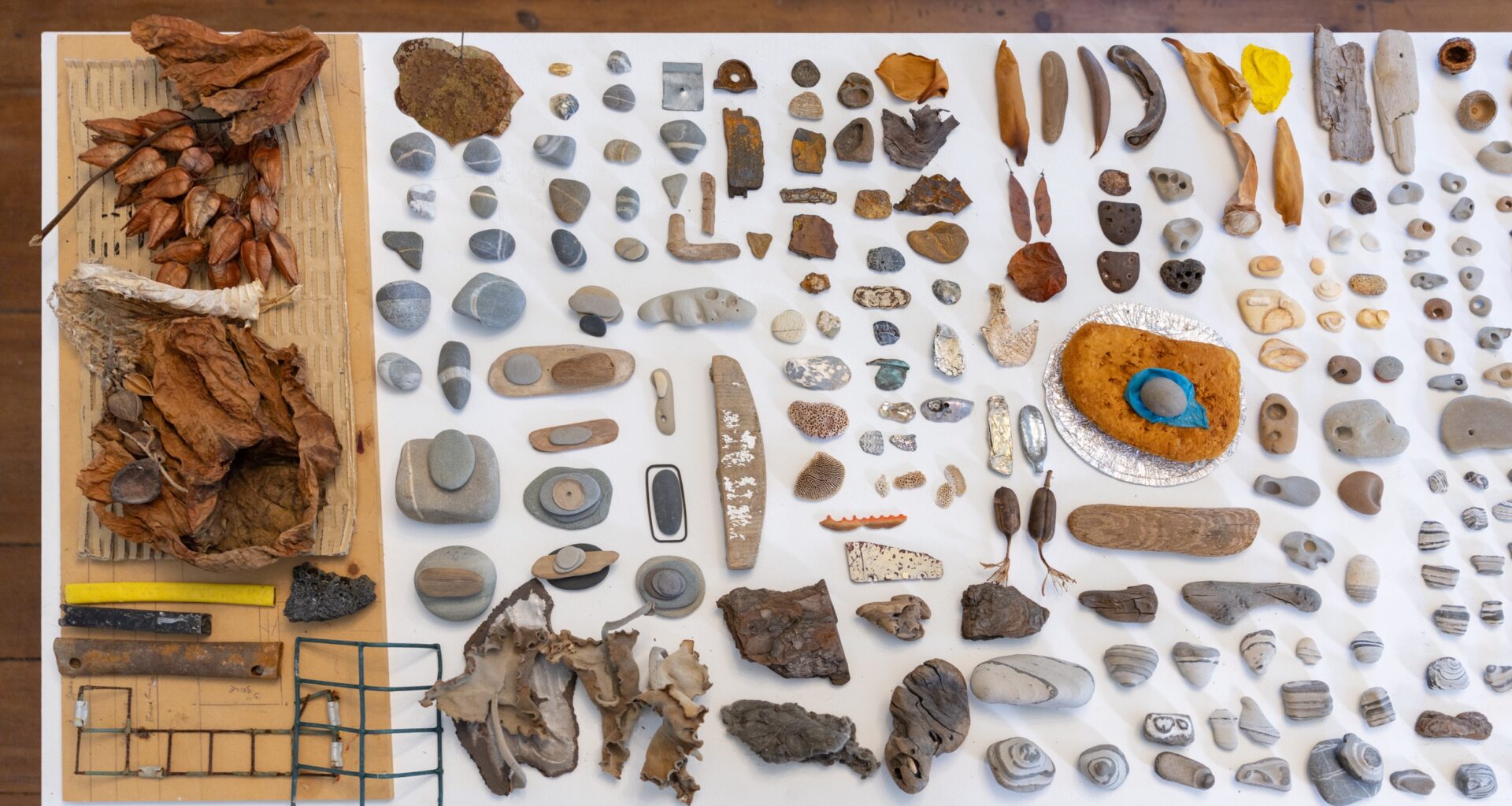
Walking Project: Animal, Vegetable, Mineral
Robert Frost Stone House Museum
June 25–October 31, 2026
Shaftsbury, VT
Berkeley-based painter Judith Belzer has a daily walking practice, a time for her to observe and reflect. While out rambling, Belzer also developed another habit, one she kept private for many years: collecting. Pocketing the flotsam and jetsam she encountered along the way, Belzer eventually amassed a private bounty of everything from rusted hardware to plastic bits and hag stones to mummified snakes.
Robert Frost, one of America’s most acclaimed and beloved poets, also had a walking habit. He considered it part of his writing practice—a time not only to clear his head and closely observe the world around him, but also to mentally draft his work while he ambled. Frost would sometimes walk with other poets, engaging in what he referred to as “talk-walking,” chatting across subjects until sometimes reaching distances of twenty-five miles in a day, as he did with his close friend Edward Thomas, a critic and poet. One of Frost’s most famous poems, “Stopping by Woods on a Snowy Evening” (1923) was written after taking a walk at his property in Shaftsbury, VT. That home is now the Robert Frost Stone House Museum at Bennington College, where Belzer’s exhibition, Walking Project: Animal, Vegetable, Mineral, is on view.
Belzer’s artistic practice, which includes painting, performance, and installation, grew out of her walks, or what we could call walks-collecting. This is the first time Belzer’s collection has been available for public view, shifting it from something very guarded and private to an “antidote to our throwaway culture,” as she writes in her statement. Certainly, part of that throwaway culture is also the erosion of our observational skills. Belzer’s collection gives viewers an excuse to stop and reclaim associative looking, visual pattern finding, and whatever meanings might be embedded there. Among the 685 objects, including a few sketch-like paintings made by Belzer, patterns do emerge: A cleaved tennis ball resembles a halved seed pod. Flattened metal bottle caps and pearlescent shells look like they could be cousins. A remarkable number of both manufactured and natural objects have holes bore through their centers, each serving as reminders of time and labor—from the unseen bivalves that grind their way through the stones that a beachcomber eventually picks up, to the unknown worker who stamped any one of the mysterious metal components that are now rusted through the middle, abandoned on the roadside. It is as poetic as it is part of the expanded canon, placing Belzer in a long history of artists who walked and/or considered walking part of their practice, such as Richard Long, whose walks sometimes result in deliberate arrangements of natural materials in galleries and museums, or self-proclaimed “walking artist” Hamish Fulton, an ethically-minded artist who works to leave no trace of his steps, funneling what he sees and learns on his walks into his studio production. Those are two artists on a list of walkers that seems to be growing. With recent publications dedicated to the act of walking as an art form, including Ellen Mueller’s Walking as Artistic Practice (2023) and the compendium in the “Documents of Contemporary Art” series, Walking edited by Tom Jeffreys (2024), it is starting to feel like walking is having quite a moment. And why shouldn’t it? Choosing to walk, whether in a meditative state, to make a mark in the grass, or to find an object, is one of the few remaining actions that is free to do and relatively within an individual’s control.