
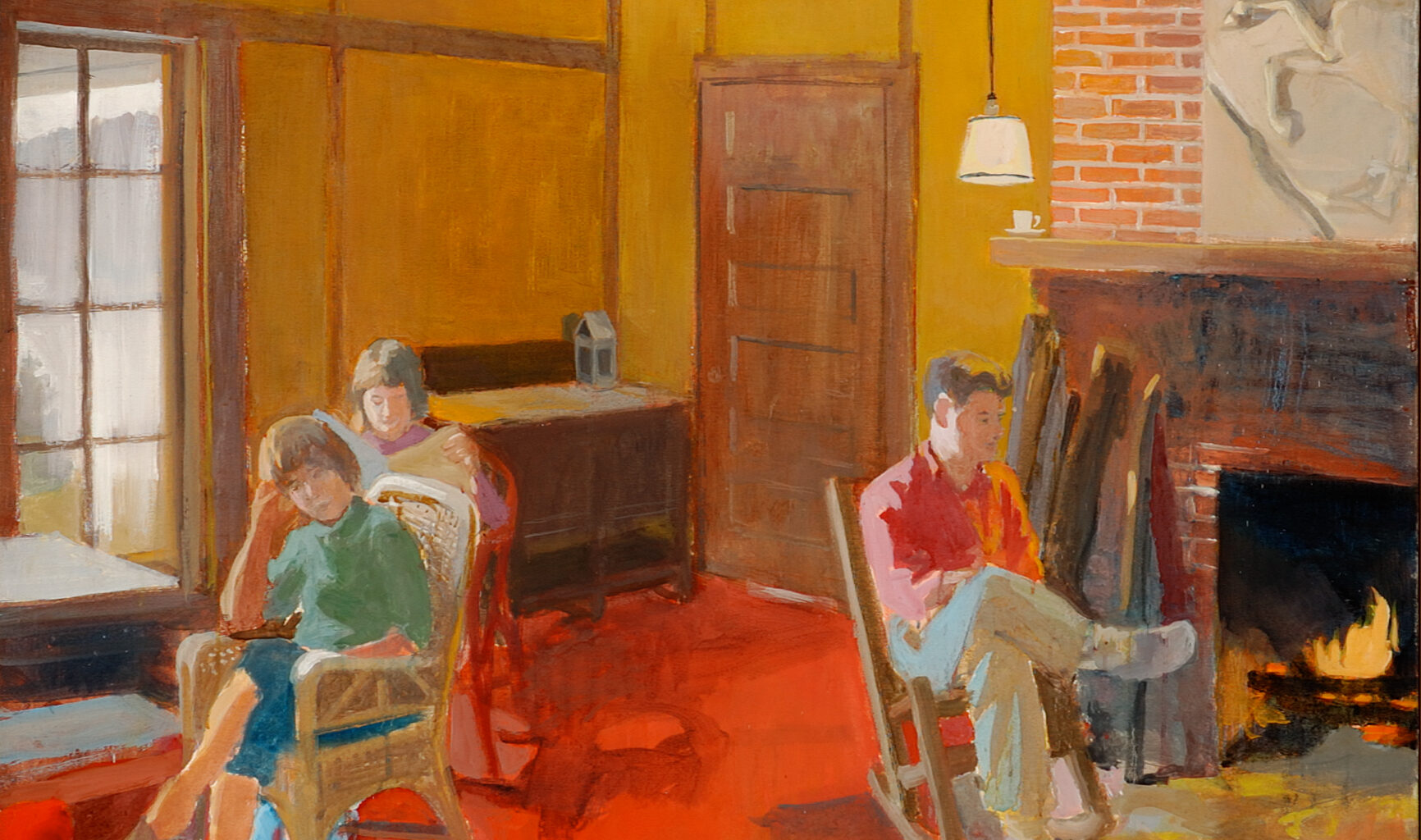
Fairfield Porter: What Everyone Knows at The Art Students League of New York was thrilling to see with veteran painter Rackstraw Downes. Porter wondrously transforms the everyday into a patchwork of fractured light and form—his “Impressionist shimmer.” Seeing paintings with Downes is a rigorous exercise in looking: “Look at that blue on the edge—it doesn’t even look like it belongs there,” he marveled, referring to a muted cerulean passage describing a lone sliver of sky on the left margin in The Garden Road (1962). Indeed, the rest of the sky is depicted as ochre-warmed titanium-white dashes atop olive-drab passages that become a skein of branches. “I have always had a feeling about shapes,” Porter wrote, “not that they resembled other ones, but that they had character.”
In A Day Indoors (1962)—curiously the only acrylic in the exhibition—Downes declared, “that fire is fantastic,” pointing to a hearth on the canvas’s margin, paradoxically dashed off in watery washes. Porter’s compositions tend to decenter the scene and disorient the viewer; the more one looks, the more it becomes apparent. Downes admiringly pointed to a rug painted as a striped lozenge-shape that could resemble an abstract painting made when he arrived at Yale University in 1961. There, his group of peers included William Bailey, Chuck Close, Janet Fish, Jane Freilicher, Al Held, Alex Katz, Robert and Sylvia Mangold, and Neil Welliver.
As a self-described “card-carrying Modernist,” Downes first saw Porter’s work during this period in the exhibition “Contemporary Art from New York Galleries,” the first of a series in the Yale University Museum. He strongly disliked the work in this show by Porter but then soon these paintings—also discussed by other students—changed the trajectory of his work. I had an uncanny feeling of the exhibition’s temporality—for me, this was art history; for Downes it was a recollection of moments in his life in art. Generations of artists see different things, and it was evident that Downes has been looking longer than I have been alive. Downes went on to know Porter and ultimately edit and write the introduction for Porter’s collected writings Art in Its Own Terms, published in 1979—coincidentally the year I was born.
As we viewed The Screen Porch (1964)—a monumental family portrait with James Schuyler, a poet-interloper—Downes recalled speaking with Porter at his 1965 exhibition at Tibor de Nagy, then located at 149 East 72 Street. He still remembers climbing the townhouse staircase to the gallery. After Downes took a brief walk through the show, he was approached by Porter, pointing to The Screen Porch, “What do you think of this one?” Downes replied, “It’s the most difficult painting in the show.” Porter pressed on, “Difficult to make or difficult to enjoy?” This exchange exemplifies the intellectual rigor of their dialog, which was fierce but respectful.
As writers, both Porter and Downes built vast discourses around their painting practices. In Porter’s writings, he regarded reality as particular, actual, and specific; frequently, he expressed a suspicion of idealism and systems imposed before experience. A sort of perceptual empiricism, Porter wanted painting to remain answerable to what presents itself rather than to a priori theory of what painting should be. I see this thinking in what Downes emphasized in the gallery: the apparently arbitrary blue, the strange interval, the fire—discoveries that arise from the sustained attention of careful looking. This kind of seeing seems to be aligned with what Porter remarks as “the real is what can be seen,” not an idea but something “specific and total” and “material and specific and actual”—arriving at what he calls “illogical immediacy.” Porter’s perceptual empiricism thus carries a claim about reality itself: the real is material, particular, and actual rather than an idea imposed upon experience.