
Frank Bolz is a top lawyer for the Democratic Party in Queens — with little to say.
“Frank, can we grab you quickly?” NY1 asked him at the recent judicial nominating convention in Queens.
He responded: “No, thank you.”
Bolz is part of a Long Island law firm with deep ties to the Democratic Party, which, critics said, has a deep influence in the Surrogate’s Court in Queens.
“The politics of Queens is underpinned by the party succeeding in its elections every 14 years for a surrogate judge,” said Ravi Batra, an attorney who has a long and occasionally controversial history with Surrogate’s Court across the city, including getting appointments himself 20 years ago.
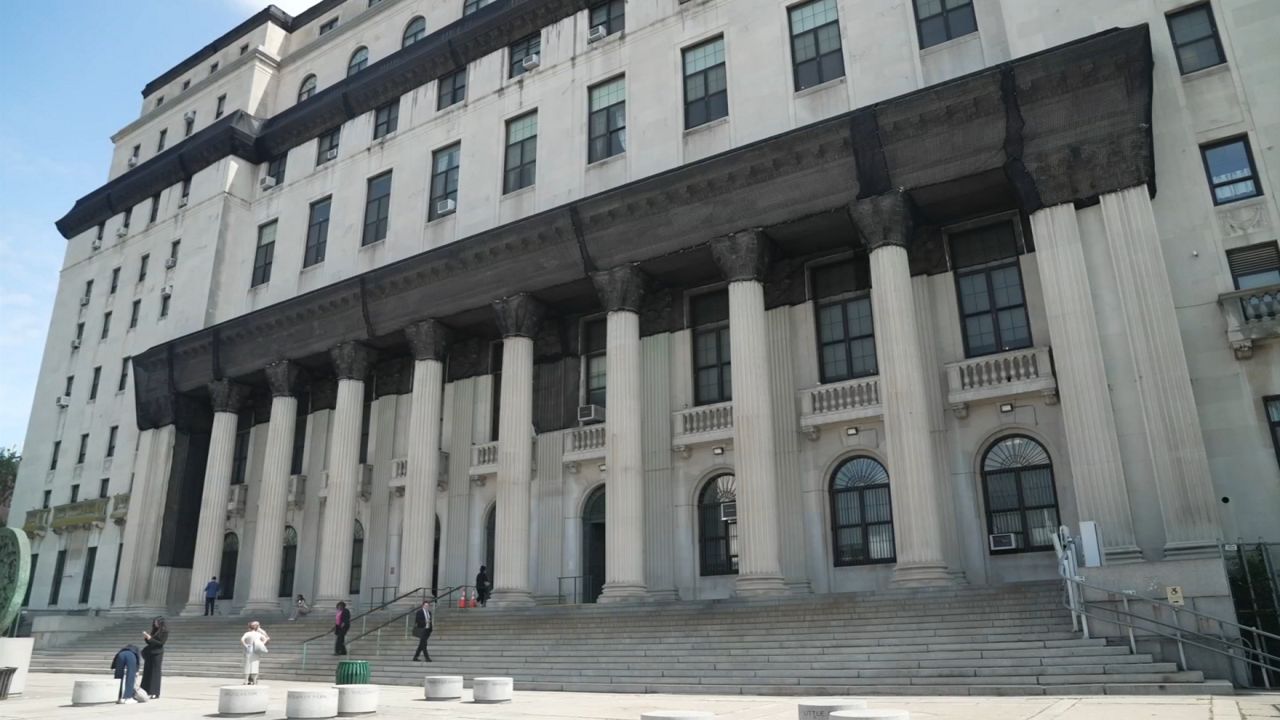
The Surrogate’s Court in Queens is a small court that handles estates, wills and adoptions. And in Queens, it’s also a place where party leaders and their partners are profiting.
“I know everyone,” said Michael Reich, the executive secretary of the Queens Democratic Party. “I’ve been in this organization for 40 years. I have been the executive secretary since 1986. We know everybody because of that.”
For months, NY1 has been examining how politics influences who sits on the bench in New York City. In Queens, the chairman of the party, Rep. Gregory Meeks, said the selection of those judges in his borough is his decision — he has the final say.
“I will tell you as far as the judges and the recommendations are concerned, that’s my responsibility,” Meeks told NY1. “Nobody else’s. I make that determination. And I tell them based upon the totality of what I heard, these are the individuals that I want to recommend to the judicial convention to be our nominees. That’s a 100% Greg Meeks decision.”
Other observers and insiders would say a Nassau County law firm has huge sway over the process— the firm of Sweeney, Reich and Bolz, where two of the partners serve as the law chairman and the executive secretary of the party.
Judicial candidates themselves recall meeting with them during the endorsement and nomination process.
“Questions were asked. You submit your resume. And they call you back for an interview,” said Oma Phillips, a candidate for the Supreme Court in Queens. “With the panel — the chairman and the lawyers.”
The firm also acts as volunteer lawyers for party-backed candidates.
“They make sure, as you can see, that legally every I is dotted and every T is crossed, that signatures are in place, and we apply when appropriate with reference to the election law,” Meeks said. “They are great lawyers. And we need them, and I thank them for their representation.”
The third partner, Gerard Sweeney, has been appointed for decades as the counsel to the county’s public administrator — a selection made by the Surrogate Court judge in Queens. That judgeship has been controlled by the party for decades.
The current one, Judge Cassandra Johnson, elected in 2024, won with the party’s backing.
The public administrator administers the estates of people who die in Queens, including when they do not have a will or that will’s validity is significantly questioned. Its counsel, in this case Sweeney, helps disseminate assets to the rightful heirs.
Sweeney is then paid fees from those estates.
NY1 obtained hundreds of pages of documents detailing how much those fees have been in the last several years. In 2025 alone, Sweeney was paid more than $4.4 million dollars.

Sweeney declined to go on camera for this story.
A spokesperson for the firm sent NY1 the following statement: “Jerry Sweeney is a highly accomplished attorney with decades of experience in this highly specialized area of law. The Public Administrator’s office handles hundreds of estates each year, some of which are incredibly complex. Thanks in part to his work, in the last year the Queens Public Administrator delivered nearly $57 million to rightful heirs, placed $7.6 million with the city for future heirs yet to be identified, and secured more than $3.2 million for New York City taxpayers — even though the entire office received less than $675,000 in funding from the city budget.”
His partner in the firm told NY1 at the county’s judicial nominating convention earlier this summer that the arrangement is not a conflict of interest.
“I am here only talking about the Democratic Party,” said Reich.
NY1 asked: “I am just wondering if there is a conflict of interest there?”
Reich responded: “No, why?”
NY1 asked: “If you help select the judges and then you end up profiting off the court?”
Reich said: “I have no vote here. I have no say. I sat there and all I did was sign papers.”
In a letter to NY1, an official from the public administrator’s office said these fees are set by state law – and there is little discretion on how much Sweeney is paid. The office also noted it generates millions of dollars of revenue for the city, much more than the other boroughs.
But some critics see this relationship as problematic.
“Because Queens is a wholly owned subsidiary of the Sweeney, Reich and Bolz firm,” Batra told NY1. “The core, the nucleus of the Queens Democratic Party is Sweeney, Reich and Bolz.”
Batra is now taking issue with how this court operates.
“We’ve experienced state actors sticking out their legs, created new processes that do not exist,” he said. “Imagine a judge, I have it on the record, instructing his chief clerk not to docket a motion.”
He is planning to sue the Queens Surrogate’s Court in federal court this fall for alleged constitutional violations related to a case he had in front of the former judge of the court — a judge who still handles some cases.
Years ago, rules were created to prevent political party influence in courts, prohibiting top party officials and campaign staff from receiving judicial appointments. Because lawyers for Sweeney, Reich and Bolz are not the chair or executive directors of the Queens Democratic Party, those rules do not apply.