
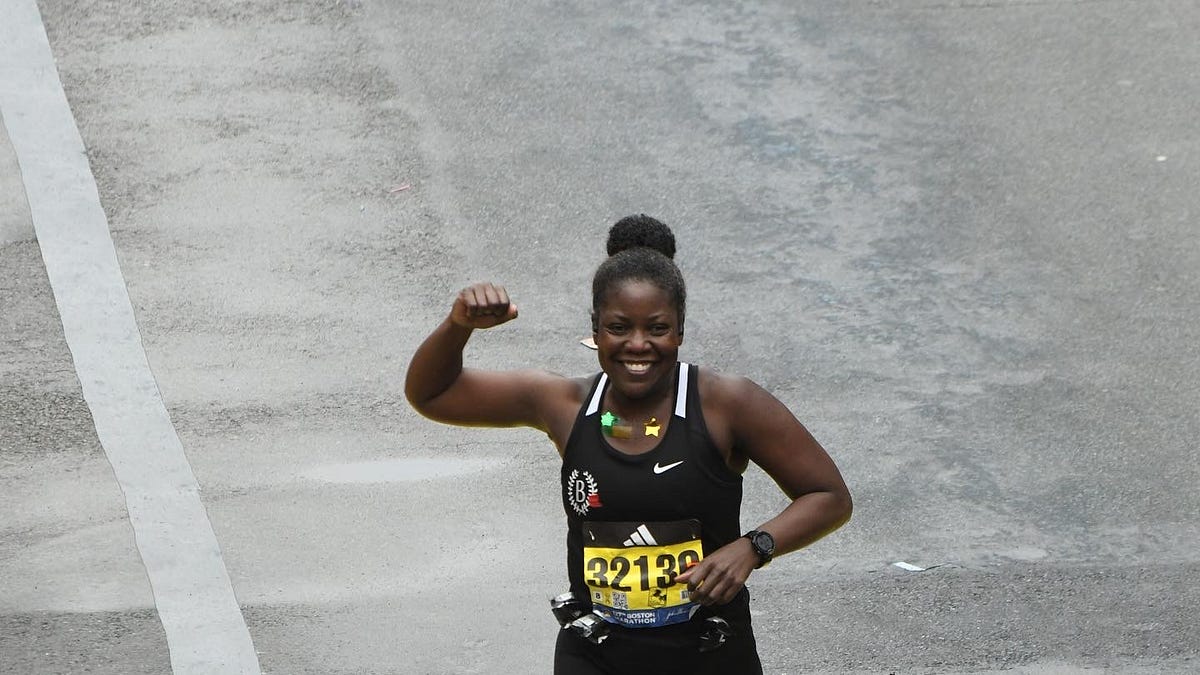
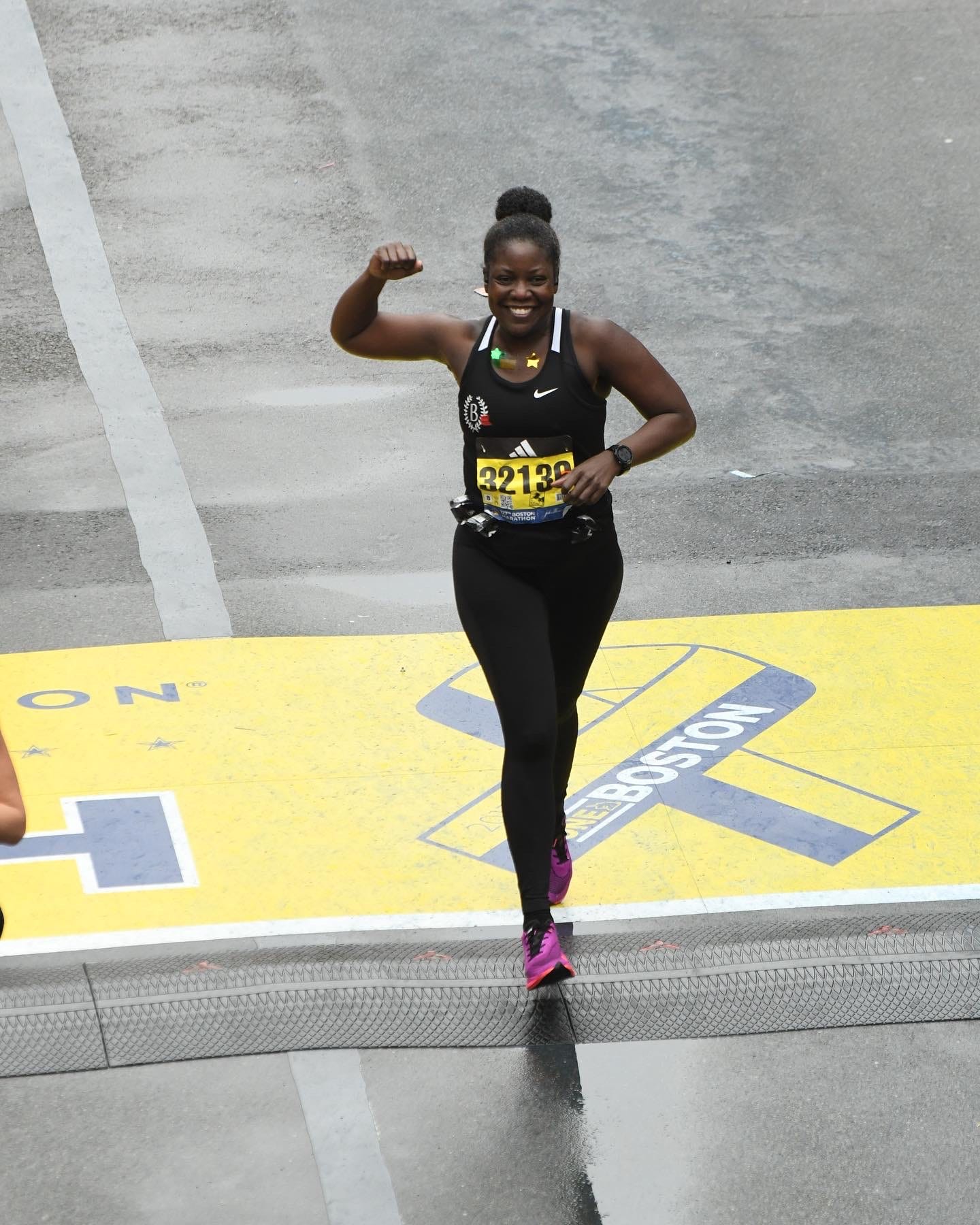
 Cheryl has run 25 total marathons, and completed her six stars at the 2023 Boston Marathon
Cheryl Donald’s roots with Brooklyn Track Club run deep.
She joined in 2017, just a year after it was founded as Brooklyn Navy Yard Track Crew, and has watched it grow from a small group of competitive runners to one of the largest clubs in New York City. Through the years Cheryl helped turn Brooklyn Track Club into a 501(c)(3) nonprofit and now serves as its board chairperson, as well as a regular attendee at Tuesday morning workouts.
But even she pushes back against the notion that runners need to be exclusive to a single group.
“I also run with Old Man Run Club. I run with Define New York Run Club,” Cheryl says. “What we’re starting to see in New York City is that people have so many different options, they can get what they want from running in a unique way that you probably can’t get in other cities.”
That mindset is part of what inspired Cheryl to start Running Sistahs Social Club, which aims to bring together Black women distance runners from across the city. And it’s also one that dates back to her time training with Nike in the mid-2010s—a period she credits with opening her eyes to the broader NYC running community.
We spoke with Cheryl to discuss the evolution of Brooklyn Track Club over the last decade, why running can be therapeutic but is not therapy, her running goals after completing the six World Marathon Majors and more.
This interview has been edited for length and clarity.
To start off, can you give an intro of where you’re from and what brought you to New York City?
So I’m an army brat, I’m a military kid, so I grew up all over the world, actually. But originally, my family is from Jackson, Mississippi. Both my parents grew up right around the corner from each other in Jackson. I went to the University of Mississippi, and having moved around my entire life, and then going to Ole Miss for college, that was my first time actually living in Mississippi, which was a great experience. But once I graduated, I said, ‘How far can I get from Mississippi?’
My paternal great-uncle lived on Long Island. My maternal great-uncle lived in Newark, New Jersey. And my father at the time was stationed out in Honolulu, Hawaii. So I said, ‘Wherever I’m going to move, I’m going to live there, I’m not going to move again.’ I knew if I went to Hawaii, they would eventually leave, so I decided to come to New York City….
I came to New York in 1997 to study marriage and family therapy at Hofstra University, then realized New York State didn’t license marriage and family therapists at the time. So after I graduated in 2000…. I had applied to a job with the federal government, it was a good opportunity, so I moved to D.C. for a while. And when I had an opportunity to come back, and I realized there were field offices, I transferred back to the New York field office in 2004. So I’ve been here consistently since 2004.
I left again in 2024 for a position in D.C., and then I got DOGE’d, if you remember all the stuff with the new administration. My team got completely terminated, we lost 500 staff in one day. And then they reassigned me to South Dakota, I said, ‘No, thank you.’ I declined that, and I retired from the federal government in May of this year. So now I’m back in New York permanently, and I work for the New York State Health Department, and I run the Office of Public Health for the state of New York. So that’s my story of who I am.
How did you initially get into long distance running?
Yeah, that’s actually a funny story. I had gone through a breakup—isn’t that how everyone gets into running, when they go through a breakup? And one of my sorority sisters said, ‘Oh, you should run the Brooklyn Half with me.’ And I was like, ‘No, no, no, no. I run on the treadmill. I do short runs. I don’t do long distance.’ And she said, ‘No, it would be good for you.’ So I googled half marathon training programs…. I said, ‘Okay, let me do this, and it’ll distract me and take my mind off of things.’
And so we were going to run the Brooklyn Half together in 2014. This was when you could still sign up for the Brooklyn Half right before the race. So we were ready to go, and then she’s like, ‘Oh, I can’t run it. I’m going to a wedding in Bermuda.’ So I asked a group of my friends if they would like to run it with me, and we all ran the Brooklyn Half together in 2014. I ran it under two hours, and I was like, ‘Oh, so I just follow instructions, and I think sub-two hours is pretty decent.’
And then from there, I caught the bug, started meeting different people in Prospect Park in Brooklyn. I think the first run club I got connected with was Lean Strong Fast. Then I started doing some of the Nike runs that were happening at that time, and then got connected with Steve Finley and Brooklyn Track Club. That’s my home club, Brooklyn Track Club, and I’ve been with Brooklyn Track Club since 2017.
Before Brooklyn Track Club, you mentioned you ran with Nike…. Can you touch on how that group aided in your own running journey, but also how you noticed it both grow and connect the New York City running community at large around that time?
Yeah, that’s a great question. I think I might have just heard about [the Nike runs] through different people in the community, and once I got there, it was really just a lot of like-minded people. Of course, you’ve heard about the BridgeRunners and Mike Saes—we are contemporaries age-wise, and I kind of met up with them and started doing some runs with them through that Nike relationship. And then with the different runs that Nike would have at the time, you would see these same people over and over again.
And at the time, Steve Finley was also the head coach for Nike Running, and he had—I think they were Brooklyn Navy Yard [Track Crew], and then they became Brooklyn Track Club in [2017]. And around 2017, Nike decided to discontinue those runs that they were doing. They were great runs, community-based runs, supported runs. We had water, fuel, bananas, different things like that. They divested from that, and Steve was like, ‘Well, if you want to keep running, you can come to Brooklyn Track Club.’ And I was like, ‘Yeah, no, no, no, I am not a fast runner.’ He’s like, ‘Oh no, everyone could come.’ That’s what they say, and you show up and you’re running with people who are sub-three marathoners and sub-five minute mile runners.
But I started running with Brooklyn Track Club, and a lot of folks who were doing a lot of the Nike runs started coming over to Brooklyn Track Club as well, and kind of created this community. And so I think Nike creating this space and supporting clubs like BridgeRunners, and investing in the community and that space, and then bridging into some of the clubs that they support now, like Brooklyn Track Club and the [Boogie Down] Bronx Runners and Mile Style and Old Man Run Club and all of these other crews that they support—[it’s] a way to really look into more of what we call the crew culture, which is not necessarily a traditional formalized run club, but more of a community-based crew of people that are either like-minded, live in the same neighborhoods, enjoy the same things, and the common denominator between them is running.
It’s been impressive seeing how Brooklyn Track Club has grown over the last 10 years—from a very small group of very fast people, to a couple hundred, to who knows how many now.
Can you talk through how you saw the club evolve and grow through those different periods? And what do you think has allowed it to grow so much?
Yeah, there have been different iterations of the club over the years—and we’ve always been a performance-based club, right? I think that’s what attracts people to the team. Folks want to get better, they want to get faster. And people always think that fast is a number, but to us, it’s relative. So if you want to get faster than where you are, this is a place where you can seriously train, be guided by coaches that have experience in these spaces, and develop a community in that space. So you don’t necessarily have to be a sub-three hour marathoner to come to the club.
And it takes time to cultivate that relationship. I would say over the years, when we first started and we started growing larger, was kind of around that time where Nike was not doing those runs as much, and people were coming so that they could continue that training formality piece. And then we started seeing the growth of the club, and we said, ‘Hey, maybe we should formalize this a little bit more.’ So I think it was 2018, 2019, we decided to create what’s called Brooklyn Track Club Association, which is the 501(c)(3) that we are now, and we became a club that was based on dues. That was huge for us, because we were like, ‘Is anybody going to want to pay dues to come and help support?’ What we wanted to be able to do was to support our coaches. Our coaches were showing up every Tuesday at the track to coach people, and that’s their brain trust, right? That’s their time. And New York City is an expensive place, people have bills. So we wanted to make sure that we were able to sustain what we were creating. And so we had a modest membership fee, and I think we had over 100 people sign up the first day, and we were really excited about that.
And the club just grew and grew and grew. During COVID and after COVID, we experienced the boom just like everyone else did. I think we were probably hovering close to 1,000 members, which was insane…. But what I think we’ve seen more recently with the running boom is that we’re seeing more clubs pop up all over New York City. I would say that that model of Brooklyn Track Club was probably one of the earlier models during that time, and now we’ve seen different clubs break off and create their own entities, and people coming from other parts of the country that are creating clubs. So I would say we’re probably hovering maybe around 700-ish people now, which I think is a manageable number…. It’s reflective of the fact that people have more options. Some people want to train. Some people want a performance team. Some people want a social team. Some people want a little bit of both, right?
“What we’re starting to see in New York City is that people have so many different options, they can get what they want from running in a unique way that you probably can’t get in other cities”
Personally, I’m a member of Brooklyn Track Club. I’m the board chairperson of Brooklyn Track Club. I created the 501(c)(3). But I also run with Old Man Run Club. I run with Define New York Run Club. And then I also created my own club with the Running Sistahs Social Club. So for me, I see the options that people have in New York City, and don’t necessarily have to be exclusive to one…. Depending on what you want to do, and depending on where you want to be, and how you socialize, and how you develop your running—I’ll call it portfolio—there may be multiple clubs that meet your needs. And so I think what we’re starting to see in New York City is that people have so many different options, they can get what they want from running in a unique way that you probably can’t get in other cities.
I’m sure it’s difficult to balance the very high-end performance side of a club but also have a very large, social, inclusive club as well. Anything else you want to touch on in terms of how Brooklyn Track Club has navigated that?
I think for the most part—and there are so many people on the team, I’m obviously not speaking for everyone. But I do believe I have a pulse on the team, and most people are striving toward a goal, right? That goal may be their own internal personal goal, or it may be a huge goal, like they want to OTQ, or they want to BQ, or they just want to get under four, or they want to get under five. And so I think what we’re seeing, at least in Brooklyn Track Club, is regardless of what their personal goals are, people are looking for community. And we have really looked at different models for doing that.
We’ve had captains in the past. We’ve had community leads—that’s a model that we’re utilizing now. The community leads, their job is to listen to the pulse of the membership and the things that they’re looking for. Do you want more opportunities to socialize? We usually do parties after events, especially after Team Champs, because usually we have a good showing at Team Champs, and so we want to celebrate that. After the New York City Marathon and the big New York Road Runners events, we tend to have social events for folks. People want to not only connect on the track, which is a big social scene—but people are kind of focused on what they’re doing—they also want to get to know people that are in different pace groups. So if I’m running a sub-four hour marathon, maybe I want to know some of the people on the team that are running sub-three hour marathons. And how do we create opportunities for people to socialize amongst the team, and then also include people from the community at large? So we’re navigating that constantly.
Our new coach now is Ned Trim, he’s doing an amazing job in his first year as the coach for Brooklyn Track Club. And those are a lot of the questions that we have during our board meetings. What are we hearing from the team? What’s the value add of their membership? What are the resources that they’re getting for joining us? And we also pay attention to how many people are showing up at these events, because that also tells you if people are interested in them. I don’t want to call it a business, but if you’re going to have an organization, you have to pay attention to the people that are invested in the organization. And when you’re also part of it—I’m showing up at 7am, I’m also utilizing that and experiencing and hearing what’s going on as well.
You mentioned the club you created, Running Sistahs Social Club. Can you talk through the origins of it, the gap that you saw, and how you’re hoping to fill that gap in the community?
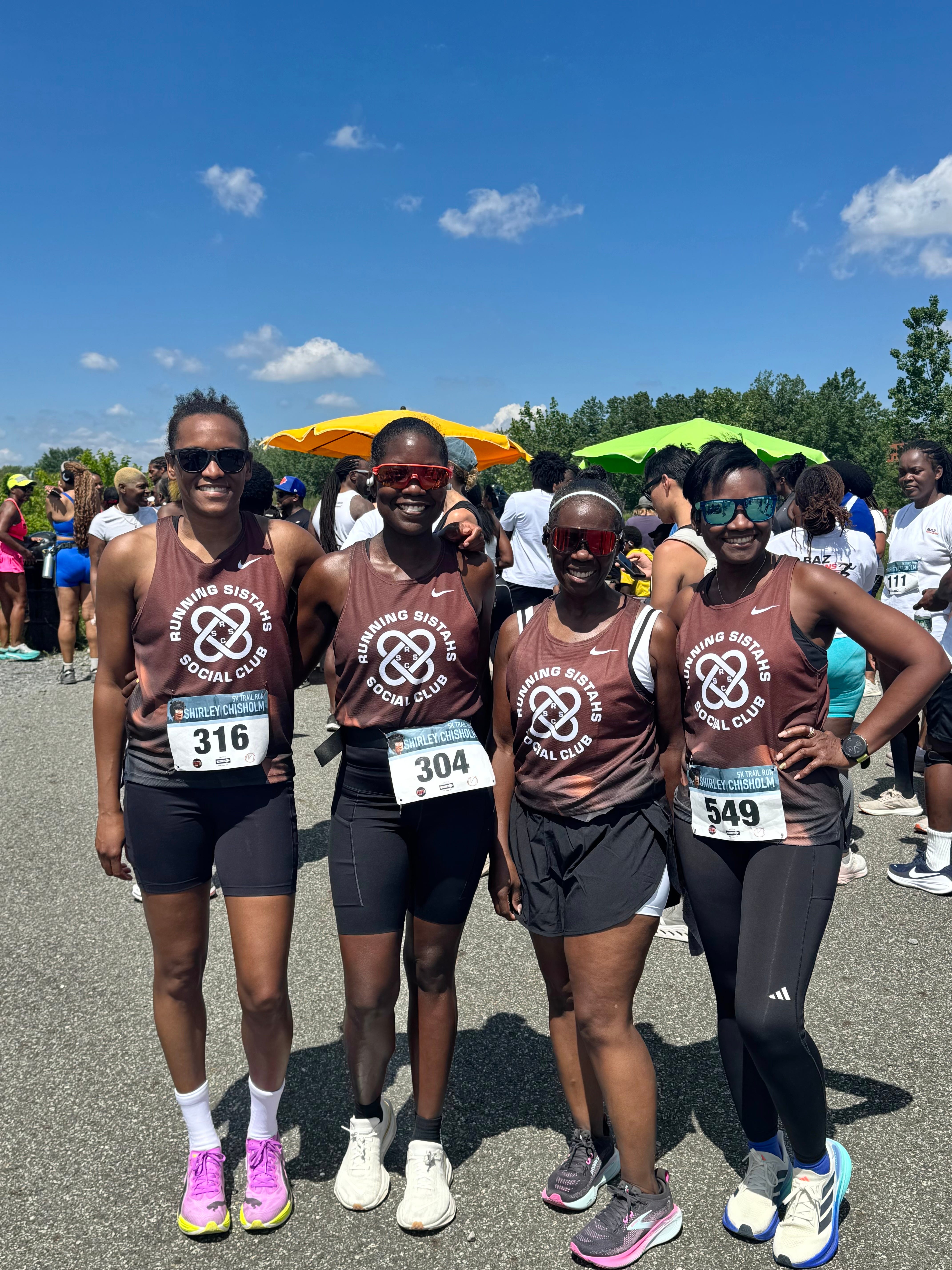
Great question. So the Running Sistahs Social Club—it’s funny, because it’s not a run club. It’s a social club for runners, but we do run together. It really is designed to bring together Black women distance runners in the community. One thing that we find is that there’s an underrepresentation of Black women runners in distance, looking at half marathons, full marathons, even sometimes 10ks, right? But we’re well represented in sprinting and track and field and those types of things.
So what I wanted to do was just create an opportunity for us to come together. And because our numbers are not as wide as some other demographics, you then tend to have people who run a myriad of paces. So we have ladies that run sub-three hour marathons, and then we have people that are running six, seven-hour marathons. And so I pulled together some friends of mine: Erica Stanley, who works with Tracksmith; Danni, who runs with Black Roses—both Danni and Erica are sub-three hour marathoners, they’re on the list of American Black women who’ve run a marathon under three hours—and then we have myself and Nisha, who runs with Lean Strong Fast. I wanted to create a coordinating council of women at different paces, so that we could reach out to our contemporaries who run in those spaces, so that we can get to know each other.
“Especially for people who are new entering the space, and maybe are like, ‘I don’t know if this is for me, I don’t see people who look like me,’ you can come with this group, socialize with us first, find out that we’re not all crazy runners—even though we talk a lot about running”
And so the premise of that is just we get together and we do social events every two months, and that’s a way for me to see people and get to know more people who look like me, and then also to create a critical mass of Black women runners that people can see and connect with. Especially for people who are new entering the space, and maybe are like, ‘I don’t know if this is for me, I don’t see people who look like me,’ you can come with this group, socialize with us first, find out that we’re not all crazy runners—even though we talk a lot about running.
And what’s nice about the social club is that we have a representation of New York City run clubs. The members are parts of different clubs around the city and around the boroughs. So you also get an opportunity to meet people throughout the city who maybe you would not have met if you spent all your time in Brooklyn, or if you spent all your time in the Bronx.
You’ve been a mental health professional for many years. One thing you’ve said in other interviews is that running is not therapy. Can you expand on that? It’s something you hear a lot as a runner—everyone says it and doesn’t really think too much about it.
That phrase is nails across the chalkboard for me, because running is not therapy. It can be therapeutic, but it doesn’t replace clinical mental health training. So what I like to say is that running is good for your emotional wellness and stability, and that it really helps balance you, but it’s not therapy. It doesn’t address issues that may be contributing to things that people may be challenged with.
But I will say that even personally, as a psychotherapist, it’s essential to my emotional wellness that I run. And I used to always tease my staff that if I haven’t run in the morning, then you’re getting a different boss. Trust me, you want me to run in the morning before I get to work, because then I’m balanced and I’m zenned out. So I think that there is a psychological component and an emotional component to running. But when we’re really struggling, it’s so important to seek qualified mental health support.
You became a certified coach relatively recently. Can you touch on the origins or motivations there, and how that’s changed your relationship with running, or your perspective on running?
Yeah, I’ve run 25 marathons, this will be my 10th time in a row running the New York City Marathon, and I’ve been around for a very long time, I’m 51 years old. So I say all that just to say—it’s not that it’s getting old, but it’s getting kind of routine for me. I wanted to get certified because people were asking me questions, ‘How do you do this? How do you do that?’ And I was like, ‘You know what? I know this just from experience, but I would love to go back and get formal training on this, so I can really help people who are trying to enter the space.’
And for me, you run [the New York City Marathon]—it’s a unique experience each time you do it, but when you’ve run it so many times, it’s like, ‘Now I’m prepared for what’s to come.’ But with coaching, now I can look at it through new people’s eyes, first-timers, and it’s exciting for me to see them excited to do these things. And so it gives back to me just as much as it gives to them.
So this year is my first year coaching athletes for the New York City Marathon. I’m coaching a team with NARC Run Club, it’s a team of 12 runners who are running New York City, they’re sponsored by On. And for many of them, it’s their first marathon ever. So I created the training plan for them and have meetings with the athletes there. And it’s great, because their questions are exciting questions, questions that I had when I first started…and I just want to make sure that they are healthy enough and strong enough that they can enjoy that experience. And then I have three other clients that I’m working with individually who are running New York City and Marine Corps Marathon down in D.C.
“We hear a lot of people complaining, ‘Oh, there are too many people running.’ I mean, how can there be too many people running?”
So this is exciting for me, because it’s new territory, and I think it’s a great way for people like me who are vets, OGs, to really welcome new people into the community, versus any hostility toward the running boom. Because I think we hear a lot of people complaining, ‘Oh, there are too many people running.’ I mean, how can there be too many people running? People need to get off their ass and run, as far as I’m concerned, right? We have so many health conditions out there that people are struggling with. So if we have so many people who want to do something positive for their bodies, then we should be supporting that.
You’ve run 25 marathons, and you’ve been running consistently for more than 10 years at this point. This might be a tough question, but any moments, memories or races that stand out that you’d like to touch on throughout the years?
Yeah, so many memories. I’ve run so many marathons because I was chasing a BQ for so many years, and so that was part of it…. New York City [Marathon] is always the best, and I’m completely biased by that, but I don’t think there’s an experience that can top it.
I think close to that was my experience in the London Marathon. I had never been to London before, and so coming around the corner and seeing the Tower Bridge, I was like, ‘Wow, this is how people react when they see the Brooklyn Bridge,’ right? We see tourists who see the Brooklyn Bridge and they stop in their tracks and you’re just annoyed, and then I was like, ‘Oh my god, I’m that person’…. So that was a core marathon memory.
Tokyo was a core memory for me as well…. Just the culture—it was the quietest race ever, but there were so many people cheering, you could kind of see the culture reflected there…. And then when I ran a marathon in Pennsylvania, I forgot the name of it, but it was a very small marathon that a lot of people ran because it was a fast course and a lot of people BQ. And so I ran it, and I missed the BQ, but I got third place woman in my age group for a marathon, which I thought was pretty cool. I felt really accomplished doing that race. So big races, small races, everything is unique.
And then my first marathon was the Los Angeles Marathon, which was on Valentine’s Day in 2016. It was part of the Olympic Trials, so they had moved [the date] up that year, but it was also the hottest year on record in February in LA. It was my first marathon, I was like, ‘Oh my god, is everything like this?’ And fortunately, it was not. So those are the core memories.
Looking toward the future, anything you want to touch on in terms of short and medium-term goals, whether it be the next couple years, or how you continue to think about long-term goals when it comes to running?
Yeah, so I’ve done the six stars, and that was a huge accomplishment. I got it in Boston, which was special because my family was able to be there, because it was stateside, and see that. And of course, all of the history of the Boston Marathon. And so people are like, ‘What’s next after the six stars? Are you going to chase the other stars that they keep adding?’ The answer to that is no. So please tell people I’m not chasing the other stars. But I will put my name in the lottery. If I get picked for the lottery, then I’ll run these other races.
My goal is to run races in places that I haven’t been before. So in December I’m going to run Valencia. I’ve never been to Spain, so looking forward to that. I would love to run Cape Town, because I’ve never been to the continent, so I would love to run a race on the continent—it doesn’t have to be Cape Town, it can be a half marathon. I think in the future, what I want to be able to do is allow running—even though running has already taken me places, literally, that I never thought I would go, I want to continue that. And maybe even outside of the traditional World Majors, if there’s a place I haven’t been and there’s a half or there’s a full, I think that it’s always important to have a goal to shoot for.
For me, at this age, time is not necessarily as important. My goal with training is always to train for a sub-four hour marathon, and I think I’ll keep that as long as my body will allow me.
Any topics that I didn’t specifically ask about that you’d like to touch on, or any closing thoughts?
I think for people who are entering the space, something that I’ve heard from my athletes that I’m coaching is, how do you balance it all, right? And I would just say, in 2026, don’t allow social media to dictate how you run. Own your process, and enjoy it.