
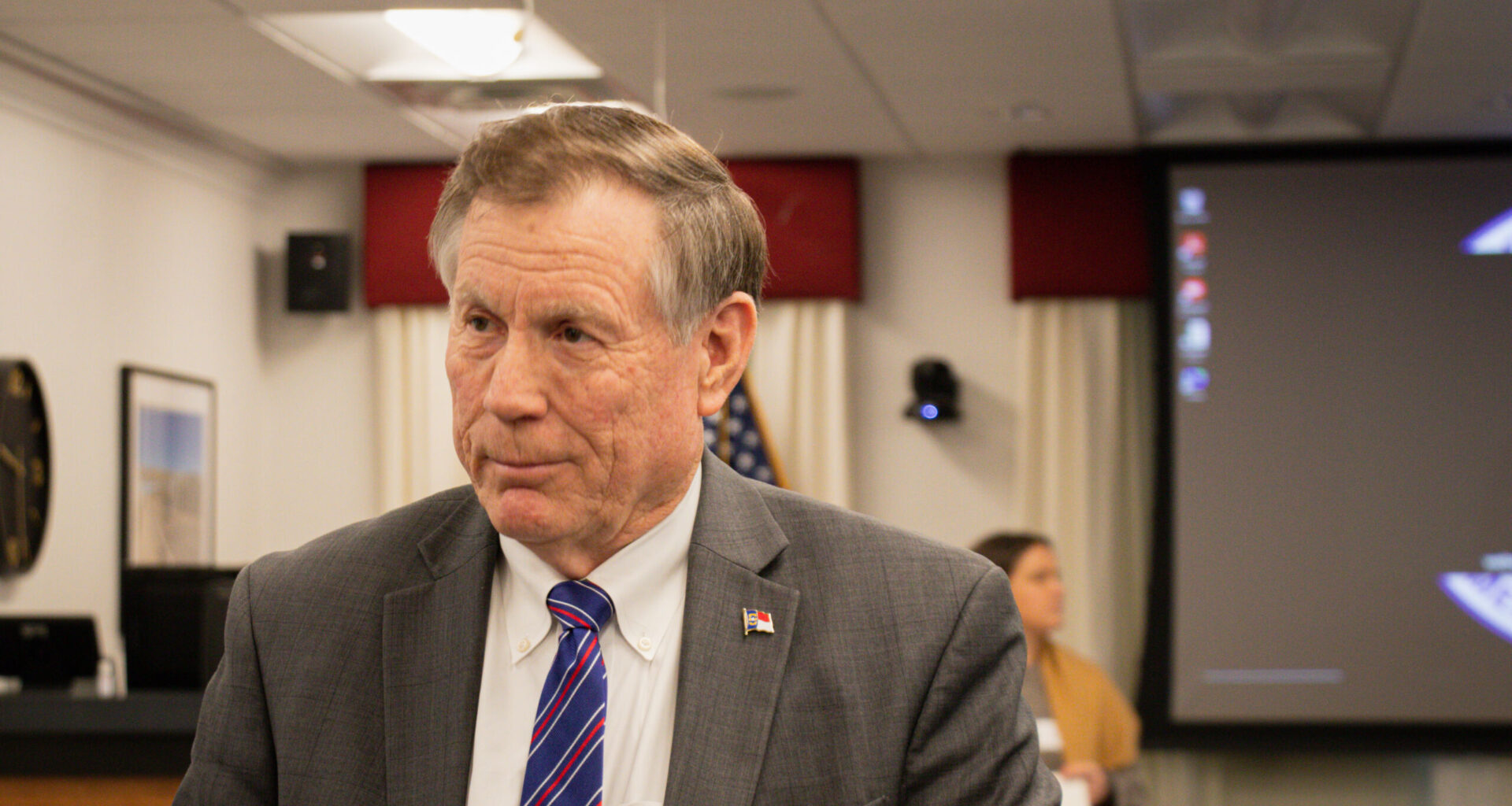
Former top North Carolina political donor Greg Lindberg has filed a federal lawsuit in New York against state Insurance Commissioner Mike Causey, two other men, and a law firm. The suit alleges an illegal “coordinated scheme” against Lindberg for “self-enrichment and political retribution.”
Causey’s office declined to comment on the suit.
Lindberg filed the suit on Sept. 10 while behind bars in FCI Atlanta, a low-security federal prison.
He was sentenced in May to 12 years in prison in connection with two separate legal actions. One involved a conviction on charges related to Lindberg’s attempt to bribe Causey after the 2016 election. The second involved a guilty plea to charges arising from a multibillion-dollar insurance fraud case.
A special master has called for Lindberg to pay $1.655 billion in restitution related to the fraud case.
His new suit alleges violations of the federal Racketeer Influenced and Corrupt Organizations Act. It also alleges conversion, breach of fiduciary duty, civil conspiracy, and unjust enrichment.
Lindberg names Causey as a defendant, along with Michael Dinius, Mohsin “Mo” Meghji, and the Williams Mullen firm. Dinius is listed as Causey’s appointed special deputy rehabilitator of “the North Carolina Insurance Companies,” Lindberg’s name for insurance companies he owned and controlled until 2018. Meghji is CEO of M3 Partners and acting CEO of NHC Holdings.
“This civil RICO action arises from a coordinated scheme by a North Carolina state official and his confederates who weaponized North Carolina’s insurance-rehabilitation statutes — and then a federal criminal restitution proceeding — into a vehicle for systematic self-enrichment and political retribution,” Lindberg wrote. “Defendants Mike Causey, Michael Dinius, Mo Meghji, and Williams Mullen, P.C., operating as an association-in-fact enterprise (the ‘Enterprise’) headquartered at 1700 Broadway, 19th Floor, New York, New York, and spanning four states, have extracted more than $165 million in fees from the insurance estates they administer — not one dollar of which was approved by the supervising court, as N.C. Gen. Stat. § 58-30-85(3) requires — while methodically destroying billions of dollars in value that Lindberg lawfully built over decades.”
“The scheme’s genesis predates Causey’s inauguration,” the complaint added. “In December 2016 — weeks before taking office as North Carolina Insurance Commissioner — Causey identified Lindberg, the largest financial supporter of his electoral opponent, as a ‘political problem’ and a ‘significant impediment’ to be eliminated.”
“One witness has attested under oath, and a second has stated in a recorded interview, that Causey plotted to ‘dismantle’ Lindberg’s insurance operations and that he ‘had a person in mind’ to do it: a long-serving North Carolina Department of Insurance (‘NCDOI’) deputy who ‘already didn’t like Lindberg and would know how to go about dealing with [his] companies and dismantling them,’” Lindberg wrote. “That deputy was Senior Deputy Commissioner Jacqueline Obusek — the very regulator whose bias Lindberg later, and justifiably, asked to have removed from his file, and whom Causey later promoted.”
“Causey then leveraged relationships with federal law enforcement to spur an FBI investigation on the strength of a fabricated $110,000 donation allegation that the FBI later admitted never occurred, demanded and received a wire, and over more than 100 recorded calls and meetings solicited contributions while asking, on tape, ‘what’s in it for me?’ Lindberg’s complaint continued. “The recordings captured Lindberg, unaware he was being recorded, insisting on ‘legal campaign contributions,’ on ‘tighter standards than the law allows,’ and on a regulator who would be ‘tough and fair, that’s all we need.’”
Lindberg credited the “entrapment” with leading to his conviction in the federal bribery case.
The complaint goes on to spell out accusations involving actions taken after Lindberg gave up control of North Carolina insurance companies in 2018. He accuses the defendants of selling his assets at a fraction of their value and harming the federal restitution process in the fraud case. In one case, Lindberg alleges that the defendants sold “Beckett Collectibles” valued at more than $1 billion for $134 million.
“Lindberg has demonstrated to the Western District of North Carolina, and contends on appeal, that restitution has not merely been paid but overpaid by more than $2 billion,” he wrote. “And the sentencing court itself characterized ‘the real loss’ in the criminal case as ‘risk’ — a risk that was lawful when taken, approved by the regulator, and not prohibited by North Carolina statute until 2019, after Lindberg had ceded control.”
“[T]he Enterprise is paid from the estate it liquidates, so every sale it completes both enriches the Defendants and dissipates the only fund from which any judgment against them, or any restitution credit to Lindberg, could be satisfied,” according to the complaint.
“Lindberg does not ask this Court to fix the amount of his restitution, to review any order of the Western District of North Carolina, or to find his conviction invalid,” he wrote. “Those questions are before the district court and the Fourth Circuit. … He asks this Court to hold the Defendants accountable, under RICO and New York law, for what they did with his assets after they took control of them — the fees they paid themselves without court approval, the transactions they blocked, the sales they forced at a fraction of value, and the sale of Beckett for approximately $134 million against a $1,003,924,000 appraisal — and to stay the next such sale until the restitution question is finally adjudicated, including all appeals.”
“We do not comment on pending litigation,” said Barry Smith, deputy director of communications at the NC Department of Insurance, when asked for a response to Lindberg’s allegations.
Before the legal action against him, Lindberg had attracted attention as a top donor to political campaigns in North Carolina. He supported Democratic Insurance Commissioner Wayne Goodwin’s unsuccessful 2016 re-election bid. Goodwin lost to Causey.
Later Lindberg became the largest financial contributor in 2017 to the NC Republican Party and two groups supporting then-Lt. Gov. Dan Forest, a Republican. Forest lost the 2020 governor’s race to the incumbent Democrat, Gov. Roy Cooper.