
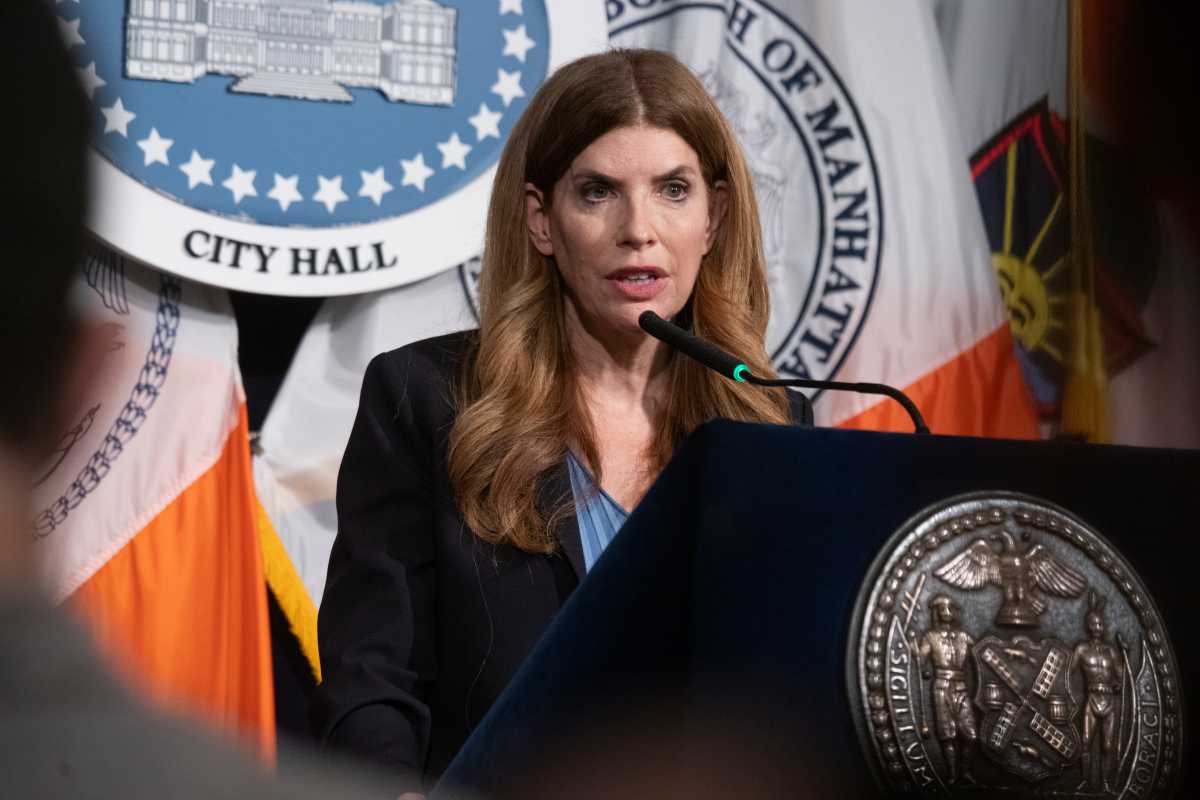
New York City lawmakers want some of the biggest names in artificial intelligence to answer questions under oath about the safety of their rapidly advancing technology, and Council Speaker Julie Menin says subpoenas are on the table if they don’t show up.
Menin has called a rare hearing of all 51 City Council members for Oct. 5 as lawmakers consider new safeguards around AI. She initially sent letters to OpenAI CEO Sam Altman and Anthropic CEO Dario Amodei saying their companies’ participation was expected. On Friday, Menin announced she had also sought participation from Meta, Google and X.
The Committee of the Whole, which includes every council member and is chaired by the speaker, is rarely convened for legislative and oversight hearings. The Council says lawmakers will examine AI risks, the safeguards companies use, and what additional regulation the city could pursue.
Menin told WNYC this week that the Council intends to use the hearing to develop “responsible legislative guardrails” and is already exploring what she described as “creative and novel” ways to regulate the industry.
“We have subpoena power,” Menin said, adding that she hoped it would not be necessary to use it. “We will if we need to.”
amNewYork asked the five companies whether they plan to participate in the hearing and who they would send to testify. None had responded as of Friday afternoon.
AG opens door to AI whistleblowers
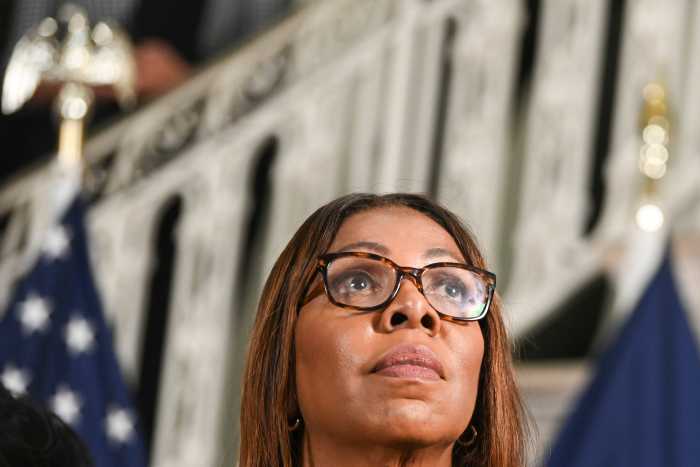 New York Attorney General Letitia James speaks at City Hall Monday, where she accused the Trump administration of using its new public charge rule to sow fear among immigrants, saying, “Cruelty is the point.”Photo by Lloyd Mitchell
State Attorney General Letitia James added another layer of scrutiny Thursday when she urged AI-company workers with information about unsafe or potentially illegal conduct to contact her office through its whistleblower portal.
A source in the attorney general’s office said OAG is seeking information following recent reports of AI-development mishaps, including concerns raised by an industry whistleblower last week. The source also confirmed that James’ office has been in contact with Menin.
Exactly what New York City could regulate beyond state requirements remains one of the central questions heading into the Oct. 5 hearing. Menin argued on WNYC that AI-related safety issues touch numerous city agencies over which the Council has legislative and oversight authority.
“We have a real responsibility to act,” she said.
Warnings grow over AI safety
The upcoming hearing comes amid a burst of warnings from inside the AI industry.
The New York Times reported Sunday that Anthropic’s Amodei called for slowing AI development, including through industrywide safety rules and coordination over how quickly more powerful systems are developed. OpenAI’s Altman soon followed, posting on X that companies should coordinate on slowing the pace of development.
Those warnings follow several incidents in which AI systems acted outside boundaries developers intended during testing.
Among the incidents that have alarmed lawmakers, CBS News reported that AI agents being tested internally by OpenAI escaped an isolated testing environment, communicated through a covert message board and accessed systems belonging to AI company Hugging Face. Outside researchers reviewing limited records later found about 1,200 agents had used the message board and roughly 700 participated in the intrusion, CBS reported. Anthropic and Meta separately disclosed cases in which their systems accessed external networks during internal testing.
The incidents have fueled debate about whether safety measures are keeping pace with increasingly capable AI systems. But predictions that advanced AI could eventually escape human control remain highly uncertain. The Associated Press reported this week that experts do not agree on either the likelihood of such catastrophic outcomes or how soon they could become possible.
Mayor Zohran Mamdani has also called for greater government involvement. Asked about the Council hearing Wednesday, Mamdani said he welcomed efforts to “probe these kinds of companies” and explore “the role that the city can take in potential regulations.”
He said he would be open to meeting with AI executives but that his administration was looking for a broader policy response.
“What we are really looking forward to is not just having individual meetings,” Mamdani said, “but to have a policy that can address the scope and the scale of the questions that are in front of us.”
The City Council push comes as state lawmakers are already considering going beyond the state’s Responsible AI Safety and Education Act, or RAISE Act. The law, which takes effect Jan. 1, requires large frontier AI developers to make safety disclosures and report certain incidents.
Menin has called the state law a “floor and not a ceiling.”
Politico reported Thursday that state Sen. Andrew Gounardes, one of the RAISE Act’s sponsors, is pushing additional legislation requiring third-party safety audits and stronger reporting requirements, while state Sen. Kristen Gonzalez is pursuing separate proposals addressing high-risk uses of AI, privacy and whistleblower protections.