
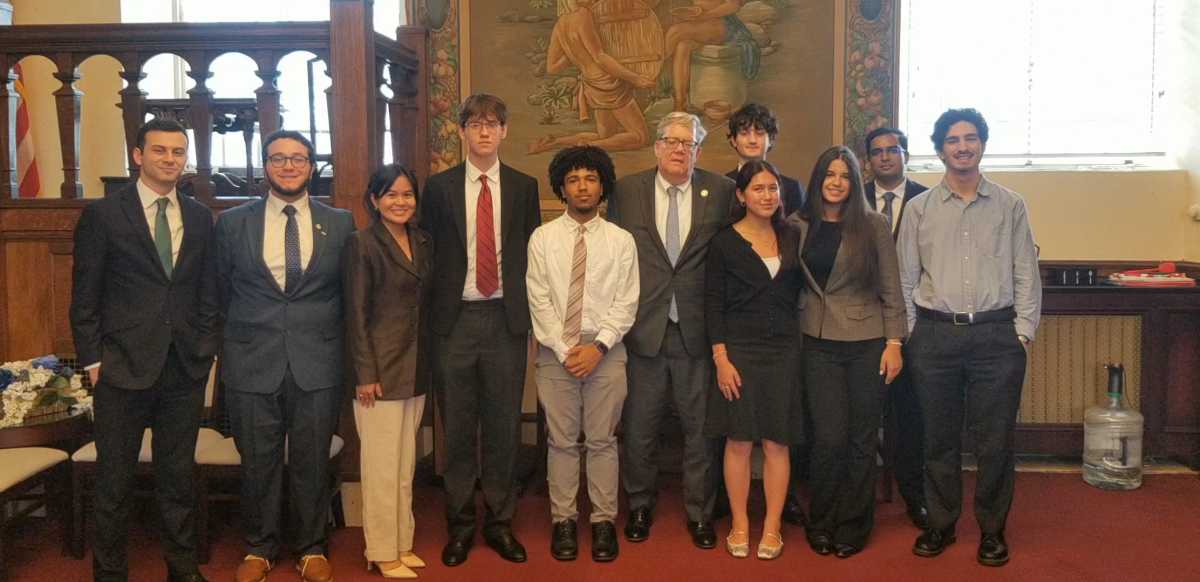
In collaboration with Administrative Judge Suzanne Adams and Justice James d’Auguste, the internship program has expanded in recent years. More than 400 high school, undergrad and law school students participated this summer and observed court proceedings, visited appellate courts, and assisted with legal research and drafting.
Interns are overseen by the judges for whom they work during the summer. As part of the program, the judges may choose their own interns, while others may prefer to have them assigned from a pool of resumes Justice Adams receives regularly.
The interns also participated in periodic “Lunch and Learn” sessions, featuring judges, lawyers and other professionals. The programs, curated by Kawtar Merfouk and Larisa Blinderman, provide opportunities to learn, network, and hear firsthand accounts about public service.
A wide variety of guest speakers participated in the Lunch and Learn series, including former Presiding Justice of the Appellate Division, First Department, Rolando Acosta, to Deputy Chief Administrative Judge for the Office of Justice Initiatives Edwina Richardson, a vast number of judges from New York and other counties, as well as lawyers from around the country, who came to speak on a myriad of topics, including commercial litigation or transaction law, as well as aviation, insurance, criminal, family and entertainment law, as some of the topics interns have expressed their interests in.
The following piece was authored by Anthony Cap, Binghamton University. The article gives a look at the NYC criminal court system through Judge Kevin McGrath’s discussion with judicial interns about judging, court administration and current criminal justice issues.
Interns get a look inside New York Criminal Court
By: Anthony Cap, Binghamton University
On Tuesday, Aug.11, 2026, I, along with other judicial interns, gathered for a Lunch and Learn given by Judge Kevin McGrath, who is the Supervising Judge presiding over criminal cases in the New York County Criminal Court. His speech was candid, interesting, and informative, detailing the structural realities and intricacies of the New York court system. Some topics he discussed included the mechanics of getting to the bench, as well as the day-to-day realities of being a judge. What he uncovered for the interns was a perspective that not many are granted. The role of being a Supervising Judge is far more administratively heavy than most assume, requiring oversight and management of a variety of dockets, staff coordination, and complex procedural intricacies.
One area that Judge McGrath delved into during his discussion was the differences between criminal and civil courts, as well as what it is like to work as a judge in either. Criminal Courts often receive greater public appeal and attention, with high-profile cases that resonate with Americans. However, Judge McGrath noted that the Criminal Court encompasses a far smaller area of the law than civil courts. Unlike civil courts, criminal courts are demarcated more narrowly, leading each case to be far more similar to another than in civil court. In civil cases, judges are faced with a far greater scope of the law, as civil litigation touches nearly every facet of human interaction. The range is monumental, spanning from complex commercial disputes to torts, contract and labor disputes, and far more, which a mere short list cannot contain. Hence, civil courts are exposed to a much larger area of the juris corpus.
Moving beyond the broader scope of civil law, Judge McGrath then shifted the conversation toward the pressing contemporary issues within the criminal justice system he oversees. He spoke about the complexities of processing Violent Felony Offenses (VFOs) and the ongoing debates surrounding New York’s recent bail reforms. Judge McGrath spoke directly to the interns, challenging them to think critically about the changes being made and those being proposed, which seek to shift the delicate balance between safeguarding defendants’ rights and maintaining community safety.
Ultimately, the conversation Judge McGrath had with us was deeply valuable; not only did it provide insightful perspectives on the court system from someone involved in it, but it also provoked reflection and thought. This lunch-and-learn session informed us that a successful legal career as a judge requires careful deliberation about the ongoing commitment to administering the rules and to the people of the State.