
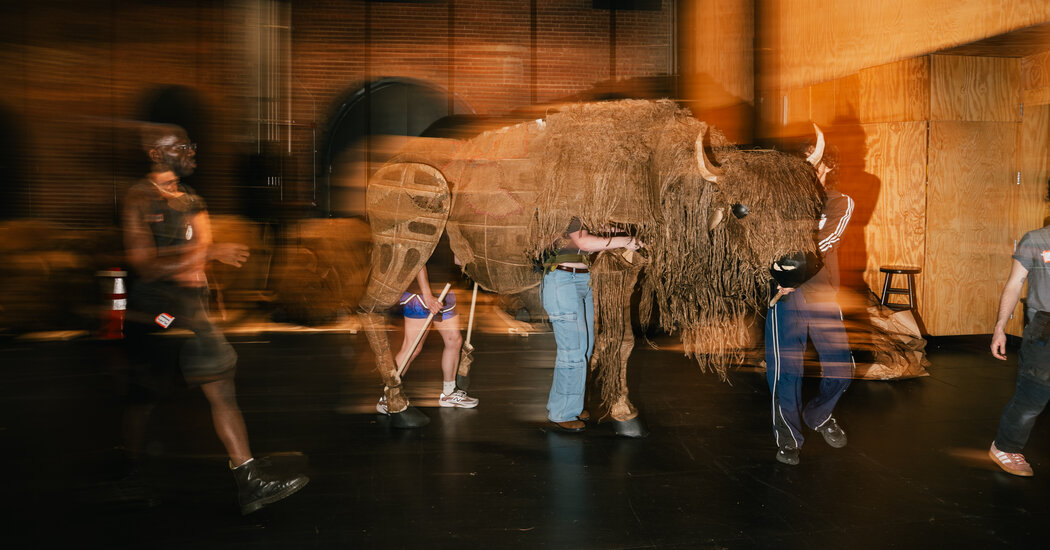
On an afternoon in late July at St. Ann’s Warehouse in Dumbo, Brooklyn, buffalo body parts were everywhere: legs, bellies, heads. What looked like hides were hanging to dry on lines strung across the brick-walled space, and 10 bulky bodies — without fur or skulls — dangled from a metal truss.
If it was a tiny bit unnerving, it was glorious, too. These bison were in the process of being created, not dismembered; on the floor, at a safe distance from the action, several nearly complete animals rested peaceably. As Jim Findlay, the theater’s producer, said, “We’re kind of an abattoir in reverse.”
Making, that is, not actual buffalo but magnificent life-size puppet versions — a 40-strong herd, designed by the South African company Ukwanda Puppets and hand-built in New York of steel, plywood and burlap, with paper ears and horns. (The stuff that looked like hides? Just burlap, bathed in glue and coloring.)
This week, those puppets will stampede on the streets of New York in “Return of the Buffalo: Tatanka Owe Akupi,” a free public art spectacle slated to wind through Lower Manhattan on Friday and Downtown Brooklyn on Saturday, with each bison operated by three puppeteers: two inside, and one next to the head. At fixed points along the routes, celebrities — including Sam Waterston, Rosario Dawson, Laurie Anderson and Susan Sarandon — will be among the performers taking part in pop-up artistic events: readings, music, dance.
Projects that ambitious, created from scratch, tend to have long gestations. But “Return of the Buffalo” was a gleam in no one’s eye until January, when Susan Feldman, the artistic director of St. Ann’s, and Karen Brooks Hopkins, the former longtime president of the Brooklyn Academy of Music, were casting about for possible ways to mark the 250th anniversary of the United States.
Then they talked with Amir Nizar Zuabi, the Palestinian artistic director of the Walk Productions, known for the peregrinating 12-foot-tall Syrian refugee puppet Little Amal, who charmed New York in 2022.
“And he just goes, ‘How about 50 bison?’” Feldman said.
She and Hopkins were instantly smitten with the idea of creating a herd of those massive animals — tens of millions of which once roamed much of North America before their numbers plummeted close to extinction. Having been nurtured into a comeback, they are now the United States’ national mammal.
After momentum around the semiquincentennial fizzled, Feldman and Hopkins abandoned the project’s conceptual link to it. Instead they focused on giving the city a big, non-ticketed, open-to-everyone arts experience to finish a summer that’s seen plenty of prohibitively priced marquee events, including the Knicks’ championship run and the World Cup.
They also scaled back their goal of building 50 buffalo, Hopkins said, when their budget (which they declined to disclose) and their timeline got uncomfortably tight. Anyway, she noted, the puppets are “vast”: 6 feet tall, 9 to 10 feet long. Forty is a lot.
Zuabi told me that the number 50 had never been about having one buffalo for each state. He just wanted to have enough of them to make an impact.
“I really hope we’ll be able to capture the awe, the majestic-ness, the size, you know, and the sheer mass of a herd,” he said.
Like spectators at a marathon or a parade, the audience at “Return of the Buffalo” (whose subtitle is the same phrase in Lakota) can stake out a spot along the route if they simply want to watch the herd pass by. Unlike a marathon, or a typical parade, they can also follow the herd the whole way.
As with Little Amal and the Walk’s climate-action public art piece, “The Herds,” which last year traveled from central Africa through Europe to the Arctic Circle, the buffalo puppets can be enjoyed on an aesthetic level with no deeper meaning attached. Gazing at them can be about wonder as much as anything else.
But Zuabi is an explicitly political artist, and his idea about the buffalo was rooted in history that predates the country’s founding, and encompasses what followed in the 19th century, with the wanton slaughter of the buffalo that Native people depended on for survival. Zuabi considers the animal’s extreme overhunting, as white settlers continued their westward expansion, “a political act of man-made starvation, of ethnic cleansing, of pure violence on man and nature and land.”
Notions of reckoning and repair, then, are central to “Return of the Buffalo.” So is the reset, or the healing, that the return of the buffalo is meant to bring.
Still, Zuabi absolutely wants the wildness of the animals to be apparent. It is important to him that the puppets stampede, and not only because it’s fun.
“It’s about negotiating space, right?” he said. “When you take a herd of animals and smash them through a city, there’s a lot of questions of ownership, of right of passage — who needs to move out of the way for who.”
In the making of an artwork that draws on specific cultures, there can be a similar need to make way, in this case for elders of the Lenape and Lakota tribes, who are among those credited with conceiving “Return of the Buffalo” with Zuabi, who created it.
JJ Lind, the artistic director of the New York collaborative Immediate Medium and a Cherokee Shawnee artist who has been involved in the piece’s creation since the spring, said that the respect is genuine.
“I really do hope that it doesn’t come across as appropriationist because I don’t feel appropriated,” he said. “I feel heard and I feel like I have helpers. Who are helping tell an important story that is not their own.”
Last weekend at St. Ann’s, all 40 buffalo were present and accounted for. The artist Robin Frohardt, who oversaw the building of them, was part of the team making adjustments and repairs to puppets hanging from a truss, their butts facing the rows of theater seats. The other buffalo lay on burlap stretchers along two walls, looking, with their glossy, fur-fringed eyes, alive and individual, if maybe a little forlorn.
“Everything has been touched by hands in, like, a very obsessive way,” Frohardt said back in August, and that is a significant part of these puppets’ appeal: that they are so very human-made.
Like “The Herds,” which tapped locals to operate the animal puppets wherever it went, “Return of the Buffalo” relies on scores of volunteers to spend several days learning how to make the puppets breathe; how to respond to commands — such as gallop, gentle stop, regroup — given in Xhosa and Arabic, two languages of the spectacle’s creators; and how to move as one buffalo and as part of a herd. And then, with their 80-plus-pound puppet, to do it all publicly.
The South African puppeteer Craig Leo, who stilt-walked to operate Little Amal, is the puppetry director of “Return of the Buffalo.” From “The Herds,” which he also puppet-directed, he knows that the objective is not really to turn civilians into trained puppeteers. The more vital point is the experience the volunteers take away.
“It’s not every day you get to be part of an entire herd of bison and charge through the streets of New York and bring awareness to, you know, the meaning of it all,” he said. “So it happens once in your life.”
What lingers for onlookers, though, with all potent public art — like Little Amal, or Christo and Jeanne-Claude’s “The Gates,” or Basil Twist’s flock of grazing puppet sheep, or Tatzu Nishi’s “Discovering Columbus” — is the ghost image in a landscape permanently altered.
For some of us, buffalo puppets are about to be stampeding through Lower Manhattan and Brooklyn forever.