
It’s not the only Brooklyn manhole cover with “Catskill water” embossed in iron. But it’s the one that caught my eye when I found myself at St. Marks Place and Washington Avenue in Prospect Heights earlier this summer.

And it led me to do a little research and discover that in 1917, Brooklyn began getting the bulk of its fresh water from the then-new Catskill Aqueduct.
I knew about the Croton Aqueduct—the engineering marvel that brought clean water to Manhattan in 1842 and helped the city develop into a modern metropolis (and stop residents from relying on fetid wells and polluted ponds, which spread disease).
But the Catskill Aqueduct? This upstate watershed, meant to ease the enormous demand for water in the early 1900s, featured 92 miles of tunnels and distribution pipes that carried water under the East River to the faucets of the borough’s homes, schools, hospitals, and businesses.
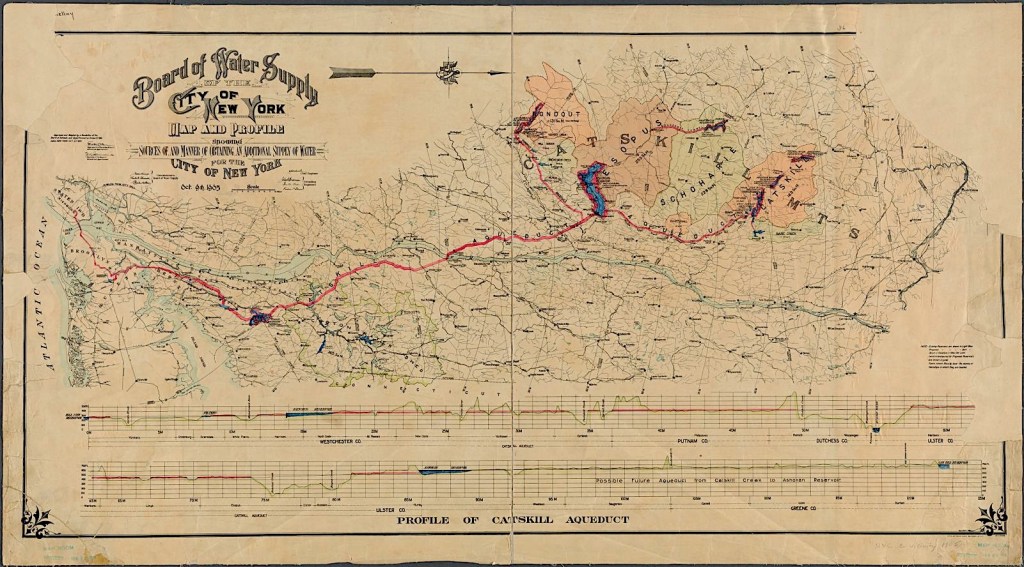
Click into the map in the second image for a closer look at the route the Catskill Aqueduct was to take when construction began in 1905.
It’s hard to imagine just how important healthy water was to Brooklyn in the late 19th century. It was so crucial, the promise of a mightier water source helped motivate the independent city to consolidate with Manhattan and form the City of Greater New York in 1898, according to the American Society of Civil Engineers (ASCE).
Before the building of the Catskill Aqueduct, Brooklyn relied on a system that brought fresh water from Long Island to the Ridgewood Reservoir, a distribution reservoir on the Brooklyn-Queens border.

That worked in the 1850s, when the system was created. But with the population of Kings County booming toward the end of the 19th century, officials realized that a more modern water source would be needed.
“With the completion of the Catskill Aqueduct (third photo) and City Water Tunnel No. 1 in 1917, Brooklyn was connected to the New York City water supply system, which brought water from watersheds located north of the city,” states ASCE.
The Ridgewood Reservoir was still in use, particularly as a backup water source later in the 20th century. In 1989, however, it was officially decommissioned.

Today, the Catskill Aqueduct continues to supply water to thirsty Brooklyn. My understanding is that the “gate” part of this manhole lid simply indicates that a shutoff valve or distribution pipe lies beneath the street.
Since 1965, the Catskill system has been joined by the Delaware Aqueduct to form the Catskill/Delaware Watershed—one million upstate acres that provide 90 percent of New York City’s drinking water, according to The New York Times.
[Map of the planned Catskill Aqueduct: NYPL Digital Collections; third photo of Catskill Aqueduct under construction, NYC Water]