
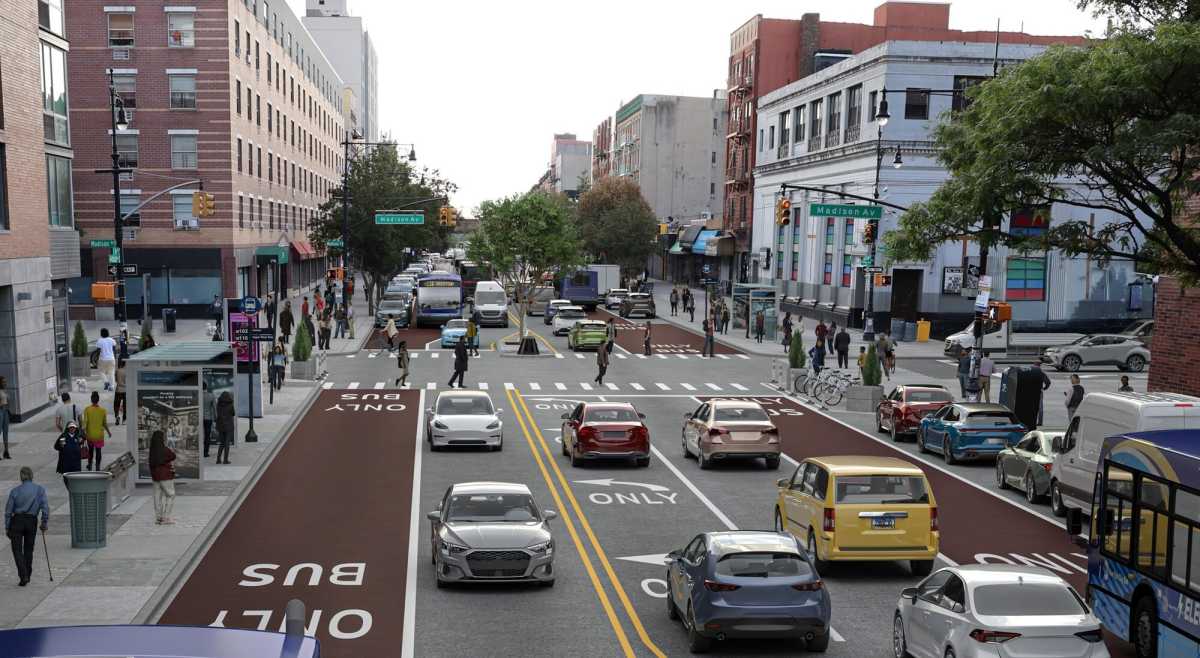
The Mamdani administration touted last week the progress it has made since taking office in January on expanding the bus lane network throughout New York City to help notoriously slow bus rides move much faster.
But what kind of progress has it been? Both transportation advocates and the facts themselves seem to agree: The new mayor has done far too little to fulfill his promise of a faster bus network for New York.
“Fast and free” buses were a cornerstone of Mayor Zohran Mamdani’s successful campaign in 2025. He hasn’t been able to get the “free” part moving very much, having met stiff resistance from the MTA and Albany, and the economic realities of the city that had to close a massive, nearly $6 billion deficit earlier this year. The city would have to spend hundreds of millions of dollars it does not have to make all city buses free. It shouldn’t be happening anytime soon.
The “fast” part of Mamdani’s bus pledge was always going to be easier to fulfill, and there was plenty of low-hanging fruit for the mayor this year to pick. The Adams administration had delayed and/or stalled a number of bus lane expansion projects in recent years, including Fordham Road and Tremont Avenue in the Bronx, and Flatbush Avenue in Brooklyn.
In his first Mayor’s Management Report — a yearly report card for every mayoral administration — released on Thursday, Mamdani touted that 12 new bus lane miles have been added to the citywide network this year, more than double the 5.5 miles built by the city in the previous fiscal year, FY2025.
Yet those 12 new bus lane miles are 24% less than the nearly 16 miles created in FY2024. And those numbers fall far short of the 30 new bus lane miles in 2026 that were required to be built, by law, under the Streets Master Plan approved back in 2019.
Buses in New York City are not going to be made faster as long as the city continues to fail to meet its mandates for bus lane and busway construction. These measures are not just about designating lanes for buses to travel; they also aim to shift traffic and institute enforcement measures, such as the MTA’s Automated Camera Enforcement (ACE) program, to hold drivers who block the buses accountable.
Millions of New Yorkers depend on buses to get around, and they waste too much time commuting; the average NYC bus travels at just 7.8 mph. By comparison, the average walking human moves at up to 4 mph; the average bicyclist can go 10 mph.
We believe an NYC bus rider should be able to travel faster than a bicyclist, but we’re not going to get there if the streets are too congested, and the city is too slow in building out a real bus lane network.
Mamdani’s the one in charge now, and the mayor needs to take the lead on making the “fast” part of his “fast and free bus” pledge a reality sooner rather than later. Bus riders in every corner of the city are counting on him to clear the way for their commutes to be far easier so they can spend more time doing what they need to do.
And we believe that most New Yorkers would be more satisfied getting a faster ride than a free ride, anyway.