
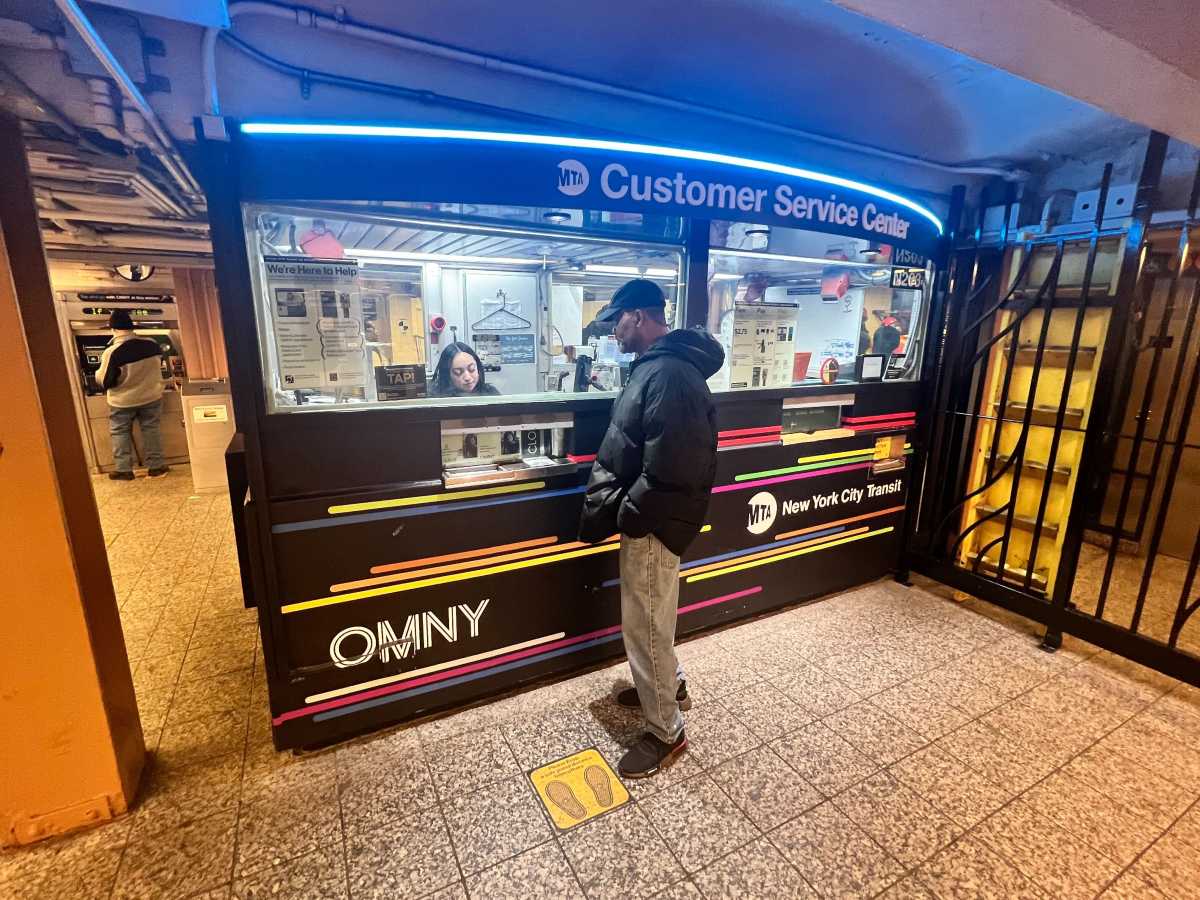
A Manhattan state judge handed the Transport Workers Union (TWU) Local 100 and a group of disability advocates a legal victory last week when it ruled that the MTA must no longer leave station booths empty when employees miss their eight-hour shifts due to an emergency.
New York County Supreme Court Judge Nicholas Moyne issued a restraining order on Sept. 18 barring MTA New York City Transit from continuing its vacant booth policy, which it launched earlier this year, of leaving station booths unstaffed for an eight-hour period should an emergency prevent a staffer from working their shift.
In his ruling, the judge sided with TWU Local 100 and the Center for the Independence of the Disabled New York (CIDNY), both of which charged in a lawsuit they filed in March that NYC Transit’s relatively new practice violated the state’s Public Authorities Law. Judge Moyne wrote that the policy qualifies as the partial closure of a station, which requires that the agency hold public hearings and provide at least 30 days’ notice to affected community boards — requirements that the jurist said it failed to meet.
Moyne ruled that NYC Transit cannot resume the practice — propagated by Bulletin No. 001-26 — until it holds public hearings and gives affected community boards the required 30 days’ notice.
“Bulletin No. 001-26 is hereby annulled, vacated, and declared null and void,” Moyne wrote in his decision.
The judge added that MTA Chair and CEO Janno Lieber and NYC Transit President Demetrius Crichlow, as the agency officials named in the suit, are “permanently enjoined and restrained from enforcing, implementing, or executing Bulletin No. 001-26, or leaving station service booths unstaffed for full shifts due to unplanned absences, unless and until respondents give 30 days’ advance written notice to affected Community Boards and conduct public hearings pursuant to Public Authorities Law.”
The three plaintiffs in the class-action suit included Local 100’s Vice President for Stations Robert Kelly, Brooklyn Borough President Antonio Reynoso, and CIDNY Executive Director Dr. Sharon Mclennon-Wier.
Local 100 President John Chiarello, in a statement, said Moyne’s decision is a “good start, but not a total victory.”
“We’ll be watching the process closely and working together with our fellow petitioners to ensure everyone affected by this proposed change of service will be heard,” he added.
In response to the decision, MTA spokesperson Mohamed Farghaly wrote: “We think the decision is wrong and intend to appeal.”
Behind the case over empty station booths
Local 100 filed the legal action shortly before its contract with the MTA expired in May. The suit has played out as the union and the agency have publicly butted heads over desired wage increases, benefits, and work rules over the past few months.
In his decision, Moyne wrote that the bulletin further violates the Public Authorities Law by interfering with station agents’ responsibility to ensure the public is safe in subway stations. Specifically, he said that agents operate the Emergency Booth Communications System (EBCS), a communications apparatus inside of the booth that allows them to alert the Rail Control Center in the case of a fire, violent incident, sick passenger, or other emergency.
“When Respondents lock a service booth for an eight-hour shift, the EBCS inside that booth is rendered completely inaccessible and non-operational,” the decision reads. “Locking the booth deprives riders entering at that location of an activated EBCS station. “
Moyne also sided with the plaintiffs’ claim that the station booth policy also violated New York City Human Rights Law because it has an “unlawful disparate impact” that denies riders with mobility challenges and visual disabilities “equal access” to the subway system. The judge said that is because station agents are essential for opening emergency gates for those who cannot traverse regular turnstiles, and for providing navigation information to those with visual disabilities.
In siding with TWU and CIDNY, Moyne dismissed MTA NYC Transit’s arguments that the policy applies to 19 multi-booth stations where there is at least one other staffed kiosk during the eight-hour closures; and that it held public hearings in 2023 when station agents were moved into customer service roles, which allows them to roam outside of their booths.
“Telling transit riders that an open booth exists somewhere else in a sprawling, multi-level station complex does not alter the fact that the specific entrance serviced by the locked booth has suffered a complete elimination of staffed access for eight hours,” the judge wrote. “Nowhere in the 2023 public notices, board documentation, or published descriptions did respondents inform the public, community boards, or riders that service booths would be locked and unstaffed for entire eight-hour shifts due to unplanned sick calls.”