
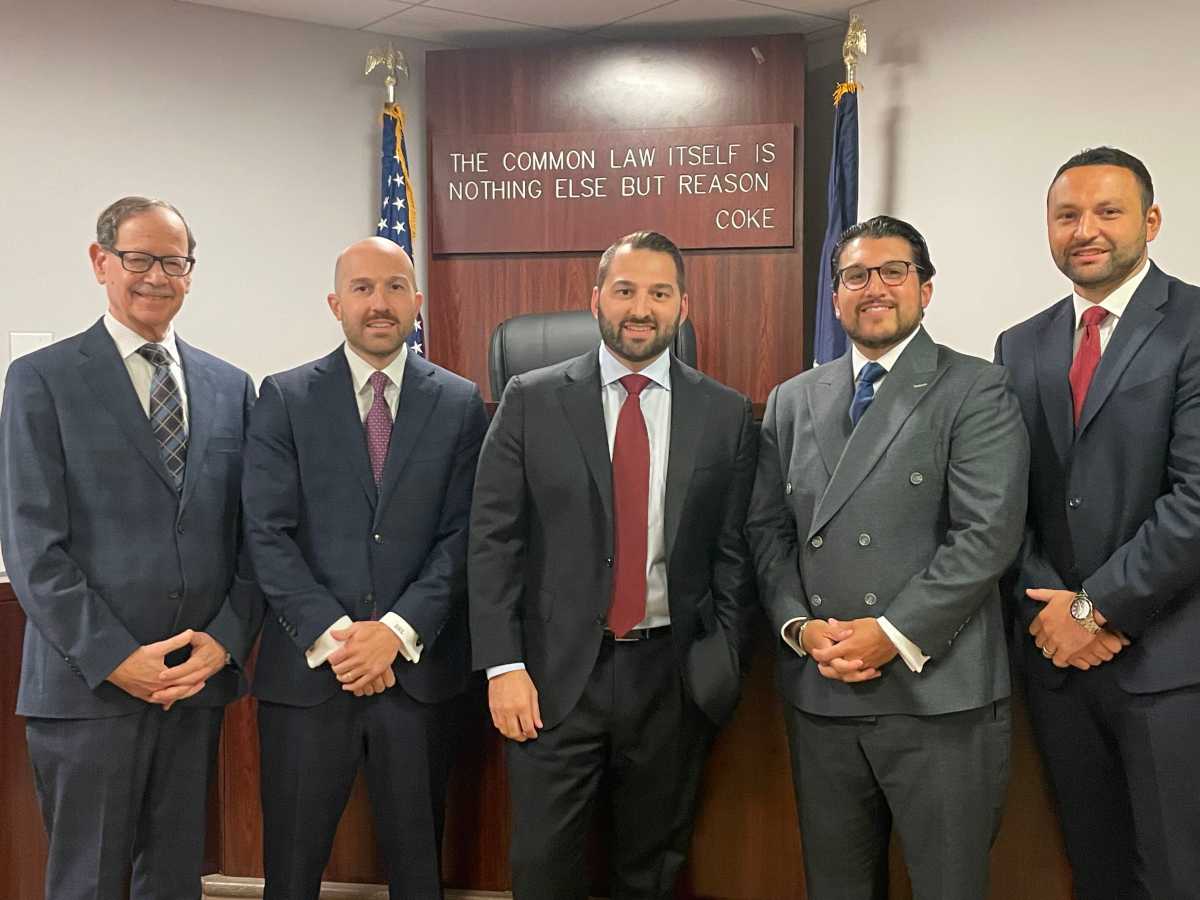
Brothers Dean, Nicholas, and Stephen Liakas said they have always cared deeply about supporting their community and looking out for others since they were kids growing up together in New Jersey. It felt natural then, they said, to pursue careers in personal injury law and combine forces by opening up their own firm to use the law to advocate for the underdog.
“We want to help the little man and hold people accountable,” Stephen Liakas said. “We decided, why don’t we just open up our own personal injury firm and do it?”
And so Liakas Law was born. Many personal injury firms focus on settling matters and shy away from taking cases to trial, the Liakases said. That’s the opposite of their firm’s philosophy, which the brothers described as taking on big, difficult cases — especially ones that could change the law, public policy, or a community’s material conditions — and litigating them to a win at trial.
“There was some point where Stephen was a practicing attorney, Dean was in law school or just about to become a practicing attorney, and we all kind of looked at each other and said, ‘We have an opportunity where we could do this on our own,” Nicholas Liakas told amNewYork Law on choosing to pivot towards their own practice where they could achieve the change they wanted to see in the world.
Sitting on the stoop of Dean and Stephen Liakas’s shared Hoboken apartment roughly 15 years ago, the three brothers, all of whom had begun embarking on careers in personal injury law, decided to take the leap.
“We all kind of looked at each other and said, ‘Hey, empty your pockets, put it on the table, whatever you got. That’s what we’re going to start our firm with,’” Nicholas Liakas said. “And that’s pretty much what we did. We emptied out our bank accounts and literally emptied our pockets, liike, ‘Hey, what do you have? Do we have money for a copier?’”
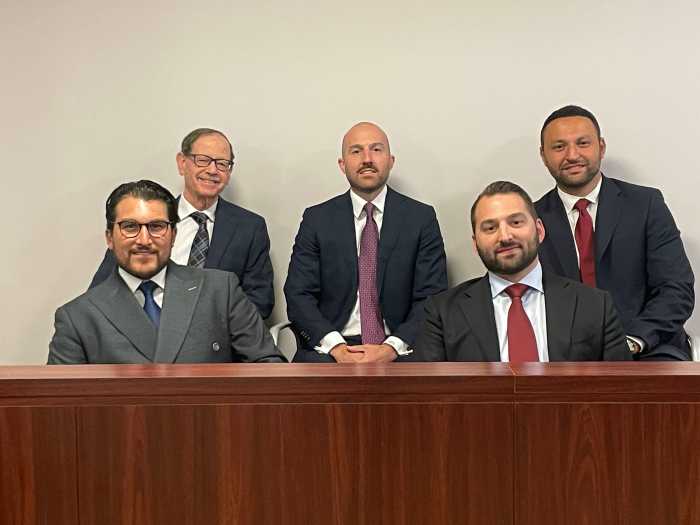 The Liakas Law team – Former judge Mark Partnow, Dean Liakas, Paul Bitetti, Stephen Liakas and Nicholas Liakas – sit in their office’s mock courtroom jury box.
The three brothers turned into founding partners in 2014 when they opened the doors of Liakas Law on their own. Since then, they’ve grown to a firm with dozens of attorneys that’s successfully handled thousands of clients’ cases – including a slew of high-profile ones and those that have accomplished their mission of altering the law and policy, referred to as impact litigation.
“What we do differently than other firms is we have cases that will change public policy and will change the way the laws are written,” Nicholas Liakas said. “We may have a case of an individual, a very serious case where we need to deliver for that family or for that person, but we also see that going along with our philosophy of ‘How do we protect the next person?’
Some of the cases that fall into that bucket include litigation on behalf of injured workers that have altered state and federal safety regulations and their representation of five people who were killed in a Bronx fire that spurred new federal legislation establishing mandatory safety standards for space heaters.
They have also helped fix firehouse staffing issues after litigating on behalf of Staten Island firefighters injured at work and contributed to the push to pass the Child Protective Services Transformation Act after advocating on behalf of an eight-year-old autistic boy who was neglected, tortured, and died while caught up in the Child Protective Services system.
And, when litigating on behalf of the family of a man with severe mental issues who had not received proper care and then committed suicide in a New Jersey jail, the Liakases won significant changes in the correctional facility. Those changes included ensuring incarcerated people receive proper care, increased lighting, removal of anchoring points where people were killing themselves.
“We changed the law,” said Stephen Liakas of the case. “Things like that really excite me and make me proud.”
‘We care about the next person’
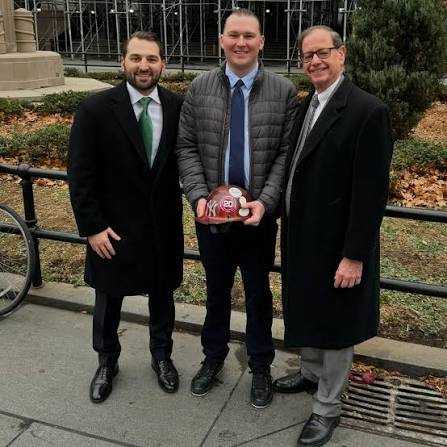 Nicholas Liakas and Mark Partnow stand on either side of a client.Photo provided by Liakas Law
They’ve also spurred supervisory and safety changes in a large New York-area hospital system to improve patient protection in a case where a physician was held liable for sexually assaulting their clients.
“Being able to affect how hospitals run to make women inside of those hospitals safer means a lot,” Nicholas Liakas said. “I have a mother, I have a wife, I have a family. I have to rely that they’re safe when they go to the hospital. If I have to rely on that, if I can do something to ensure that to a better degree, I’m certainly going to do it. I think it just makes the city safer. It makes our work have even more meaning beyond the immense meaning that it already carries.”
Of course, the brothers said, not every case changes the law.
They care deeply about working on — and have won an array of multi-million dollar settlements and verdicts for people and families — simply because they were in a life-altering crash or were injured on the job, results that don’t necessarily have an impact beyond that person’s life.
But it’s cases that have that long-term, beyond-the-courtroom impact that are some of the most important to the Liakas’ mission and keep driving them forward.
“We’re on this side trying to do what we can do on one individual case,” Nicholas Liakas said. “I think if we can prevent bad things from happening, that’s where a trial lawyer really becomes important. That’s the place of the trial lawyer in society: to check these insurance carriers, or these big corporations that will otherwise go unchecked.”
“A trial lawyer should be a protector, someone who stands up for people, someone who protects the next person,” he added. “We care about the next person.”
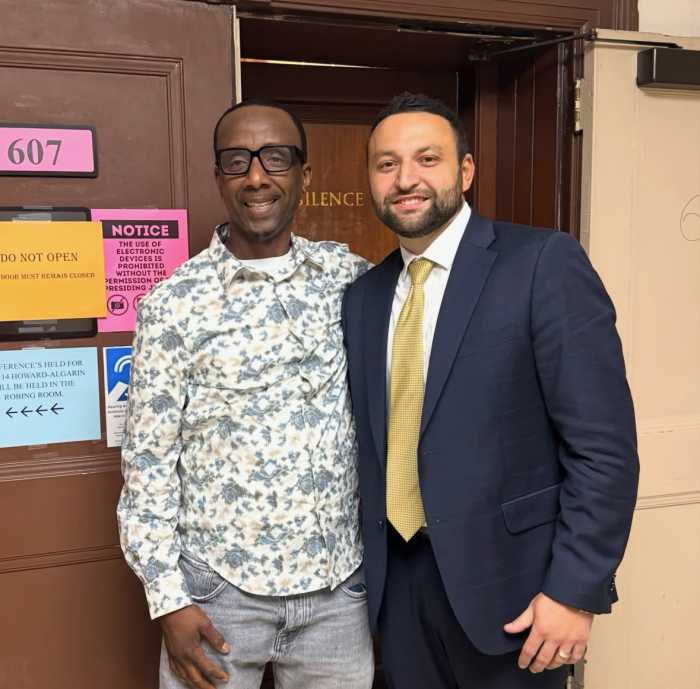 Trial Team Co-Chair Paul Bitetti stand with a client.Photo provided by Liakas Law
That philosophy also makes them a formidable courtroom opponent, they say — and makes their name one that scares insurance companies and defense firms, which helps them get the outcomes they want for their clients.
“A lot of firms are settlement firms. Insurance companies will look at the firm, and they’ll say, ‘Oh, this is just a settlement firm. We don’t have to worry about them.’ Or they’ll say, ‘Okay, this firm actually tries cases,’” Dean Liakas said. “That’s what we’re talking about with that change and helping these communities by being known as a trial firm. I think that is what separates us as a firm.”
“Defense attorneys know when they’re against a settlement firm,” Nicholas Liakas added. “When they get the reports from their doctors, they know what it’s going to say before it’s even sent to them because it’s gonna say the same thing as the last one that doctor wrote, since they use the same doctors, they use the same experts, they use the same everything.”
The brothers say they’re committed to using their record and actions to change the perception of personal injury law at large – they hope to shift people’s understanding of personal injury attorneys as people on big billboards chasing down money to people who care deeply about their clients and work for large-scale change.
“Everything you see about personal injury is about grabbing money. That’s not what it’s all about. It is about money because that’s what our recourse is, and that’s how we can try to rebuild someone’s life and make their life easier if they’ve suffered an immeasurable loss,” Nicholas Liakas said. “But I think an important aspect of how we’ve developed our firm, and what really sets us apart, is we are not a mill where we’re just churning cases.”
The brothers say they are also going against the current trend of leaning on artificial intelligence and taking on massive caseloads to process more people faster for the sake of counting numbers. That’s impersonal, they told amNewYork Law, and they are in the business of keeping personal injury truly personal.
“We saw from other places that we may have worked or interned at how they were running things. We were able to take bits and pieces and see what was good, bad, how they dealt with clients, how they dealt with their files, and I think we all just said, ‘We can sharpen this tool, we can do it better and better represent these individuals,’” Dean Liakas said.
From what their staff says, it seems they’ve been successful in that effort.
Three years ago, they brought on now-Liakas Law Trial Team Co-Chair Paul Bitetti and former Brooklyn Supreme Court Judge Mark Partnow, both of whom said they were attracted to Liakas Law because of this philosophy.
“Personal injury seemed like the best area of the law to help someone going against these massive entities, whether it’s a corporation, the City of New York, or large insurance companies,” Bitetti said. “You are fighting for the underdog, and that’s something that’s always driven me, and something I really liked about Liakas Law from the beginning.”
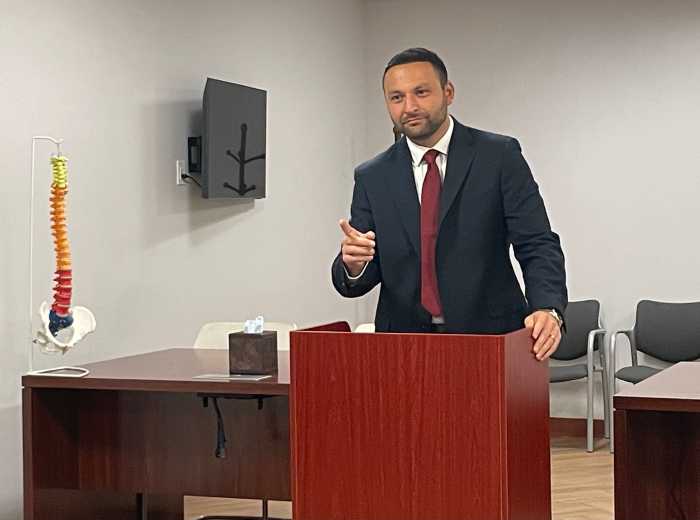 Bitetti in the office’s mock courtroom.Photo by Isabella Gallo
Partnow, who spent roughly 20 years on the bench, retired at 70 to join Liakas Law’s trial team. He said he made the choice to join the Liakases after assessing the brothers’ attorneys as they repeatedly appeared before him in his courtroom, saying it was always a “pleasure” to see how prepared and knowledgeable the firm was in trials and hearings.
“I spent many, many years as a Kings County Supreme Court Judge. I’ve tried hundreds of cases, and I’ve dealt with many, many law firms,” Partnow said. “As a judge the attorneys from Liakas Law stood out, apart from all other law firms. There’s something special about Liakas Law Firm – the caliber of their attorneys, the way they care about their clients, the way they try a case … When an attorney from Liakas Law walks into the courthouse, you know that that attorney is going to be prepared.”
“It’s been absolutely gratifying,” Partnow said of returning to the other side of the courtroom bench via the Liakas firm. “I love being here. I’m proud of what I do, and I’m proud of what the attorneys here at Liakas Law do every day.”
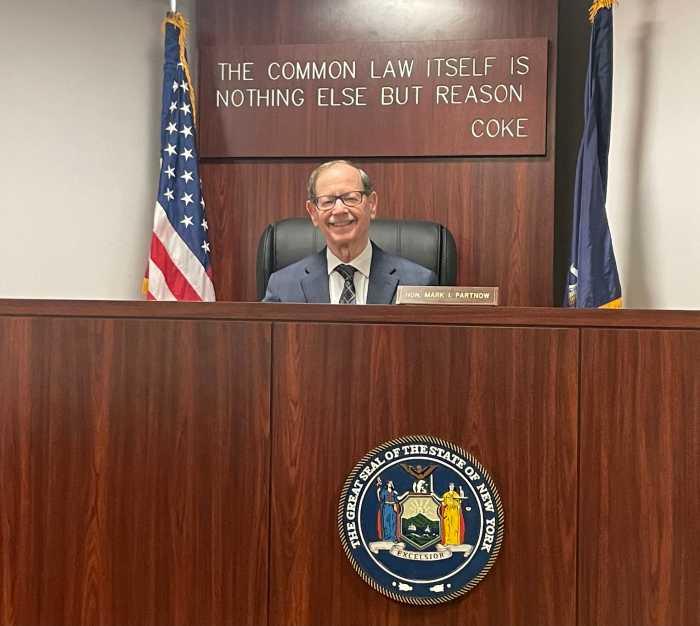 Partnow sits on the mock courtroom’s judge bench.Photo by Isabella Gallo
It’s this community-centered approach outside the courtroom and hyper-prepared, aggressive approach within it that the Liakases credit to their success. When you grow a reputation in a community – whether that be within a certain field, like the construction workers’ union community, or intentionally growing roots in certain geographic communities, like the Bronx – that community refers you to the next person in it that needs help.
“Over the years that we’ve been open, we’ve been really in these communities,” Nicholas Liakas said. “So, when something catastrophic does happen in a community, the family, whether they reach out to their community leaders or whoever they know for help, our name pops up.”
“I think that our investments in the community have really helped us get those policy-changing cases or catastrophic cases that really do affect communities,” he added. “When people see you can deliver results, word spreads.”