
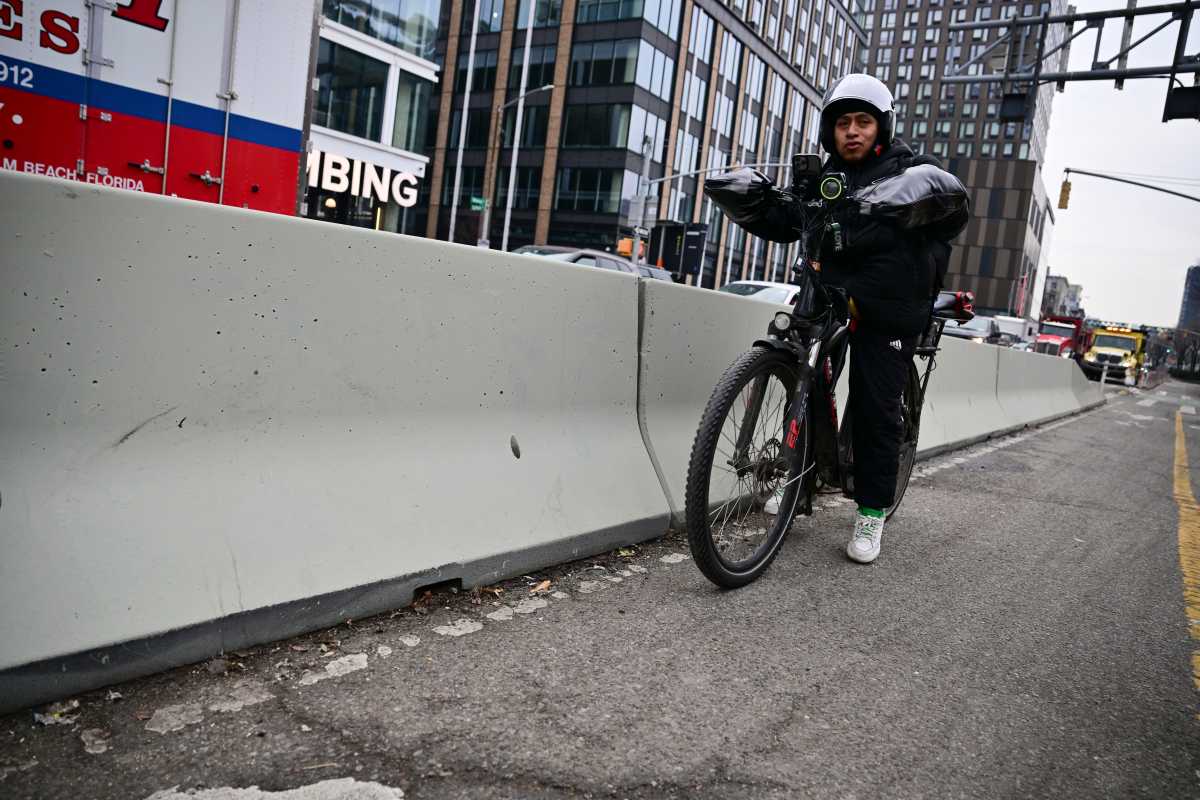
On September 30, the NY City Council will hold a hearing on e-bikes and e-scooters, taking up 17 bills that address everything from commercial riding regulations to police enforcement practices. An e-bike is the fastest, cheapest, and most reliable way to get around for a growing number of New Yorkers, yet commuting on two wheels can be hazardous, with preventable car collisions claiming the lives of riders on a far-too-regular basis. At the same time, reckless, high-speed micromobility riding has left some New Yorkers injured and shaken, further dividing communities on how best to share the road.
This hearing is the Council’s opportunity to ensure e-bikes integrate safely onto our streets, enabling a city where choosing a more sustainable and affordable way to get around feels rational. The only way for the Council to effectively do that, however, is to focus on two key priorities: stopping the sale and use of illegal high-speed “e-motos,” and rapidly expanding connected, protected bike lanes that make roads safer.
A legal e-bike in New York tops out at 20 or 25 miles per hour depending on class, while a legal e-scooter is limited to 15 mph. An illegal e-moto is an entirely different machine: devices seized by authorities—including the one involved in a Brooklyn crash that killed a woman getting off a bus—can travel up to 60 miles per hour, closer to a motorcycle than a bicycle. These illegal vehicles are often marketed as e-bikes, and though they do not meet legal definitions, they are openly sold in NYC stores and by online retailers.
Despite these discrepancies, September’s e-bike hearing will likely include a bill calling for an NJ-style requirement that all e-bike riders carry a license, registration, and insurance. This is a bad idea. A legal e-bike poses similar risks to an analog bicycle, making a licensing scheme a serious waste of taxpayer resources. It would take the biggest hit on delivery workers and low-income New Yorkers, who depend on these bikes and are the least equipped to absorb new fees and paperwork burdens. It would negatively impact the many tourists from other states whose e-bikes will not be legal to operate in New York. And ultimately, it would fail to address the illegal, unsafe e-motos that were never going to register in the first place.
The NYC Department of Transportation estimates that more than half of all rider deaths involve these e-motos, and the Mamdani administration just issued cease-and-desist letters to 42 online retailers, demanding they stop selling these vehicles in NYC. It’s a strong first step, but to fully eradicate this problem, New York should look to proven solutions from other global centers.
European regulators have focused on cracking down on illegal devices at ports and on the streets. Dutch authorities, for example, have ensured port workers know how to spot illegal vehicles. This paid off in 2024, when authorities seized a shipment of roughly 16,500 illegal e-motos at the Port of Rotterdam, and confiscated more than 10,500 additional vehicles off the streets. They also deployed 250 roller test benches so enforcement officers can check a vehicle’s top speed in real time, sometimes prompting heavy rider fines or confiscation of illegal vehicles. Meanwhile, France treats derestricting a motor as a serious offense, with steep penalties for whoever tampers with it, whether that’s a rider, a repair shop, or a retailer.
European cities have also shown the power of protected bike lanes, with Paris as a recent success story. Over the past decade, the city built more than 1,000 kilometers of new bike lanes and invested more than 250 million euros in street safety improvements. The result: cycling’s share of trips doubled, from about 5% in 2020 to 11% in 2025, while car use fell to around 4% of trips in central Paris, marking a 40% reduction. Research shows that people started cycling because the protected infrastructure felt safer and made it more convenient to ride. At the same time, hospitalizations from motor vehicle collisions dropped by over 50%, and the city saw a marked improvement in overall air quality.
That is the model for New York: target illegal devices, especially before they reach the street, and build protected lanes that help keep all street users safe.
The Mamdani administration’s crackdown on illegal e-motos and other devices should expand, with escalated outreach to and penalties for sellers of illegal vehicles, especially online. The Council should pass a resolution calling on our city’s federal elected officials to introduce a bill to stop these vehicles from entering the country in the first place. Finally, we should give the NYPD the tools to verify a device’s actual speed and power, and focus enforcement on confiscating these vehicles rather than issuing criminal summonses to riders.
When it comes to infrastructure, DOT’s own data shows that adding physically protected bike lanes improves safety for everyone on the road. The Mamdani administration has done a lot to advance deployment of this infrastructure, including introducing a resolution to simplify the review of street safety projects like bike lanes, which will ultimately speed up project deployment. Meanwhile, Council Member Selvena Brooks-Powers has sponsored Intro 124, which would establish a much-needed task force to study options for making street design and infrastructure safer amid increased cycling citywide.
E-bikes are the most affordable, lowest-emission way for a New Yorker to get around, and more people are choosing them every year. On September 30, the Council can protect that by targeting illegal e-motos and the retailers that sell them, and by building protected lanes that keep riders and pedestrians safe. Do both, and New York becomes a place where the cheapest, cleanest way to travel is also the safest.
Stéphane Ficaja is a French engineer and urban mobility expert. He is the Co-Founder and COO of Upway, an e-bike retailer headquartered in Greenpoint, Brooklyn.