
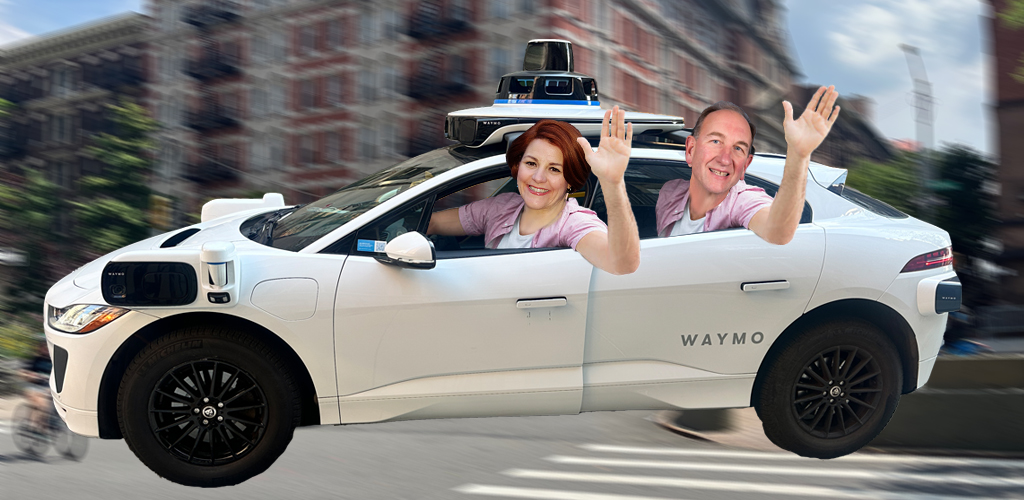
A new Waymo-backed advocacy group couched in the language of traffic safety and stocked with ex-elected officials and other public sector heavyweights launched last week to support bringing self-driving cars to New York state — after Gov. Hochul backed organized labor and nixed her plans to legalize them early in last year’s budget negotiations.
A Better Road Forward, a 501(c)(4) that describes itself as a “statewide coalition of New Yorkers,” frames itself as “an educational resource and a platform for community engagement” as Hochul and state legislators weigh letting “autonomous vehicle” companies like Waymo expand beyond driver-monitored testing currently underway in New York City and Buffalo.
“This campaign is about bringing New Yorkers into the conversation about the future of autonomous passenger vehicles on our streets,” Basil Seggos, the group’s advisory board chair and the former commissioner of the state Department of Environmental Conservation, said in a statement announcing the new group.
New York, Seggos added, “has a chance to seize the moment on innovation and sustainability.”
The advisory board includes former New York City Council Speaker Christine Quinn, who now runs the homelessness nonprofit WIN; Rev. Mark Blue of the Buffalo NAACP; former Bronx Assembly Member Kenny Burgos, who now leads the state’s apartment-owner trade group; former state Department of Motor Vehicles Commissioner Mark Schroeder; and Julie Samuels of the tech-backed policy think-tank Tech:NYC.
The group plans to put on community events, create a testimonial website and buy advertising. Waymo is providing funding and “advice and support” for the group, the company confirmed to Streetsblog.
“Waymo supports A Better Road Forward and its mission to improve transportation safety and accessibility in New York, however its leaders and members speak for themselves,” company rep Ethan Teichner said in a statement. “We are providing advice and support to the coalition because we know an increasing number of New Yorkers are excited about what autonomous vehicles can do for their communities, but don’t have a platform to make their voices heard.
“Autonomous vehicles must be deployed responsibly, guided by a statewide framework that accounts for the experiences of New Yorkers who face persistent transportation challenges,” Teichner added.
Schroeder, a former Buffalo city comptroller who spent nearly a decade running the state DMV, said his role is partly to translate the self-driving gospel for Albany’s institutional players — including labor unions that helped kill Hochul’s AV push earlier this year.
“You have people who are adroit, who have information on it, and who are going to be able to engage in conversation with the assembly, with the senate,” he said. “As a commissioner of DMV, we had 3,000 employees, and every one was a member of a union, CSEA or PEF. I know how to talk to them and understand what their issues are, and then we need to work things out together. Why? Because we all have the same constituency: the public.”
Hochul’s abruptly abandoned plan would have let municipalities like Buffalo and Albany opt into driverless pilots and required companies pay $1 million fee to participate. The governor cut the measure out of her budget in February, before lawmakers even had a chance to formally weigh in, citing pushback from “stakeholders, including in the legislature.”
The reversal was a win for an unusual alliance of labor unions, safety advocates and the Uber-backed Independent Drivers Guild. At the same time, Bronx Assembly Member Karines Reyes and state Sen. Luis Sepulveda introduced a bill to ban robotaxis outright.
Waymo spent relatively little defending the governor’s plan compared with the tech industry’s other Albany priorities this year: The company spent about $1.1 million in lobbying in the first half of 2026, compared to the more than $15 million Uber and Uber-backed Citizens for Affordable Rates spent successfully pushing Hochul’s bid to lower insurance costs at the expense of traffic crash victims.
Waymo’s human-operated New York City testing permit has since expired. No company has approval to run driverless service anywhere in the state.
Arguments on both sides
Supporters of AV point to Waymo’s claim that its vehicles crash and injure pedestrians less often than human drivers do nationally.
Some disability advocates have echoed that case. Rodney Stanford of the American Council of the Blind of New York told Streetsblog that human rideshare drivers sometimes turn away blind riders with service dogs. “Robot taxis will obey the laws, the human element, not so much,” he said.
The safety case is far from settled, though. The National Highway Traffic Safety Administration is investigating Waymo after one of its vehicles struck a child near a California school, and the company has acknowledged its cars repeatedly failed to stop for loading school buses in Austin, Texas — incidents a Johns Hopkins analysis this year cited in finding AV safety data remains limited and inconsistent industrywide. In July, police in San Mateo, California, detained two teenagers after a Waymo vehicle’s sensors flagged a safety concern, reigniting privacy questions.
Still, organized labor remains the most persistent obstacle.
A 2026 Open Plans analysis warned that a robotaxi rollout would reshape congestion, curb space and driver livelihoods citywide. Street safety advocates aren’t sold on the technology’s readiness.