
As the Trump administration tries to turn attention back to the Western Hemisphere after months of war in Iran, officials are seeking to intensify the fight against Latin American cartels.
At the United Nations General Assembly this week, State Department officials are expected to announce that 14 Latin American and Caribbean nations are labeling 25 criminal groups as terrorist organizations, according to U.S. and Latin American officials. The groups have already been labeled foreign terrorist organizations by Washington.
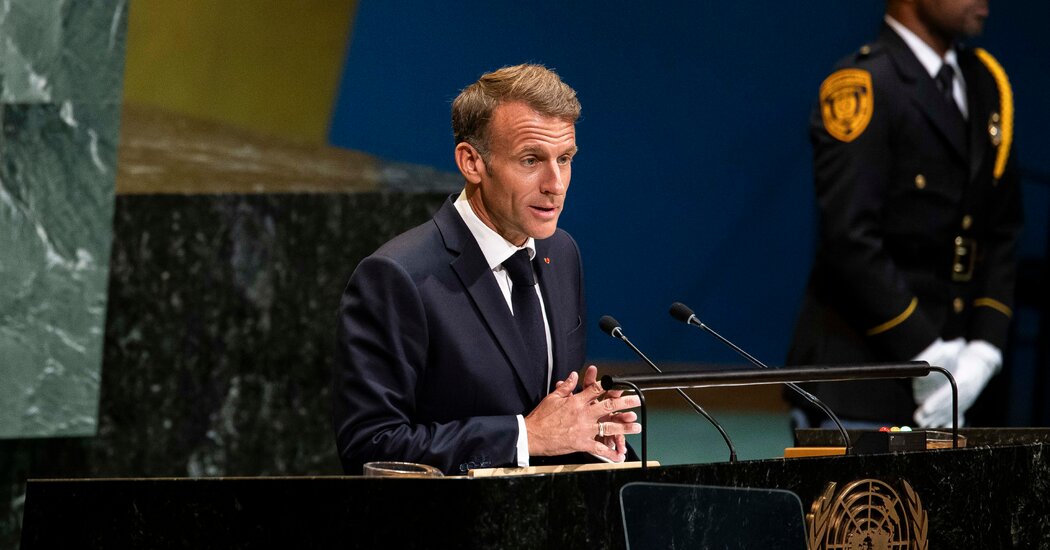
“Upon taking office, I designated the drug cartels as foreign terrorist organizations and unleashed the United States armed forces to eliminate them,” President Trump said in remarks at the General Assembly on Tuesday. “The cartels are the ISIS of the Western Hemisphere — not good people.”
Having Latin American leaders designate the same groups as terrorists, analysts say, further lays the groundwork for potential military strikes against criminal groups accused of drug trafficking.
The joint statement will be announced on the sidelines of the General Assembly, according to two U.S. officials, who asked not to be named because they were not authorized to speak publicly.
The formal mechanism for the designation is the Rio Treaty, the officials said, a 1947 defense pact among more than a dozen nations in the Western Hemisphere that holds an attack on one member to be an attack on all.
The move would mark the first time that a group of Latin American governments has collectively signed a sweeping terrorism designation alongside Washington.
The countries signing the statement — which belong to the Shield of the Americas, an alliance of nations with conservative governments that was formed by the Trump administration — are Argentina, Bolivia, Colombia, Chile, Costa Rica, the Dominican Republic, Ecuador, El Salvador, Guyana, Honduras, Panama, Paraguay, Peru and Trinidad and Tobago.
Peru and Paraguay confirmed that they had signed the joint statement. The State Department and the governments of the other countries did not respond to requests for comment.
Former U.S. officials and experts said the move could have sweeping effects in the region. “They’re doing it at U.N.G.A. to try to give it legitimacy,” said Todd Robinson, an assistant secretary of state for international narcotics and law enforcement at the State Department under President Joseph R. Biden Jr. “But I think the strategy is basically wrong. Criminal organizations are not terrorist organizations.”
Mr. Robinson said the United States had made more headway fighting traffickers in Latin America by focusing on the “civilian security apparatus that is trained to go after these organizations — to go after their money, to collect evidence, to indict and prosecute and to, under the rule of law, bring these people to justice.”
A militarized approach, by contrast, has not succeeded in curbing the flow of drugs to the United States and could result in extrajudicial killings, Mr. Robinson said. “It already has,” he said, citing lethal strikes on boats that the Trump administration, without providing evidence, said were carrying drugs.
Those attacks, which have killed more than 220 people, violate international law and could constitute crimes against humanity, a U.N. legal expert wrote this week.
Since President Trump returned to office, the State Department has added around 20 Latin American and Caribbean groups to the United States’ list of foreign terrorist organizations.
The groups include major Mexican cartels such as the Sinaloa cartel; transnational gangs like Tren de Aragua, which started in Venezuela; and Ecuadorean gangs that U.S. officials say supply cocaine to Mexican cartels. Mr. Trump has accused the groups of attacking the United States by flooding it with drugs and with migrants whom he has linked to crime.
The scene of a murder last year in Culiacán, Mexico, the stronghold of the Sinaloa Cartel.Credit…Paul Ratje for The New York Times
While the terrorist designation offers tools to freeze or seize U.S.-based assets, it does not, on its own, authorize military operations. The Trump administration has nonetheless leaned on its designations when announcing military strikes.
The designation of the same groups as terrorist by Latin American countries appears to be part of the administration’s effort to pursue using military force against the groups — and to recast what critics see as a U.S.-driven agenda as a regional priority, said Gimena Sánchez, the Andes director for the Washington Office on Latin America, a research group.
But the designations could impinge on national sovereignty and each country’s laws governing the use of force, she added.
Labeling groups as terrorist, Ms. Sánchez said, could also lead to bombings that could endanger civilians and could expand governments’ power to target citizens, enabling officials to accuse virtually anyone, including political opponents, of being “pro-terrorist.”
Juan Pablo Segura, the assistant secretary of state for Western Hemisphere affairs, and former Homeland Security Secretary Kristi Noem, now special envoy to the Shield of the Americas, met last week in Washington with diplomats from the 14 Latin American nations to prepare the joint statement.
This month, following a trip by Secretary of State Marco Rubio to Colombia, Ecuador, and Peru, U.S. officials announced that $52 million in military aid would be shifted from Middle Eastern and European countries to those three nations, as well as Panama, to combat “narcoterrorism” and secure the Panama Canal.
Mitra Taj contributed reporting from Lima, Peru, and Lucía Cholakian Herrera from Buenos Aires.