
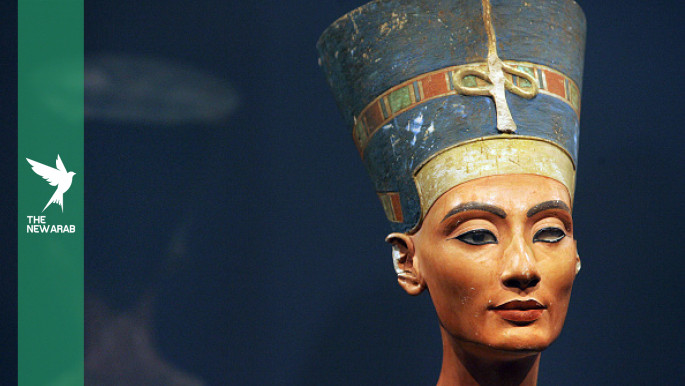
Nefertiti is one of the most important yet mysterious queens in Egyptian history [Getty]
New evidence pointing to hidden chambers near the tomb of Tutankhamun has revived hopes that the long-lost tomb of Queen Nefertiti, one of ancient Egypt’s most celebrated figures, may finally be within reach.
Researchers using ground-penetrating radar and microgravity surveys say they have detected signs of previously unknown corridors and chambers extending beyond the famous pharaoh’s tomb, known as KV62, in Egypt’s Valley of the Kings.
The findings have breathed new life into a controversial theory first proposed by British Egyptologist Nicholas Reeves in 2015: that Tutankhamun’s surprisingly small tomb is actually only the outer section of a much larger royal burial complex, and that Nefertiti could lie within its still-sealed chambers.
Though her tomb has not yet been found, researchers believe they may finally have identified a promising new place to look.
The team, led by former Egyptian antiquities minister and Ain Shams University archaeologist Mamdouh Eldamaty, combined radar surveys from inside Tutankhamun’s tomb with more than 1,200 microgravity measurements of the surrounding ground.
The results indicate what researchers believe could be a rubble-filled corridor around two metres wide leading away from Tutankhamun’s burial chamber, along with several low-density structures with right angles that could represent artificial rooms.
One particularly intriguing feature, dubbed “anomaly 7”, appears as a roughly square high-density area surrounded by a lower-density zone.
Structural engineer George Ballard, one of the researchers, suggested it could potentially represent a chamber containing objects, although he cautioned that the measurements were approaching the limits of what the technology can reliably detect.
Who was Queen Nefertiti?
Nefertiti was the Great Royal Wife of Pharaoh Akhenaten, one of the most controversial rulers of ancient Egypt, who radically transformed Egyptian religion during the 14th century BC by elevating the worship of the sun disc Aten and introducing a form of worship sometimes described as an early form of monotheism.
She occupied an unusually prominent position alongside her husband, appearing in surviving images performing religious and royal functions normally associated with the pharaoh himself.
Nefertiti was also closely connected to Tutankhamun. Genetic evidence indicates Akhenaten was Tutankhamun’s father, while his mother was another close relative of Akhenaten rather than Nefertiti, according to the prevailing interpretation of DNA studies.
Nefertiti was therefore likely Tutankhamun’s stepmother, but she was also his mother-in-law: Tutankhamun married Ankhesenamun, one of the daughters of Akhenaten and Nefertiti.
Towards the end of Akhenaten’s reign, Nefertiti largely disappears from the historical record. Some Egyptologists believe she may subsequently have ruled Egypt herself, potentially under another royal name, although the theory remains disputed.
Her fate, death and burial place have never been conclusively established.
Famous today for the painted limestone bust discovered at Amarna in 1912, Nefertiti has consequently become one of the most recognisable figures from ancient Egypt despite the mystery surrounding her final years.
What could be behind Tutankhamun’s walls?
That mystery is central to Reeves’s theory about Tutankhamun’s tomb.
Despite the extraordinary treasures Howard Carter discovered there in 1922, KV62 itself is unusually small for a royal burial. Reeves proposed that it had originally been constructed for another royal figure and was hurriedly adapted after Tutankhamun died unexpectedly while still young.
He identified lines and cracks beneath the tomb’s decorated walls that he argued could mark concealed doorways leading to the remainder of an older royal burial.
Attempts to prove the theory have produced conflicting results, however. Previous radar surveys have variously suggested hidden spaces or found no evidence of them, and the idea that Nefertiti lies nearby remains disputed among Egyptologists.
The researchers may soon have an opportunity to test what is actually there.
They are seeking permission from Egypt’s Supreme Council of Antiquities to drill small exploratory holes towards one of the suspected spaces and potentially send miniature camera-equipped vehicles inside.
If approval is granted, the investigation could begin as early as November.