
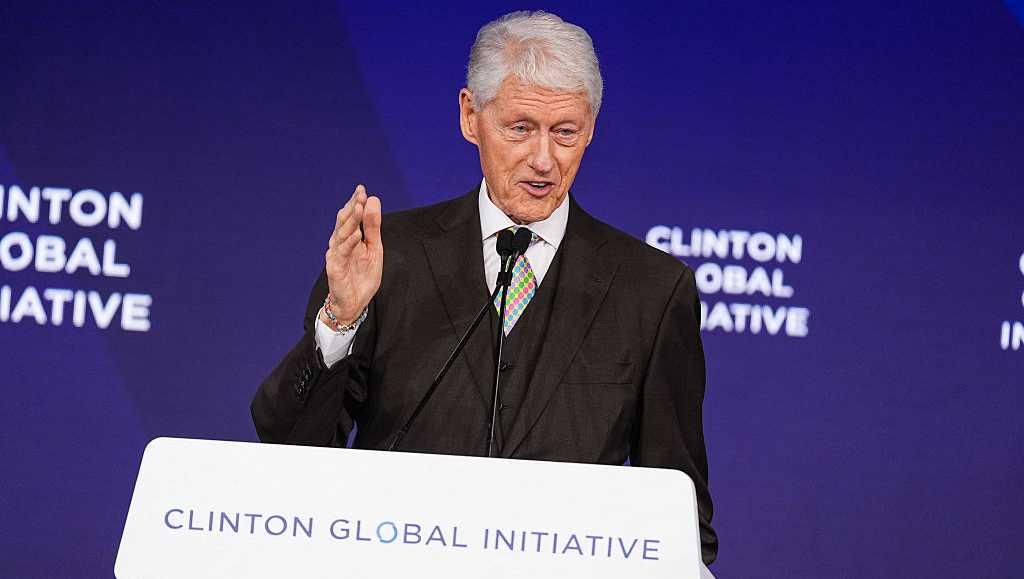
Former President Bill Clinton at CGI conference calls on leaders to fill gaps left by ‘retreating governments’
 NEW YORK —
Former President Bill Clinton opened this year’s Clinton Global Initiative conference Tuesday in New York, calling on attendees to promise to “step into the void created by retreating governments” following cuts by the United States and other nations to foreign assistance.
“We know that we can’t completely fill the hole that retreating governments are leaving behind,” said Clinton, adding that philanthropy and other sectors will have to find new ideas and resources to protect progress on issues already made.
He made his appeal after opening the conference, challenging President Donald Trump and his administration on multiple fronts.
Related video at the top: Bill Clinton talks about immigration and Minneapolis at CGI conference
“I suppose I could take my entire allotted time to discuss the self-evident wisdom of building an Arc de Triomphe in Washington to hold all our drones,” Clinton joked. “Some of this stuff it’s hard to make up.”
After the laughter subsided, though, Clinton seriously laid out how he disagreed with the idea that “cooperation is not important, that winning is important in the short run.”
The Clinton Global Initiative has convened political, business and philanthropic leaders to address the world’s issues for more than two decades.
Related video below: Bill Clinton talks about the risks of AI at CGI
Donna McKay, the Breast Cancer Research Foundation’s president and CEO, unveiled one of those new ideas Tuesday.
New funding ideas for research and democracy
BCRF Ventures is the foundation’s first venture philanthropy fund, a $100 million initiative launched Tuesday with an $11 million donation from philanthropists Karen and Rob Hale to pay for its creation and early investments to encourage others to donate.
“It makes sense that at this point in time when there are extraordinary advances happening that BCRF throw everything that we can at research and science,” McKay told The Associated Press in an interview. “What this venture philanthropy program will do is try to fast-track advances and get them to patients as quickly as possible.”
The new initiative will not replace BCRF’s more traditional grantmaking to breast cancer research scientists, which the foundation expanded last year in the face of federal funding cuts to medical research.
The goal for the venture philanthropy fund is to use the earnings from the successful companies it supports to bolster more companies.
“The success of one breakthrough has the potential to finance the next and the next,” McKay said.
Stacey Abrams, former Georgia state representative and leader of the vote mobilization and education nonprofit 10 Steps Campaign, announced a coalition of democracy nonprofits banding together to launch the Democracy Index Fund, which will pool resources to support pro-democracy organizations, and the Democracy Hedge Fund, designed to earn revenue while also providing support for pro-democracy organizations.
“Authoritarians have a playbook. They also have a budget,” Abrams said as she announced the new funds. “And now, so should we.”
‘This is a moment to give out money. Lots of it. Right now.’
Carmen Rojas, the Marguerite Casey Foundation’s president and CEO, outlined a more common-sense approach that is still seen by many in philanthropy circles as radical.
“This is an invitation that I give to donors, to foundations in the room, to anybody who has a rich cousin; this is a moment to give out money,” she said. “Lots of it. Right now.”
Rojas explained how there is currently extraordinary need, and that should be met with extraordinary action. The Marguerite Casey Foundation announced plans in June to increase its annual donations to at least $500 million over the next decade in order to alleviate some of the pain the communities it serves are feeling following federal funding cuts. In 2025, the foundation dipped into its endowment in order to hand out $135 million.
“There was greater risk in inaction,” she said, explaining the step many nonprofits would refuse to consider because it could put future investment earnings at risk. “The greatest risk we face is sitting on a set of resources that communities across this country desperately need to protect their neighbors, to be able to build relationships with one another, to have their needs met.”
Rojas told The Associated Press in an interview that her foundation’s bold strategy has encouraged others to utilize it as well. She wants foundations to reconsider the requirement that they give 5% of their value annually in order to maintain their tax-exempt status – calling it a floor rather than a ceiling.
Ford Foundation President Heather Gerken encouraged conference attendees to remember to dream of what they want to accomplish.
“As much as we are in the trenches and fighting the fight, we need to look out over the horizon,” she said. “The reason we are here is that we have had a democracy that has not served everyone. And so we need to figure out how to dream a new democracy into existence.”