
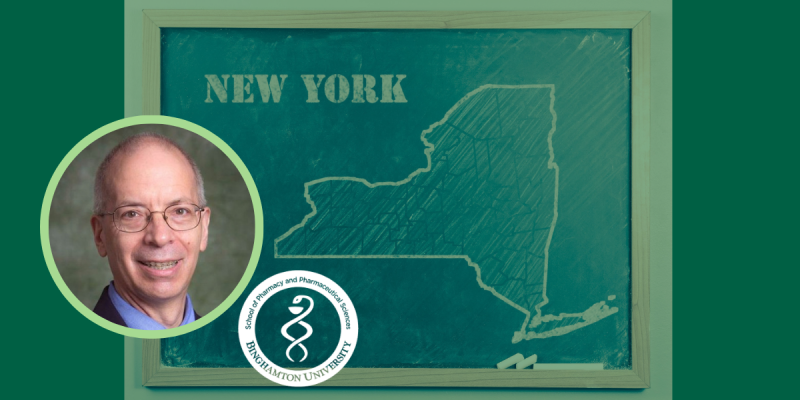
Across New York state, there are more than 31,000 active pharmacists, 6,700 registered pharmacy technicians, and thousands of pharmacy facilities. Maintaining professional standards, addressing concerns, and protecting public health with that many constituents is no small task.
In steps the New York State Board of Pharmacy.
Thirteen board members represent a balance of diverse geographic regions and practice specialties, including nine licensed pharmacists (who must hold active NYS registration and have at least five years of licensed practice in the state), two registered pharmacy technicians, and two members of the public (representing health consumers statewide). The board’s work is supported by a small number of professionals and a full-time executive director appointed by the Board of Regents.
Since 2022, one of these members has been a dedicated Binghamton faculty member.
Leon Cosler, RPh, PhD, is a tenured associate professor in the Department of Pharmacy Practice at Binghamton University’s School of Pharmacy and Pharmaceutical Sciences. With more than 20 years of experience in pharmacy education, Cosler has had a variety of academic leadership roles.
“I remain deeply honored and humbled by the privilege to serve New York state and the pharmacy profession in this capacity,” Cosler said. “Service on the board reinforces the immense scope of impact that pharmacists can have on public health and safety throughout the state. At Binghamton University, we strive to instill this same sense of civic duty, professional ethics, and dedication to patient welfare in our students.”
The primary objective driving the New York State Board of Pharmacy is the protection of public health, safety, and welfare. Board members advise the NYS Education Department (NYSED) and the Board of Regents on professional standards, licensing criteria, and practice oversight for individual practitioners as well as registered establishments statewide. Members also work with NYSED’s Office of Professional Discipline (OPD) in ongoing reviews of investigative findings stemming from routine facility inspections or consumer complaints to maintain regulatory integrity and safeguard patient care.
How long have you been on the board and what has your experience been like?
I was appointed to the Board of Pharmacy by the NYS Board of Regents in November 2022 following a comprehensive state vetting and interview process. Board members are appointed to five-year terms and may serve up to two consecutive terms.
My time on the board has been both deeply rewarding and humbling. It provides fascinating firsthand insight into state administrative governance and illustrates how public health policy directly translates into daily practice standards. Participating in disciplinary reviews and regulatory evaluations constantly reinforces the profound responsibility we share as stewards of public trust. Every decision we make directly touches patient safety and shapes the quality of pharmacy care across New York state.
What are your motivations for serving on the board?
Having practiced as a licensed pharmacist in New York state for over 40 years, I feel tremendous gratitude for the pharmacy profession and the diverse, fulfilling career pathways it affords — from direct patient care and health outcomes research to academic instruction preparing the next generation of pharmacists.
When an opportunity arose to fill a board seat requiring a background in academia, I was deeply honored to be nominated and selected by the Board of Regents. Serving on the board is my way of giving back to a profession that has shaped my entire career. It allows me to apply my clinical, administrative, and practice experience toward protecting health consumers while ensuring our state practice standards remain strong and ethical while protecting public safety.
How are you able to take your experience on the board and use it at SOPPS?
My service on the board directly enriches my teaching and mentoring at Binghamton University’s School of Pharmacy and Pharmaceutical Sciences (SOPPS). I regularly integrate Board of Pharmacy service, ethical issues, and regulatory case studies into my core courses, including Health Care Delivery (PHRM 510) and Health Care Ethics (PHRM 530), as well as guest lectures in Pharmacy Law (PHRM 512).
Beyond classroom instruction, I am particularly proud of facilitating direct engagement between regulatory leaders and our academic community. I have had the privilege of coordinating campus visits from the executive director of the Board of Pharmacy, Dina Jazrawi, and fellow board members. These interactive presentations give our PharmD students, faculty, and staff unprecedented access to state regulatory leaders, helping our future graduates embrace professional accountability, ethics, and their civic duty right from the start of their professional careers.
What have you learned since joining the board? Is there anything that has surprised you?
Joining the board has been an eye-opening learning experience. Like many practitioners prior to appointment, I assumed the Board of Pharmacy possessed independent authority to directly draft and enact laws and regulations governing all things pharmacy. In reality, legislative statutory changes rest solely with the New York State Legislature. The board, however, serves a vital advisory role — helping NYSED translate legislative statutes into fair, practical, and enforceable administrative procedures and regulations.
I have also been deeply impressed by the extraordinary dedication of my fellow board members. The sheer volume and complexity of disciplinary case reviews require significant volunteer time and meticulous attention to detail. Seeing how collaboratively representatives from diverse pharmacy sectors — community, inpatient health-system, nuclear, managed care, and academia — work together with public members to protect New York consumers has been truly inspiring.