
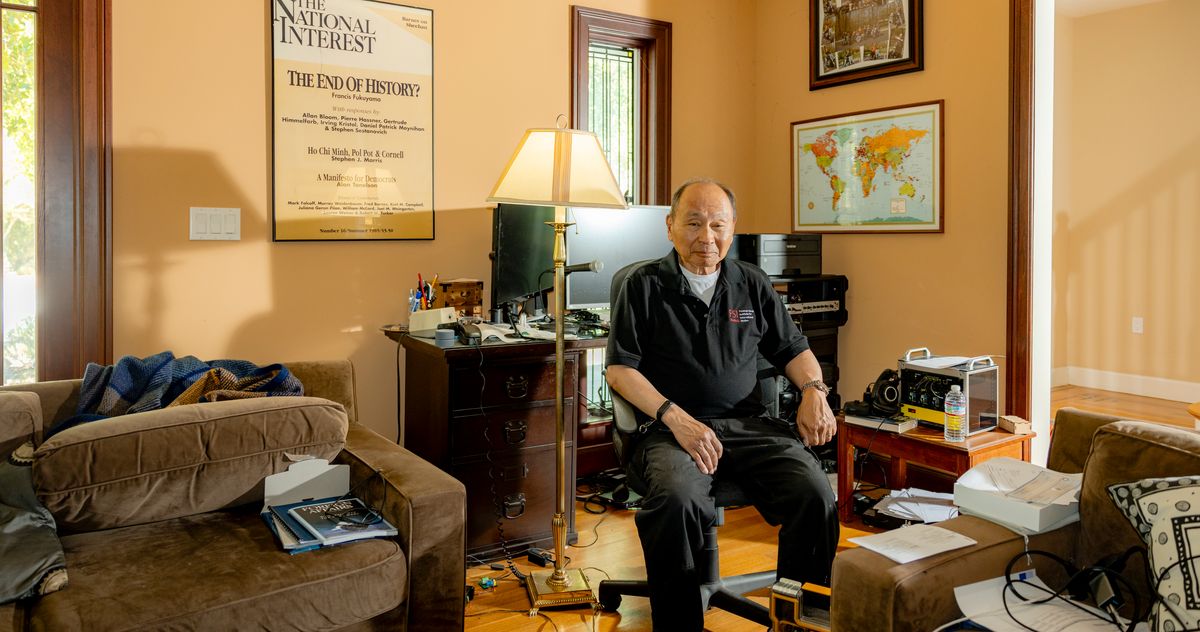
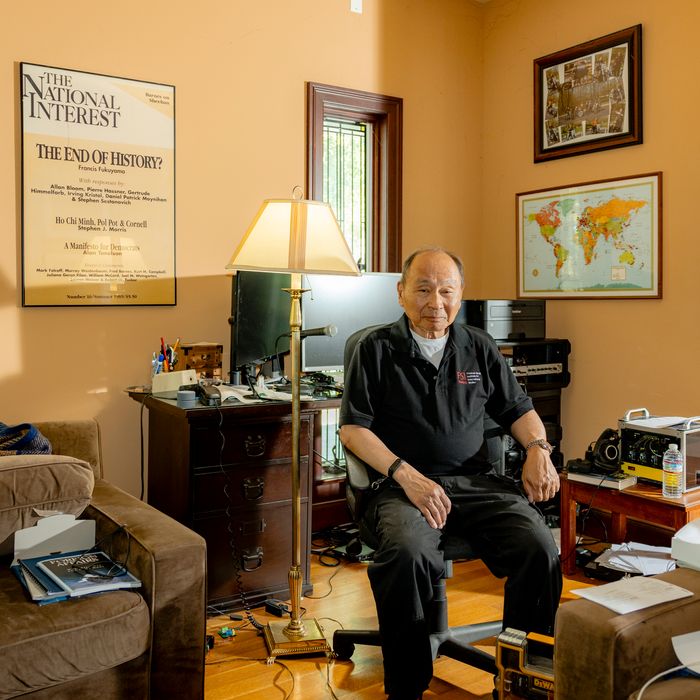
Long before Francis Fukuyama was one of the world’s most famous political scientists, he was a New York City kid, living in a ninth-floor Stuyvesant Town apartment as the only child of a theologian and potter.
“It was a very avant-garde, liberal environment,” he says, when we meet downtown on the publication day of his latest book. Fukuyama’s father was a Congregationalist minister who campaigned for civil rights and against the Vietnam War, getting to know the likes of Cornel West. “Do you know Judson Memorial Church?” Fukuyama asks. “That was our church when I was a kid.” Judson was not just a place for worship, but also a major arts venue, where a young Francis encountered the Judson Poets’ Theater, which “scandalized everybody, because they did these programs with a lot of nudity and that sort of thing.” It was there that he attended his first-ever wedding, in the early ’60s, between a Black man and a white woman. When the minister asked if anyone had objections, Fukuyama says, “This other white woman gets up and says, ‘Yeah, I have an objection. I’ve been living with the groom for the last six months!’” (Fukuyama’s mom told him that weddings weren’t usually like this.)
This mixture of understatement and curiosity is classic Fukuyama, and anecdotes like this dot In the Realm of the Last Man, his 13th and, he tells me, last book. Unlike his previous works of accessible, if dense, political theory, this book is a memoir.
The 73-year-old soared to fame in the final years of the Cold War by proclaiming the “triumph of the West, of the western idea.” As one authoritarian regime after another collapsed, he wrote that western liberal democracy would be “the final form of human government,” in a 1989 essay that forever yoked his name to its four-word title: “The End of History?”
Fukuyama’s frequently misunderstood thesis, later expanded on in a book released in 1992, posited that the principles that emerged from the French Revolution — liberty and equality — reflected central facts about human nature, and that liberal democracy, while imperfect, had best figured out how to govern societies with those principles in mind. Even at the time, he admitted that liberalism was not always the most exciting ideology, and some parts of human nature would remain unfulfilled. People would still, wrote Fukuyama, deliberately seek out “struggle, danger, risk, and daring.” And, crucially, he said, events would keep happening — just not in the service of a superior political ideal.
His well-timed provocations, and that memorable phrase, shot Fukuyama to improbable fame. His essay was “the hottest topic around” when The New York Times Magazine met the “unlikely celebrity” in the fall of 1989. (The obscure journal that published it reportedly was outselling “even the pornography” on newsstands.) Fukuyama became a fixture of C-Span, and his slogan was “bruited about in Washington think tanks, the press, and the academy.” By 1997, he had become a “global guru.”
After “The End of History?,” Fukuyama launched a decades-long effort to understand states and institutions; wrote a dozen books on subjects like trust, identity, and biotechnology; and taught at George Mason, Johns Hopkins, and now Stanford. But his Instagram comments are a case study in how thoroughly a single idea can overshadow a long career. “Do you think Ginger knows history ended?” someone asks, in response to a photo of his dog; “Mr Fukuyama this contradicts your thesis as history is happening,” another notes, below a California sunset. It’s almost like the young scholar once made a deal with the devil: He would get almost everything he could ever want, but in exchange, people would make the same bad joke, forever.
In person, Fukuyama is a little smaller than I expect — not more than five-foot-five — but instantly recognizable. He wears a navy blazer, blue shirt, and baseball hat from a museum in rural Indiana. I’d suggested we meet at the 9/11 memorial, in part because those attacks felt like the end of the post–Cold War moment in which Fukuyama made his name. The 25th anniversary was still three days away, but ground zero was already swarming with police. Fukuyama — “Frank,” as all who know him pointedly refer to him — had already been at the Freedom Tower once this year, to inaugurate a “Tyranny Tracker” from the Human Rights Foundation, one of many “human rights, democracy, advocacy” organizations with which he is involved. “It feels like pretty ancient history,” he tells me, of 9/11. He had witnessed the smoke rising from the Pentagon in Washington, D.C., where he had an office as a newly appointed Johns Hopkins professor.
Liberal triumphalism was rattled after the attacks, and Fukuyama became a soft target for critics from both the left (Tariq Ali dismissed his victory lap for the West as premature) and right (conservative pundit Charles Krauthammer accused him of underrating the threat of Islamic extremism). In the following years, he would break dramatically with the neocons while also distancing himself from liberal identity politics. But the constant drumbeat of critique might be why he seemed pleasantly surprised to note that most reviews for his new book have been positive — with a few exceptions, like Yale legal scholar Sam Moyn, “who has been criticizing me my whole life.”
As we stroll past the 9/11 memorial and the the continent’s largest manmade waterfalls, he tells me that the recuperative project of his book is not just about that never-ending bad joke about history ending, but also “to talk about a few things that were more personal” — without getting too, well, personal.
Instead of long tales of the past, the book has brief chapters — some as short as three pages — with titles like “Learning to Love Bureaucrats” and “The Best Way to Live.” They dart from recaps of his previous books to observations on human nature to anecdotes about meeting people like Muammar Gaddafi and Julia Kristeva. Fukuyama’s deadpan narration, subsuming both personal history and world events, can be anti-sentimental to the point of comedy. “There is nothing beautiful in the United States east of the Rocky Mountains,” he writes at one point.
The book floats stoically, sometimes nihilistically, above his accomplishments. “My life has revolved around different forms of intellectual activity,” he writes, but “it is often very hard to understand what if anything I’ve accomplished as a result.” He tells me he does not believe there will be a “Fukuyama school” in 50 years. He is far more proud of his former Stanford students who work in local politics — an Oakland councilwoman, a Houston judge. The only thing close to a brag he utters was that he helped make Shop Class As Soulcraft, the 2009 book about manual trades, into a best seller by reviewing it for the New York Times.
In his book, pleasure comes up in relation to “learning how to hand-dovetail drawers and case pieces” and “purchasing equipment,” pointing to his sustained entanglements with his hobbies: photography, woodworking, metalworking, programming computers, motorcycles, hiking. He gets obsessed with these things, he said on a recent podcast, “just like Trump is obsessed with his ballroom.”
Even the unexpected libidinous moments in the book are in service of them. When Fukuyama describes discovering his father’s stash of Playboy magazines, it is mainly to tee up a spread on high-end cameras — shot “as beautifully as that of any of the women in the issue ” — which sets him on a lifelong photography obsession.
In contrast, he writes almost nothing about his long marriage or three children, who show up most memorably as the recipients of beds he constructs out of wood. “I don’t think that everyone wants to hear about what a great personal life I’ve had,” he tells me, of those omissions. “There’s not much drama there.” (I later realized we were meeting on his 40th wedding anniversary.)
Fukuyama does excavate some new personal terrain in chapters about his family’s history with Japanese internment during World War II, pieced together through documents he unearthed only two years ago, including his grandmother’s and aunt’s letters from the camps. Both they and several other family members were interned in Arkansas and Colorado in the 1940s. But he emphasizes that they bounced back, studiously avoiding any connotations of a trauma plot. What happened to Japanese Americans was “not the worst victimization in American history,” he maintains. He has also “never liked” the term “Asian American.” Whenever other kids drew attention to his Asian heritage, his father told him to “just say you’re an American. You’re as American as anybody else.”
“On the other hand,” he now admits, “it does make me sensitive to certain things,” like recent attempts to eliminate birthright citizenship, “which I actually take pretty personally, because my mother was in the United States on a student visa when she had me, and if Stephen Miller and Trump had their way, I may not be a citizen.” (Fukuyama’s paternal grandfather owned a hardware store in L.A.’s Little Tokyo; his mother grew up in Kyoto and emigrated in 1949 to study at the University of Chicago.)
In fairness, Fukuyama’s rejection of the biographical goes far beyond his ethnicity; when I asked if growing up in Pennsylvania had any bearing on his interest in Shaker furniture, he replied, “Everybody starts with Shaker, because it’s just easy to build.”
The heritage that elicits the most emotion from him is his intellectual one — above all, his Cornell mentor, Allan Bloom, the charismatic classicist and author of The Closing of the American Mind, who pulled Fukuyama into his orbit when he was an undergraduate. There’s also Bloom’s teacher, the German Jewish émigré philosopher Leo Strauss, and the Machiavelli scholar Harvey Mansfield, now 94, with whom Fukuyama would do a book talk in Cambridge. They are a vanishing type: conservative intellectuals, Great Books men.
But Fukuyama cannot get too emotional even about that, shrugging, “You couldn’t possibly teach a classic western-civilization course anymore, because it’s too narrow.” At 73 years old, he continues to surprise. He no longer considers himself conservative at all. “I want universal health care,” he says. This is a different-sounding Fukuyama from even a few years ago, when he mounted a somewhat lethargic defense of the status quo in Liberalism and Its Discontents. Today, he sounds, at times, like the left-wing critics of liberal individualism, saying that “who you think you are is the kind of embedded society that you live in.”
Once the heat of the afternoon burned off, we strolled toward a Labor Day rally on Liberty Street. “I used to have a Harley, like those police,” he tells me. But he had recently given up motorcycles, after getting into four accidents. He had also given up strenuous hiking, as it had become harder, with age, to carry a heavy pack up a mountain, and his wife had convinced him to give away his pickup truck, a Chevy Colorado, largely on aesthetic grounds. And, he declared serenely, “we’re kind of at the end of photography,” both as his personal hobby and as a form.
Fukuyama is, as ever, calm about all of this. But human nature abhors a vacuum; few can tolerate “living in a world without struggle,” as he wrote in 1992. If books and bowback chairs and hiking and so much else in Fukuyama’s life are indeed over, the ground has likely been cleared for something new. And maybe the past, even for Fukuyama, is not quite over. He couldn’t resist snapping a photo of the labor rally before descending into the Oculus. A few days later, he posted a photo from the mall too, captioned: “Back in New York, just in time for 9/11.”