
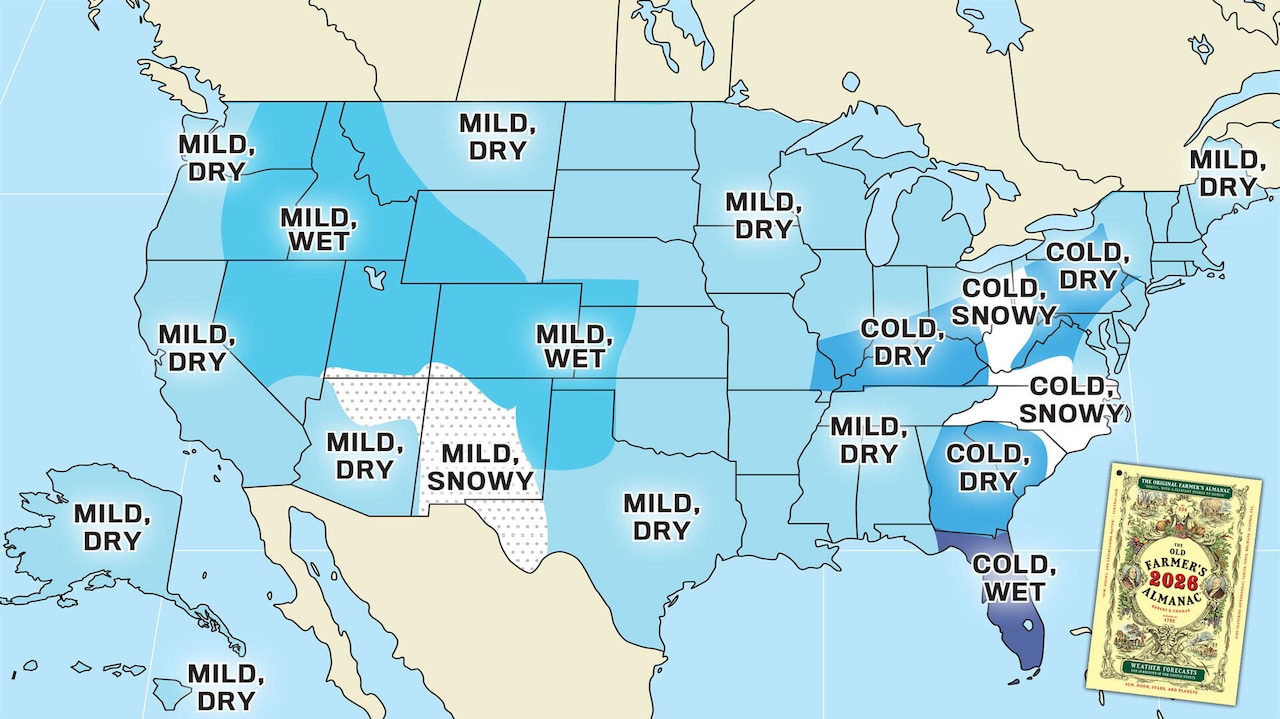
STATEN ISLAND, N.Y. — The Old Farmer’s Almanac recently issued its 2025-2026 U.S. winter weather forecast and it looks a typical or slightly milder winter is expected across most of the nation.
Much of the U.S. is forecast to experience near normal to slightly milder temperatures. However, the Appalachians, Southeast, Florida and the Ohio Valley are some areas in which colder-than-average temperatures are expected.
In terms of precipitation, the Old Farmer’s Almanac says the majority of the country should expect drier conditions. Florida, the Intermountain region and the eastern Desert Southwest are exceptions; these destinations could see above-average precipitation amounts this winter.
When it comes to the fluffy stuff, most of the country is forecast to receive near or below-normal snowfall amounts this winter. More snow than usual is expected in the Carolinas, southern Appalachians, eastern Ohio Valley, southern Rockies, and eastern Desert Southwest, according to the publication.
Winter weather across New York
What about New York?
The state is split into a few regions as part of this outlook, yet despite that, the forecasts are rather similar.
New York City is grouped with the Atlantic Corridor, which is slated to experience milder and drier conditions.
As indicated by Old Farmer’s Almanac, the Atlantic Corridor will experience above-average temperatures and below-average precipitation amounts. The coldest periods are expected to be in Mid-to-late December, as well as early and late January. Although generally forecast to be below average this winter, snowfall is expected in late December, early January and late February.
The Northeast, which also encapsulates much of eastern and northern upstate New York, has a similar forecast.
According to the Old Farmer’s Almanac, temperatures will be above normal and precipitation — including snowfall — will be below normal throughout a good chunk of upstate New York. The snowiest periods in the Northeast are expected to be in mid-November, early and mid-December, as well as early February.
In the Lower Lakes, which includes Buffalo and Syracuse, a milder winter is also expected. Temperatures will be up and precipitation down, but snowfall will not vary greatly. As explained in the almanac, snowfall amounts will be near to below normal, with the most snow falling in mid-to-late November, December, early and late January, early February and early to mid-March.
Lake-effect snow is always a possibility, given the proximity to the Great Lakes; Lower Lake residents are advised to keep an eye on December and March.
The AccuWeather winter outlook
Earlier this month, AccuWeather issued a winter forecast of its own. In that outlook, meteorologists foresaw below-average snowfall amounts in New York City.
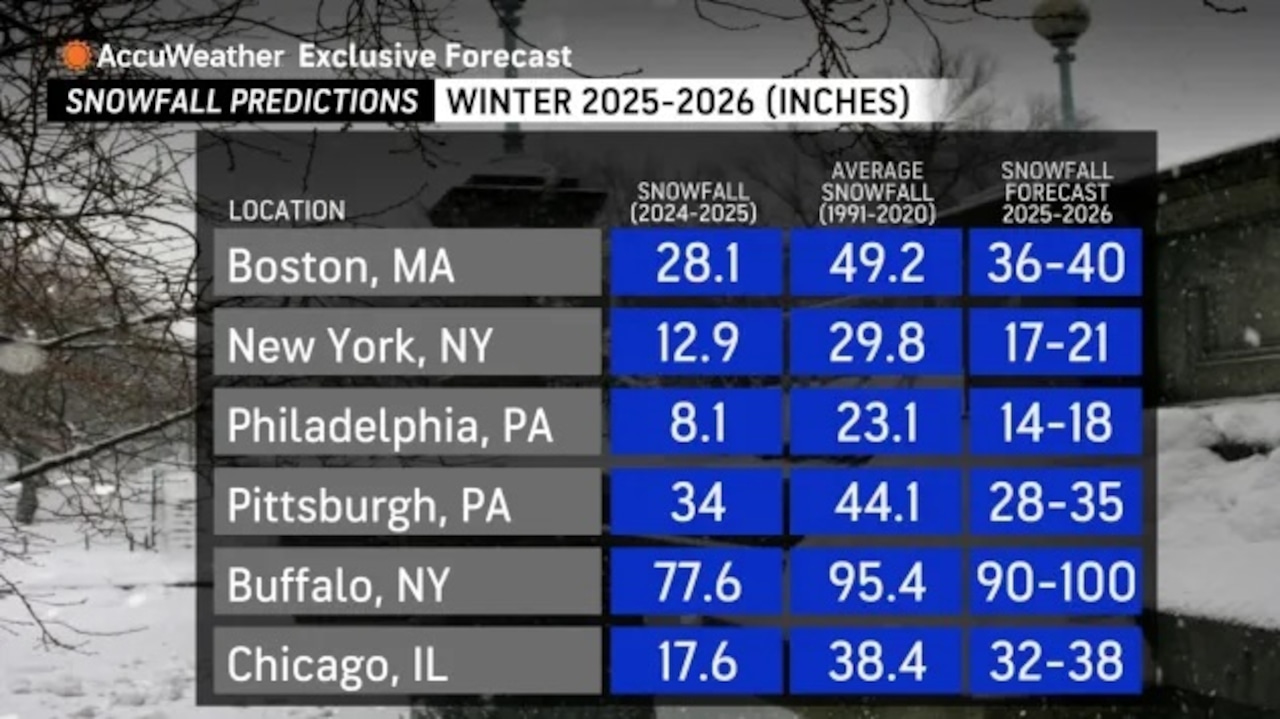 An AccuWeather graphic shows the forecast snowfall amounts in various cities, including New York City for the winter of 2025-26.(AccuWeather)
In all, AccuWeather revealed that the city is forecast to receive between 17 and 21 inches of snow through the end of the winter. The estimated snowfall total falls short of the historical average snowfall recorded in the city, registered at 29.8 inches. Still, the anticipated snowfall amount exceeds the 12.9-inch snowfall tally recorded last winter.
Similarly, forecasters predict that slightly warmer temperatures than usual are on the horizon for the five boroughs.
While the city may see less snow, AccuWeather forecasts an active December around the Great Lakes. By the end of the season, Buffalo is expected to record between 90 and 100 inches of snow. Historically, the Queen City receives about 95.4 inches on average, as previously noted by AccuWeather.
If you purchase a product or register for an account through a link on our site, we may receive compensation. By using this site, you consent to our User Agreement and agree that your clicks, interactions, and personal information may be collected, recorded, and/or stored by us and social media and other third-party partners in accordance with our Privacy Policy.