
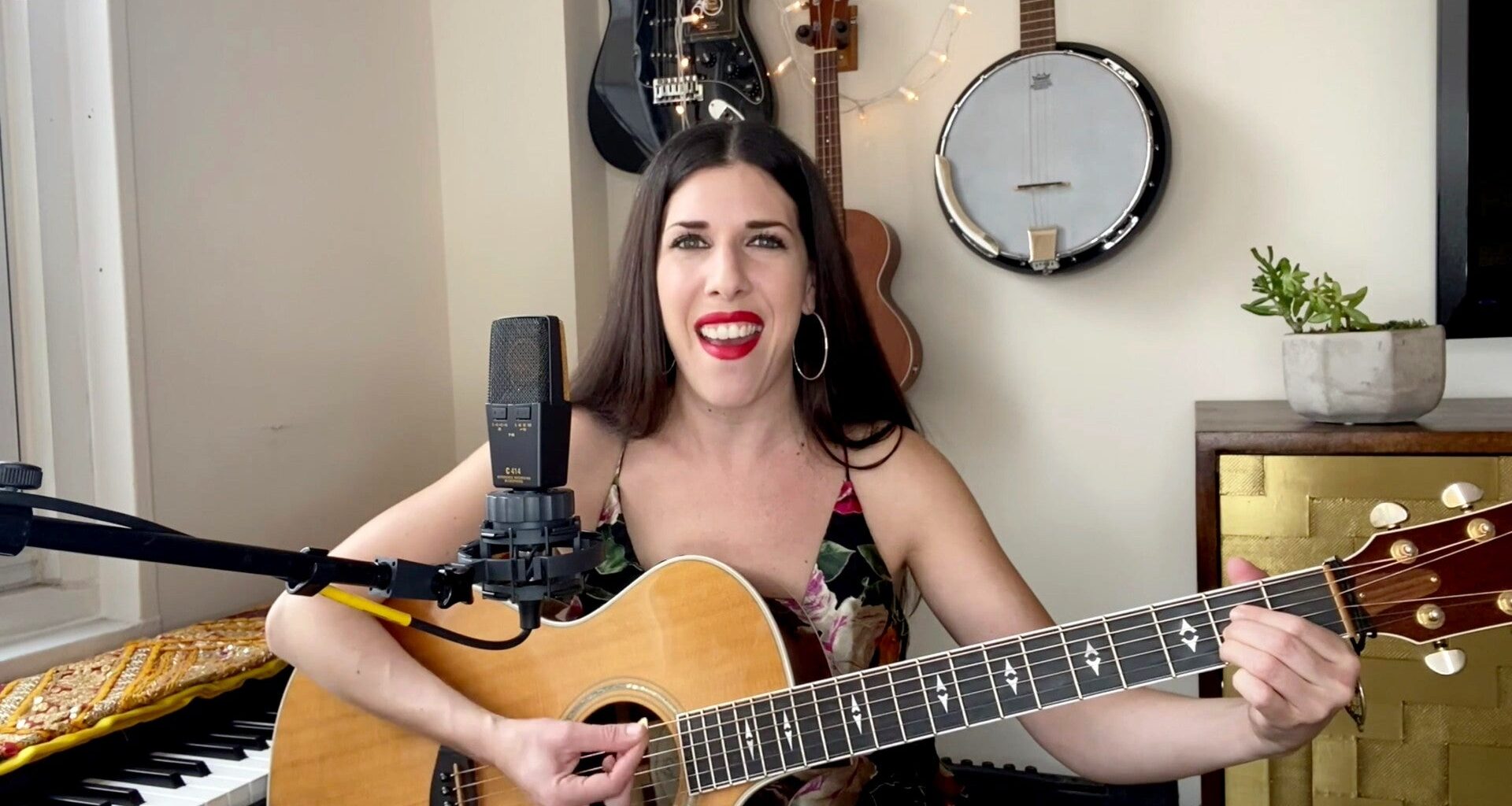
Elana Arian has always associated Jewish music with summer camp.
From the time she was a little kid at Kutz, a summer camp affiliated with the Union for Reform Judaism where her parents were on faculty, to when she was a camper at URJ Camp Harlam, Arian liked singing songs, playing guitar and, eventually, leading music for the entire camp.
“I can’t remember a time when I didn’t connect to Judaism through song sessions in the dining hall,” Arian said. “As a kid, that’s what being Jewish meant to me.”
Now an accomplished composer, prayer leader and faculty member at the Hebrew Union College-Jewish Institute of Religion, Arian tours full-time to congregations across North America. She is also the music director behind a special event: a hootenanny, a communal sing-along of Jewish music taking place at Congregation Rodeph Sholom in Manhattan.
Tickets are on sale now for the Nov. 13 event, both for in-person attendance and via livestream.
“In a moment when fear and division too often drown out harmony, the hootenanny reminds us that song can still unite what the world tries to tear apart,” said Rabbi Ben Spratt, senior rabbi at Rodeph Sholom. “Judaism is strongest when every voice is lifted together — in joy, in resilience, in hope. We’re proud to carry forward the courage of past generations and to shine as a beacon of Jewish pride and belonging.”
The event is a benefit for Eisner Camp and Crane Lake Camp, two URJ camps in the Massachusetts Berkshires. Proceeds from the event will benefit the camps’ scholarship fund, making it possible for more families with financial need to give their children a transformative Jewish summer experience.
The hootenanny will feature a who’s who of Jewish musicians who not only have become regulars on summer camp playlists, but whose work is familiar to tens of thousands of Jews across North America. In addition to Arian, the event will feature Noah Aronson, Michelle Citrin, Dan Freelander and Jeff Klepper (Kol B’Seder), Alan Goodis, Jacob Spike Kraus, Joanie Leeds, Naomi Less, Dan Nichols, and Julie Silver. The artists are donating their time for the hootenanny, and the musicians will be on stage together for the entire show.
“The spirit of this is a group of friends and musicians who are playing together and enjoying themselves,” Arian said.
The is the second hootenanny that Rodeph Sholom, a congregation of approximately 1,900 members, has hosted. The first, in late 2022, came as COVID restrictions were being lifted. More than 650 people attended the concert in person, with roughly 300 more watching online.
“People wanted to sing with each other and wanted to come together,” recalled Shayna De Lowe, Rodeph Sholom’s senior cantor. “Being in that room was pure magic. It reminded us why music mattered so much in that moment — and how much it still matters now.”
Those two ideas form the basis of the hootenanny, which has its roots in American folk music. The legendary singer Woody Guthrie led hootenannies — open-mic-style communal singalongs — in the 1940s, and they were further popularized in the 1960s by such folk luminaries as Joan Baez and Pete Seeger.
Many of the songs to be performed at this hootenanny will stem from the Jewish music revival launched by the late Debbie Friedman, who began writing melodies in the late 1960s and early 1970s at Jewish camps. Friedman’s songs, including her setting for “Mi Shebeirach,” the Jewish prayer for healing, are staples in synagogues across America.
The spirit Friedman ignited still resonates today, carried forward by a new generation of Jewish musicians.
The upcoming hootenanny will feature both the camp-inspired sacred music Friedman popularized — some played by Friedman’s contemporaries — as well as newer Jewish music. In addition, a group of New York-area teens will take the stage as songleaders after participating in a master class the previous evening with Goodis and cantor Rosalie Will.
Watch parties are also planned at congregations in Albany, N.Y., and Boston. At Rodeph Sholom, an in-person after party will follow for those in their 20s and 30s.
The presenting sponsor of the event is the Off-Broadway one-man play “Other,” with New York Jewish Week as media sponsor and numerous congregational partners across New York and New England serving as co-sponsors.
Debby Shriber, executive director of URJ Camps, said the importance of Jewish music at URJ camps cannot be overstated.
“The music is the soundtrack of our lives,” Shriber said. “It’s embedded in everything we do at camp.”
(Tickets for the Nov. 13 hootenanny at Congregation Rodeph Sholom, for the livestream, and for the after party are available.)
Power local Jewish news that matters to you. Your year-end donation ensures we can document the essential stories for Jewish New Yorkers, from City Hall to your local bagel shop.
Jewish stories matter, and so does your support.