
Anne Fernald’s “Her Own Voice: Eight Women Who Rewrote Life and Art” explores the oft-unsung histories of radical women. Through a collection of short biographies, the book spotlights women who dared to forge bold ways of living for themselves and chart new paths in art altogether. Each played a major role in shaping the modernist movement as we recognize it today, and each did so despite the systemic oppression they faced.
Fernald is a professor of English and women, gender and sexuality studies at Fordham. She is an internationally renowned scholar of feminist modernism and early 20th century literature. She has authored numerous academic articles and a 2006 book, “Virginia Woolf: Feminism and the Reader.” She is also the editor of the Cambridge University Press edition of Virginia Woolf’s “Mrs. Dalloway” (2014), the Norton Critical Edition of “Mrs. Dalloway” (2021) and the Oxford University Press’s “Handbook of Virginia Woolf” (2021).
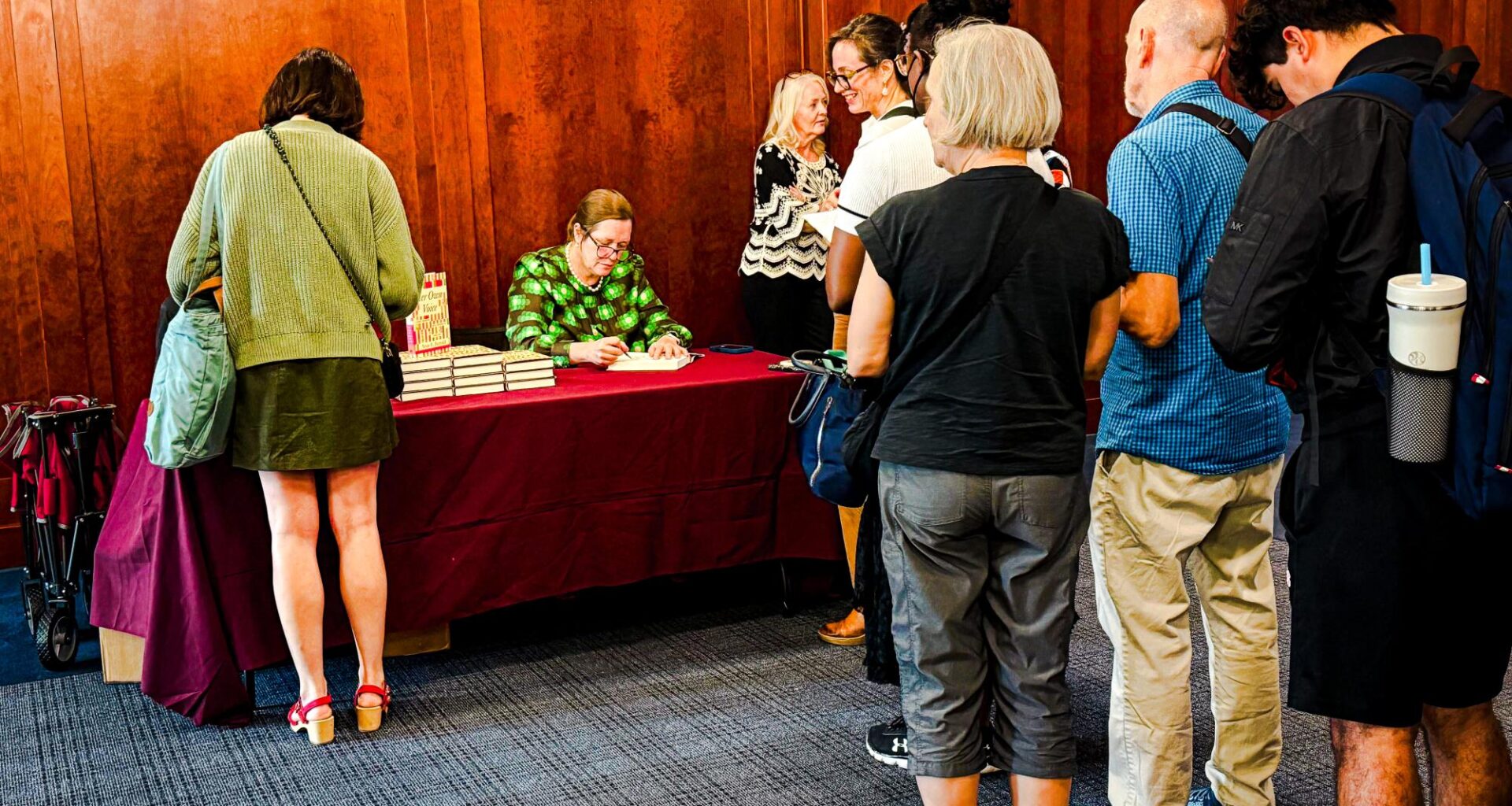
Her new book, published by Beacon Press, is divided into four segments: “Wanderers,” “Rebels,” “Explorers” and “Mentors.” It launched on Sept. 9 in a room packed with Fordham community members and friends from all parts of Fernald’s life on the 12th floor of the Leon Lowenstein Center.
“Her Own Voice” is a clear departure from the bulk of Fernald’s scholarship, which is generally focused on Woolf. But it still began with Woolf.
“It’s kind of incredible to see Seattle, Jersey City, my Woolf life, my academic administration life (and) my Fordham life, first among all, represented in this room,” Fernald said.
The hour-long event was divided into three segments: a reading by Fernald, an interview portion moderated by English Professor Sarah Zimmerman and a question-and-answer portion with the audience.
“Her Own Voice” is a clear departure from the bulk of Fernald’s scholarship, which is generally focused on Woolf. But it still began with Woolf.
In a separate interview with The Observer, Fernald said her friend once told her that Woolf “sucks the air out of the room, and once you start working on Virginia Woolf, she’s such an interesting woman that everyone pays attention to her and only her.”
Fernald began looking for other women who made radical decisions to change the shape of their lives, gradually curating the list through her courses on modernist women.
Fernald wanted to turn this phenomenon on its head. She is a long-time admirer of Gloria Steinem’s practice of always bringing someone with her when she delivered a keynote.
“So I’m like, ‘What if Woolf could bring people with her? And so, instead of having her suck the air out of the room, what if she’s inviting other people in?’” Fernald said.
Fernald’s idea for the book solidified, in part, when a librarian friend of hers asked her to give a lecture on English novelist Sylvia Townsend Warner so that more people would come to know her writing.
Warner was in her 30s and in a dysfunctional relationship with a married man when she fell in love with a woman, joined the communist party and moved to Spain, a radical move for a woman in the 1920s. After learning this in her research, Fernald began looking for other women who made radical decisions to change the shape of their lives, gradually curating the list through her courses on modernist women. She took note of the particularly striking or memorable figures she encountered while teaching.
“These are hopeful stories, but they’re hopeful stories about struggle.” Anne Fernald
It was very important to Fernald to represent a diversity of women from various professional fields, backgrounds and sexualities. She was reminded of the significance of this mission while reading a collective biography where, halfway through the book, the author coyly remarked that all the women in her book were white women from Boston like herself, and perhaps that was the reason why she liked them. Fernald was taken aback.
“Ooh, note to self: Never do this. That can’t be the reason for your set (of women), is that they all look like me and remind me of myself.’ And so, I had to push against that bad book,” Fernald said.
Fernald discussed how, in the years between beginning to write the book (during the second Obama administration) and the time of publication today, the political climate has changed dramatically. A self-described optimist, Fernald said she originally felt that she was writing a book about things getting better. While writing, she had to strike a balance between the triumphalist narratives she was inclined toward and spotlighting the women’s struggles. She found that balance in their persistence after disappointment.
“These are hopeful stories, but they’re hopeful stories about struggle,” Fernald said. “I really need to remind myself of these stories because I’m feeling the barrage of distrust of women, hatred of women, attacks on women, and to remember what the women before us went through and what they were able to achieve and how they persisted is really, really important.”
 Fernald’s new book, “Her Own Voice: Eight Women Who Rewrote Life and Art,” is a collective biography on eight 20th century women who shaped modernism. (LUCIEN FISCHER)
Fernald added that she always thought the stories would be interesting, but did not imagine that “we would be in a place where people would be so hungry for these stories.”
Of the eight women, Harlem Renaissance novelist Jesse Redmon Fauset and English writer Vera Brittain are Fernald’s favorites: Fauset for her endurance and Brittain for her tenacity.
Fernald described Brittain’s rage at the discrimination she faced as a woman and how it is conveyed in her writing. This contradicts the associations with conservative values that Brittain’s proper and feminine image might bring.
Brittain was a conventionally attractive woman, and being pretty was something that she wrote and thought a lot about. This was not mere vanity; Brittain felt that, as an activist representing left-wing social movements, she would be taken more seriously if she looked like the stereotypical portrayal of a nice, respectable young woman — sweet and mild-mannered — according to Fernald.
The politics of fashion and gender expression played out in each of the eight women’s lives in different ways, Fernald explained.
The underestimation of especially feminine women like Brittain really stood out to Fernald.
“Sometimes I, even in my own thinking, still get caught in ‘pretty and vulnerable, ugly and strong.’ And so, ‘pretty and strong’ is always super cool,” Fernald said. “Also, I’m very interested in and affected by all the same pressures of attractiveness that all women are affected by. I’m not proud of that, and I fight it in my own way, but I think about it.”
The politics of fashion and gender expression played out in each of the eight women’s lives in different ways, Fernald explained.
“Warner was not pretty, got over that (and) didn’t think of herself as pretty, but had an entire girlhood with a mom who was disappointed not to have a pretty daughter,” Fernald said. “And that’s scarring.”
Una Marson, a Jamaican activist and writer in 1930s London, refused to straighten her hair and wore colorful clothes that were popular in Jamaica at the time despite the pressures, as a Black woman, to conform to white beauty standards.
“Part of what I’m trying to write about in this book is there are different paths for different people and different performances of your gender that’ll be available to you depending on who you are and what you’re comfortable with and where you are in your life,” Fernald said.
“Changing your mind is so powerful, and it’s so hard to admit, and we have so little grace for it in the political landscape right now, but it’s so necessary.” Anne Fernald
Another message that was particularly important to Fernald from Brittain’s life was how vocal and public she was about changing her mind. Brittain wrote a memoir, “Testament of Youth,” about World War I. As a young woman, she was staunchly patriotic and encouraged her fiance and brother to enlist in the war. Two of her brother’s best friends also enlisted. All four died. After these losses, Brittain spent the rest of her life advocating for peace. Nonetheless, she remained quite generous to her younger self, which Fernald found “deeply, deeply touching.”
“Changing your mind is so powerful, and it’s so hard to admit, and we have so little grace for it in the political landscape right now, but it’s so necessary,” Fernald said.
This concept aligns with Fernald’s broader vision for the book, which is to depict women who made bold decisions about who they wanted to be and what they wanted their lives to look like, in ways that would have been unimaginable for their mothers.
To open the event, Fernald read from her chapter on Fauset. The reading focused on a party celebrating the publication of Fauset’s first novel, “There is Confusion,” at which, to quote Fernald’s electric cold open, “Fauset’s career as a novelist nearly ended the night it began.”
“There is Confusion” served as a major catalyst for the start of the Harlem Renaissance. During the party, a series of male writers, editors and publishers gave speeches diminishing Fauset’s achievements and praising the younger generation of Black writers, a group from which Fauset (at 42 years old) was clearly excluded.
With characteristic humor, Fernald acknowledged the irony of reading about a book launch that went awry.
“I realized when I picked this that I maybe was tempting fate by reading about an event gone wrong at an event, but so far so good,” Fernald laughed.
Fauset struggled for much of her life with being taken seriously as a Black woman in male-dominated literary circles. Prior to the publication of her first novel, she worked as an editor and mentored various younger male writers, helping them not just for the sake of their own personal success, but for the proliferation of Black art, and, more broadly, the advancement of literature itself.
However, she had a real “hunger to be considered as a peer of the younger men whom she mentored,” Fernald said. Fauset also did not shy from standing up for herself throughout her life.
Of the eight women, Dorothy Arzner, a pioneering American filmmaker, stands out as the only one who is not a writer — though she wrote some screenplays early in her career. Fernald decided to include Arzner after she kept coming up in her courses, particularly in conversation with students who are dancers.
 Anne Fernald, Fordham professor of English and women, gender and sexuality studies, is a leading expert on Virginia Woolf.
Fernald began thinking about one of Arzner’s films, “Dance Girl Dance,” which she often teaches. For a “super conventional movie that just looks like a rom-com from the ’40s,” the film is remarkably feminist, Fernald said. It follows Lucille Ball as a burlesque dancer and Maureen O’Hara as a ballerina. Both are in love with a guy “who’s an idiot,” according to Fernald, but neither settles for him, unlike so many romance movies.
“(The film shows that) both ways of being a woman are valuable and powerful and cool,” Fernald said.
Arzner was also one of few openly queer women in Hollywood at the time.
Fernald’s next big project is a biography on Fauset. It is already in the works. Offering a small sneak peek, Fernald shared an exciting moment from her time in the archives, reading Fauset’s half-brother’s unpublished diary. In the midst of pages of mundane journal entries, she found a touching segment written shortly after Fauset’s death.
“(He wrote:) ‘We buried Jessie a couple months ago. This is the first I’ve been able to write about it. How sad that she never had the career that she should have had.’ So that was stunning to read. And such an incredible quote,” Fernald said.
Fernald is looking forward to continuing her work on the biography and a series of coming guest lectures and book events in New York, Florida, California, Washington D.C. and beyond.