
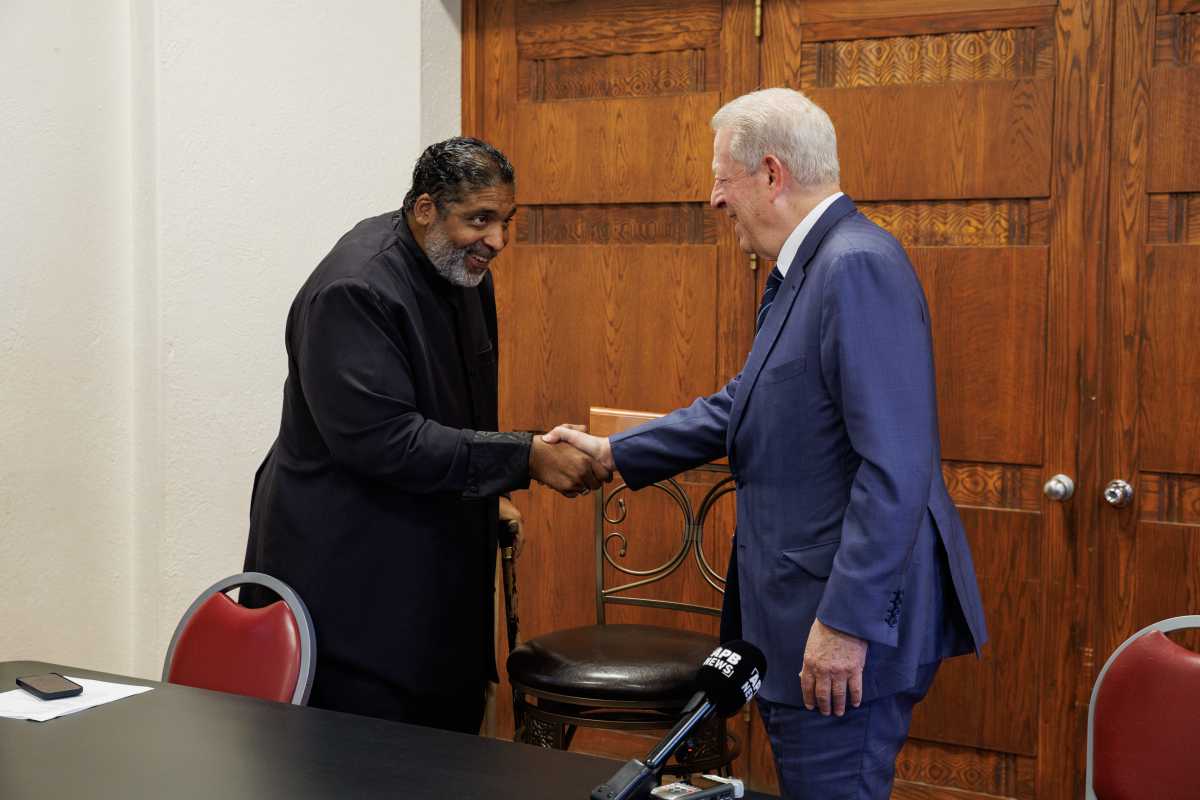
There is something profoundly moving about a man who continues to sound an alarm long after the world has learned to live with its ringing. Across the table from former Vice President Al Gore, I felt the reverence such persistence deserves, along with the sorrow of its necessity. Surely, by now, protecting the Earth that sustains us should require less persuasion. Yet there he was, his familiar Southern drawl carrying the weight of everything we had been warned about, and everything we might still save.
Long before art and the luxury market became the focus of my career, I had imagined a future in politics, worked on Capitol Hill and protested for women’s rights outside the Supreme Court. In those days, the prospect of speaking with the former Vice President would, quite honestly, have made me faint. Many moons later, I somehow found myself across from him, drawn back into that earlier urgency as he tried, still, to shake humanity awake to the reality of the climate crisis. The scope had widened to the conditions of life itself, although beneath it lay a painfully familiar struggle: persuading those with the power to prevent suffering that they have an obligation to do so.
Our press roundtable preceded The Immorality of Inaction: Voicing Truth on Climate, held last week at Riverside Church. Convened by the Center for Earth Ethics at Union Theological Seminary with the Center for Sustainable Urban Development at Columbia Climate School, the gathering brought Vice President Gore together with Bishop William Barber II, Karenna Gore and dean Alexis Abramson. As the city prepared for Climate Week, their conversation gave its vast concerns a human proximity that made abstraction difficult to sustain.
 Former Vice President Al Gore delivers keynote address at “The Immorality of Inaction: Voicing Truth on Climate,” Riverside Church, New York City, September 18, 2026.Photo: Ron Hester
“We’re gaining momentum,” Vice President Gore said of advances in clean energy, while acknowledging how much remained undone. There was something almost painful in the discipline of that hope: the determination to recognize progress without using it to look away from lives already devastated. Listening to him, I began to feel how much perseverance asks of a person who understands the consequences of surrender.
A surrender at this stage is deadly. Nepal’s August 26 collapse of rock and glacier ice gave the warnings a terrible immediacy. World Weather Attribution identified warming as a likely destabilizing influence, while leaving its precise role unresolved. In this case, uncertainty could scarcely excuse indifference to those left amid the wreckage.
“Morality is measured in policy”
When Bishop Barber spoke, the room fell silent. His sonorous authority recalled the clergy’s capacity to offer sanctuary and sanity, while asking us to admit another person’s suffering into the shelter of our own concern. The Poor People’s Campaign co-chair had described climate inaction as “political violence” in the announcement, citing its disproportionate burden on poor and low-wage families. At the roundtable, his invitation to be “scared to life” made fear feel capable of becoming useful, provided we allowed it to move us toward one another.
When I was given the final question, climate, democracy and our tolerance for falsehood had become inseparable in my mind: “How do we restore the authority of truth without allowing truth itself to become merely another partisan identity?”
Vice President Gore paused, initially noting that the subject appeared in his prepared remarks, then turned to authoritarianism and Theodor Adorno. His description of “the transformation of all questions of truth into questions of power” named the danger with unsettling economy. Once allegiance determines what we permit ourselves to acknowledge, defending even an obvious falsehood can become a demonstration of loyalty. Reality becomes negotiable precisely when our survival requires us to respect it.
 Bishop William Barber II delivers a keynote address at “The Immorality of Inaction: Voicing Truth on Climate,” Riverside Church, New York City, September 18, 2026.Photo: Ron Hester
Bishop Barber carried the argument toward conscience, finding the categories of left and right “too puny” for the obligations before us. He invoked justice, the general welfare and his faith’s foundations of “love, justice, mercy, grace.” Perhaps resistance to anti-intellectualism begins in just such a willingness to be inconvenienced: to let evidence disturb our loyalties, and another person’s vulnerability alter what we are prepared to defend.
By 3 pm— Riverside Church was full, and the intimacy of the roundtable opened into a larger communion. Spiritual song moved through the gathering. The Indigenous participants brought a particular grace, their composure making the urgency more arresting, until Oren Lyons, faithkeeper of the Turtle Clan of the Onondaga Nation, looked over the crowd and spoke.
“Before you came over the water … it was peaceful.”
A light chuckle passed through the church. For me, the guilt landed with the dead weight of a padlock. His words evoked a Haudenosaunee tradition organized around peace, while exposing the grotesque confidence with which conquest had made other peoples’ territories available, their knowledge expendable, their lives subordinate to someone else’s ambitions. What frightened me most was the endurance of that entitlement: the permission to take, to exhaust, to impose, and still congratulate ourselves on our progress. Suddenly, the distance between historical dispossession and contemporary ecological injury felt terribly short.
Through testimony and song, with all the insistence of trumpets, horns, red flags and pleas, the afternoon returned us to empathy and its demands. Beneath the scholarship, the spiritual authority and the grief ran an almost unbearably tender request: please, stop harming what sustains us.
The Earth feeds you, me, all of us. Every cultivated pleasure, every painting we stand before, every future we imagine for someone we love, depends upon its continuance. To spend a life celebrating beauty is also, surely, to accept responsibility for the conditions that allow it to exist. I had come into that room with reverence; I left understanding how much it required of me.