
 USA TODAY Network via Reuters Connect
Royalty is all about taking a select few and placing them upon a pedestal for adoration and worship by the faceless masses. And often, when a team wins a title, it happens as a result of star players doing what star players do — making big plays at pivotal moments and swaying outcomes with jaw-dropping feats. But as the championship series of the WPBL’s inaugural season progressed from one game to the next, the stories behind each result weren’t written by the team captains or the players with the most impressive regular-season stats. Rather, a varied cast of unlikely heroes took the stage each night and managed to put on a unique rendition of a show we’ve all seen dozens of times before. We’re all familiar with how a playoff series typically unfolds, and we’ve even seen how it’s gone when these exact teams faced one another during the regular season. And yet, a band of unlikely heroes with representation from both the Los Angeles Queens and the San Francisco Firebells came together to offer us something completely unexpected.
Below we’ll walk through the five-act play that was the WPBL’s championship series, which went the full five games and which the Queens ultimately won, and highlight the unlikely heroes from each game by describing what they did and why their accomplishments were so improbable.
Game 1: Queens 7, Firebells 6
Because their first-round series with the Heights went the full three games, the Queens had just one day off prior to Game 1 of the championship series on Wednesday. Comparatively, the Firebells’ last game was the previous Friday, since their series against the Hunters began one day prior to Queens-Heights and San Francisco dispatched of Boston in a two-game sweep. Michelle Roche — the Queens’ most effective starter — threw 3 1/3 innings in Game 3 against the Heights, and Ayami Sato — their only other pitcher with more than one start during the regular season — threw two innings in Game 3 after covering three innings in Game 2. Out of necessity, Game 1 was a bullpen game for Los Angeles, while the Firebells got to line up their optimal rotation, which meant no. 1 starter Kelsie Whitmore took the ball for San Francisco in the series opener.
Below is a comprehensive accounting of the pitching lines for Queens pitcher Jamie Mackay heading into the championship series.
Jamie Mackay Pitching Game Log
Date
Opponent
IP
H
R
ER
BB
SO
8/5/26
Boston Hunters
1.0
0
1
1
1
1
8/8/26
San Francisco Firebells
2.1
3
3
1
2
1
8/14/26
San Francisco Firebells
3.2
10
8
8
1
3
8/21/26
San Francisco Firebells
1.1
2
1
1
1
2
9/3/26
New York Heights
2.1
10
11
7
1
2
9/12/26
New York Heights
2.0
3
1
1
1
1
Includes Semifinals
Mackay’s line in Game 1: 5 2/3 IP, 4 H, 2 R, 2 ER, 1 BB, 5 SO.
Pedantically, I’m not sure it still counts as a bullpen game if the team only uses two pitchers. In retrospect, utility player and occasional pitcher, Amira Hondras started the game in something of an opener role, pitching an inning and a third and facing 10 batters before turning the game over to Mackay, who went the distance from there. It looks like a pretty tidy game plan from where we currently sit, but Queens manager Eric Young Sr. told reporters after the game that he was managing one inning at a time, checking in with Mackay every step of the way to make sure she was good to stay on the mound.
Mackay continued to assure her manager she could keep going back out there, but at some point, it had to start getting tough for Young to believe her. To this point in her WPBL career, she’d never pitched more than four innings, and her longer outings were the ones in which she got tagged for a whole mess of runs.
You Aren’t a FanGraphs Member
It looks like you aren’t yet a FanGraphs Member (or aren’t logged in). We aren’t mad, just disappointed.
We get it. You want to read this article. But before we let you get back to it, we’d like to point out a few of the good reasons why you should become a Member.
1. Ad Free viewing! We won’t bug you with this ad, or any other.
2. Unlimited articles! Non-Members only get to read 10 free articles a month. Members never get cut off.
3. Dark mode and Classic mode!
4. Custom player page dashboards! Choose the player cards you want, in the order you want them.
5. One-click data exports! Export our projections and leaderboards for your personal projects.
6. Remove the photos on the home page! (Honestly, this doesn’t sound so great to us, but some people wanted it, and we like to give our Members what they want.)
7. Even more Steamer projections! We have handedness, percentile, and context neutral projections available for Members only.
8. Get FanGraphs Walk-Off, a customized year end review! Find out exactly how you used FanGraphs this year, and how that compares to other Members. Don’t be a victim of FOMO.
9. A weekly mailbag column, exclusively for Members.
10. Help support FanGraphs and our entire staff! Our Members provide us with critical resources to improve the site and deliver new features!
We hope you’ll consider a Membership today, for yourself or as a gift! And we realize this has been an awfully long sales pitch, so we’ve also removed all the other ads in this article. We didn’t want to overdo it.
In case you didn’t read all that, here’s the short version. Membership includes:
✓Ad-free browsing
✓Unlimited FanGraphs & RotoGraphs articles
✓Historical & platoon projections
✓Leaderboard & player-page stat heatmaps
✓One-click data exports
✓Customizable player-page dashboards
✓Dark & Classic site modes
✓Weekly Members-only mailbag
✓FanGraphs Walk-Off, your year in review
✓Optional homepage photo removal
✓Gift articles to non-members
So what was different in Game 1?
During the postgame press conference, Mackay told the media she felt as though her pitching motion had been lacking what she referred to as “whip and snap” (not to be confused with “bend and snap” — which is very different). To tackle the issue, Mackay, who just began her last year at the University of South Carolina, set about doing a little research in the manner that any good college student would. “I was looking some stuff up on TikTok,” she said. “I came across this account, I think his name’s Coach Merrill out of Arizona. He had this good drill that I really liked.” And so she gave it a shot. “It felt really, really good,” she said after her Game 1 win. “It’s the best I’ve felt.”
Some players are beholden to their routine and avoid tweaking their mechanics much during the season, others sharpen up their deliveries between playoff series using a drill they learned on TikTok.
On the other side of the ball, Queens shortstop Caitlin Eynon was quietly one of Los Angeles’ three or four best hitters during the regular season. But because she got off to a slow start and didn’t hit for a ton of power or steal any bases, she was easy to overlook. After hitting .285/.312/.285 in the first half of the season, she slashed .458/.500/.792 in the second half, and in the postseason, she was one of her team’s top hitters, with a .440/.516/.560 line.
In Game 1, Eynon went 3-for-3 with a sac fly and contributed to three of the five innings in which Los Angeles scored a run. After Firebells second baseman Amanda Gianelloni put San Francisco up 4-1 with a grand slam in the bottom of the second inning, in the Queens’ half of the third, Eynon came to the plate with no outs and drove in Ashton Lansdell with her team’s third consecutive single. Whitmore got the next three batters, and the Queens were held to just that one run in the inning, but Eynon’s RBI single was a crucial step toward eventually retaking the lead.
In the bottom of the third, the Firebells scratched across the only two runs allowed by Mackay on singles from shortstop Joely Leguizamon and center fielder Ela Day-Bédard. The Queens got one run back in the fourth when shortstop Ayuri Shimano drove a single into the gap in right-center to score catcher Maggie Foxx. In the fifth, with the Queens trailing 6-3, Eynon hit her third single of the game, then came around to score a couple batters later when first baseman Sarah Edwards shot a single through the right side. The Queens pulled within one shortly thereafter, when left fielder Isabella Villareal scored from third on an errant backpick at first by Whitmore. But the comeback wasn’t complete until the sixth. Lansdell tied the game with a double that scored center fielder Mo’ne Davis and allowed Shimano to advance to third. Then a sac fly from Eynon put the Queens up 7-6.
Even with Lansdell in scoring position and just one out, Los Angeles failed to pad its lead with any insurance runs. As the Firebells came to hit in the bottom of the seventh of a one-run game, all eyes were on the bullpen, expecting to see closer Meggie Meidlinger warming up. But Young stuck with Mackay, who closed out the win. In a game decided by such a narrow margin, the Queens could not have earned the win if not for Eynon’s late-breaking ability to consistently put the ball in play and Mackay’s TikTok-inspired fix that allowed her to throw more quality innings than ever before.
Game 2: Queens 11, Firebells 7
Foxx was a serviceable hitter for the Queens during the regular season (.333/.440/.476), but she faded pretty severely in the second half, logging just three hits over her final 23 plate appearances, though she did work opposing pitchers for six walks over that span. Then, during Los Angeles’ first-round series against the Heights, Foxx was largely forced out of the lineup in favor of hotter hands. After sitting Game 1, she caught the two innings that Mackay pitched in Game 2, but when Mackay came off the mound, she took over for Foxx behind the dish. As for Game 3, Foxx was unlikely to do more than pinch-hit, until a knee injury befell second baseman Samaria Benitez. Hondras filled in for Benitez at second, while Foxx replaced Hondras in right field. With Benitez now done for the season, Foxx resumed regular playing time. She singled and scored in the fourth inning of Game 1 of the championship series, but otherwise had a quiet day at the plate.
In Game 2, Foxx flipped the script entirely. She opened the scoring for the Queens with a solo shot in the second. She worked a walk in the fourth, then came in to score when reliever Peyton Coria bobbled a slow roller on the first base side of the mound. Later in that same inning, Foxx lined an RBI single to center, then scored from first on a double from Hondras. Foxx singled again in the sixth, but was left stranded. She made her first and only out of the game on a fly ball to center in the seventh.
Shimano was the Queens’ other primary offensive threat in Game 2. A late addition to the roster due to visa issues early in the season, Shimano didn’t appear in a game for the Queens until August 21. She spent the final eight games of the season getting her footing and batting a solid, but unremarkable (at least in this league) .300/.464/.350 with one double, no home runs, and zero stolen bases. Shimano also logged 8 2/3 innings on the mound, pitching to a 5.65 ERA with eight strikeouts — numbers strong enough to make her the team’s third- or fourth-best pitcher, at least by results.
Batting leadoff in place of Benitez, Shimano struck out to start Game 2 but still reached base safely as the final strike got away from Firebells catcher Samantha Gutierrez, who hadn’t caught in a game since August 30 due to an eye injury sustained during infield practice. The dropped third strike was the start of a very long day behind the plate for Gutierrez. Los Angeles seemed to suspect Gutierrez might be sporting a little rust and was primed to take advantage. Shimano stole three bases on the day (the team swiped seven bags total), including one in the first and another following a single in the third, but the Queens couldn’t cash in either time. In the fourth, Shimano hit her second grand slam of the postseason (her first was during Los Angeles’ banger of a Game 3 against New York) as part of a 10-run inning that put her team on top for good. She followed up with another single and a stolen base later on, but in a game where the Queens scored 11 runs, they also managed to leave 10 runners on base.
An honorable mention among the unlikely heroes from Game 2 goes to Hondras, who, like Foxx, struggled at the plate to close out the regular season. She contributed two stolen bases and a pair of hits on Thursday, including an RBI double.
Game 3: Firebells 10, Queens 5
Niki Eckert got the start for the Firebells in Game 3 with her team facing quick elimination. Depending on where you slot in Jill Albayati, who pitched to a 1.40 ERA over just 10 innings in her injury-shortened season, Eckert was either San Francisco’s second- or third-best pitcher during the regular season. For her part, Eckert logged a 5.63 ERA over 18 2/3 innings with 13 strikeouts. The Firebells could consistently rely on Eckert for at least three innings whenever she took the ball. The only time she pitched fewer than that was on August 2, when she entered in relief of Whitmore during San Francisco’s first game of the season.
But while she reliably ate innings for the Firebells, her results became less reliable as the season wore on. Over her last two starts of the year, Eckert allowed nine earned runs in seven innings on 10 hits and four walks with four strikeouts. Then, her shaky results carried over into the postseason. During Game 2 of Firebells’ first-round series against the Hunters, Eckert relieved Albayati in the third inning with two out and the bases loaded. She left a pitch up to DH Edith De Leija, who lined an RBI single to left. Next, she ran a full count against second baseman Suzuka Yamamoto, but got the strikeout to end the inning. She faced the minimum in the fourth but needed 19 pitches to do it. In Eckert’s final inning of work, she surrendered a hit and three walks and threw two wild pitches — the second of which allowed a run to score. Though that run was the only one charged to Eckert, she was too all over the place to leave her out there for another inning, forcing manager Matt Williams to go to Liz Gilder, the newly designated postseason closer, in the sixth. Since the Firebells won Game 2 and finished the sweep, they earned four days off for the entire pitching staff to rest. Therefore, Eckert’s wildness turned out to be inconsequential, but in the moment, Williams probably would have preferred to get at least one more inning from her.
But in a longer series, there’s nowhere for a struggling pitcher to hide. And besides, for as erratic as her command had been, she was still getting enough chase to limit the damage. Simply, she was Williams’ best available option for Game 3.
Provided with a 3-0 lead before she even took the mound, Eckert gave up a leadoff walk to Shimano, and of the 20 pitches she threw in the inning, 11 were balls. Still, she got outs from the next three batters to preserve San Francisco’s lead. She allowed a couple of singles in a scoreless second and worked fewer deep counts. Shimano again led off with a walk in the third. Eckert responded by getting a quick out from Lansdell on a liner to second, but then Mackay yanked a fastball on the outer half over the left field wall. Still, those two runs were the only two Eckert allowed over four innings. By the time her day was complete, Eckert had tied her longest outing of the season and posted her best line (4 IP, 2 ER, 5 H, 2 BB, 2 SO) since an August 22 start against the Hunters.
Thanks to the entire San Francisco lineup, Eckert did have the luxury of pitching with a lead, but that’s fairly normal for the league’s top offense. The unlikely hero contributing to the 10-run outburst was Leguizamon. For most of the regular season, she looked lost at the plate. Instead, the shortstop earned her playing time by providing some of the league’s best defense at a premium position, and the rest of her team’s lineup more than compensated for her light hitting. She finished the regular season tied for second in total strikeouts with 11 and led the league in strikeouts looking with six. Overall, she hit .309/.387/.364, whereas her team collectively slashed .376/.478/.563. Her end to the regular season painted an even bleaker picture. Over San Francisco’s final eight regular-season games, Leguizamon posted a .258/.387/.323 line.
Her performance at the plate seemed to really bottom out during the first round of the postseason. She stranded too many baserunners and her timing was off; she was easily out-maneuvered and clearly second guessing her own swing decisions.
But after showing signs of thawing out earlier in the series, Leguizamon broke out of her funk and made her mark on Game 3 in more ways than one. Playing with a gnarly black eye she acquired in Game 1, when she caught a throw from right fielder Skylar Kaplan with her face rather than her mitt (she got checked out and was able to stay in the game), Leguizamon led off the second inning of Game 3 with a solo shot to left, extending her team’s lead to 4-0. The Firebells tacked on another three runs in the inning, and Leguizamon contributed a double to San Francisco’s offensive showing later in the game. Almost every Firebell in the lineup recorded two hits en route to a 10-6 victory, but Leguizamon was the only hitter with two extra-base hits. And she was definitely the only one to make a little extra cash off her performance.
“He owes me $200,” Leguizamon said during the postgame presser in reference to her dad, who was in attendance at the game. “Ever since I was little, he said if I hit it over the fence, I get $200.” Now, $200 per home run sounds like it could get expensive, but later in her comments, Leguizamon revealed that her long ball in Game 3 wasn’t just her first home run in the WPBL. “No, it was my first one in life,” she admitted. She’s not sure if the deal will continue for subsequent dingers, but she did later confirm on her Instagram story that the $200 for the initial home run was paid in full.
Game 4: Firebells 17, Queens 4
Leguizamon kept her hot streak alive in Game 4 by going 4-for-4 with a double and a sac fly as the Firebells handed the Queens their hindquarters in a 17-4 drubbing. After the game, she told reporters that playing in two do-or-die games had helped simplify her inner monologue at the plate. “I’m not overthinking,” she said. “I’m just in a competitive mindset and not letting any strategy get in my head.” With her team’s back against the wall, she gained the clarity necessary to strip away all the non-essential details clouding her judgment and causing her to second guess herself.
Two other Firebells tallied four hits on Sunday. Albayati had a strong regular season at the plate, but she missed the last few weeks with a hamstring injury and had yet to really round back into form in the box until she went 4-for-5 in Game 4. The other member of the four-hit club was left fielder Jua Park, who was 3-for-17 across her first five postseason games, then went 4-for-4 with two doubles and a hit-by-pitch in Game 4. It’s easy to ignore a hitter like Park on a team with Whitmore, Kaplan, Jorge, and Andréanne Leblanc, but without much fanfare, Park hit a respectable .400/.520/.450 during the regular season. And though her presence may feel quiet to outside observers, her teammates could not disagree more.
“I love that girl,” were the first words out of Whitmore’s mouth when asked about Park during a media availability following the final game of the regular season. She then went on to describe how one of the first things she learned about Park — who is from Korea — was that she had been teaching herself to speak English heading into the season. “When I heard about that I was like, ‘Wow, she’s already winning as a teammate,’” Whitmore said. “She’s such a light on the team, just talking to her, being around her, and she’s a grinder. She gets after it.”
“Jua has swag. Like, she has the best aura,” Gianelloni explained when it was her turn to weigh in. “We think that she’s secretly a model in Korea and she’s just not telling us.”
Park earns her playing time, in part, by being able to fill in wherever Williams needs her. The same is true for Day-Bédard, who plays center whenever Whitmore is on the mound and covers the corner outfield positions as needed. And like most players in the league, Day-Bédard was also down to take the mound for an inning or two in relief. She made five appearances totaling eight innings during the regular season with a 15.75 ERA. Her numbers were heavily inflated by two rough outings against the Heights, where she allowed 10 earned runs across 3 2/3 innings. Day-Bédard faced the Queens just once prior to the playoffs back on August 21, pitching two innings and allowing one run on two hits in a 17-3 victory.
But though Day-Bédard owns an encouraging, albeit limited, track record against Los Angeles, she probably wasn’t a huge factor in San Francisco’s game plan until after reliever Rosi Del Castillo was injured while fielding a groundball during Game 1. With Del Castillo out for the series, Williams went to Day-Bédard to be the stopper in the midst of the 10-run onslaught from the Queens in the fourth inning of Game 2. Albayati started the inning and allowed the first four batters to reach. With two runs already in, Coria took over in relief and was able to get one out, but in addition to one run scoring on an error, she also issued two walks and gave up a grand slam. Day-Bédard entered on 12 days rest and got Edwards to drive home Lansdell on a fly out to left. Back-to-back hits by Foxx and Hondras scored two more runs (one unearned). One hit-by-pitch and a batter’s interference call later, and the inning was mercifully over. Day-Bédard stayed in the game and ate another two innings without letting the Queens tack on any additional runs.
Encouraged enough by Day-Bédard’s performance, Williams made the call to go to her again in relief in Game 4. Whitmore made the start for San Francisco, but after throwing five innings in Game 1 on Wednesday, when Williams saw Whitmore labor through 32 pitches and allow three runs (two earned) during her second inning of work on Sunday, he didn’t want to risk letting her pitch any deeper in the game. Day-Bédard paid off her manager’s decision by absorbing three innings and allowing just one run on three hits and two walks. She struggled to locate her pitches at times and had to pitch through traffic on the basepaths as a result, but she kept the Queens from rallying back while also posting her longest outing of the season. With 5 2/3 innings pitched across two games, Day-Bédard nearly matched her regular-season innings total in a single series, while her 1.24 ERA checks in a full order of magnitude lower than her regular-season mark.
Game 5: Queens 2, Firebells 0
Hondras got an honorable mention in Game 2, but she gets a full mention in Game 5. Not for anything she did at the plate (she was 0-for-3 with a strikeout), but for her contributions in the field. After Game 4, Young told reporters, “The team that has the least amount of errors on Tuesday is the team that’s going to win.”
As far as errors go, prior to the championship series, the Firebells had bested the Queens every step of the way.
Error Rates
Regular Season
Head-to-Head
Semifinal Round
Championship Series
Team
Fielding %
E
E/G
E
E/G
E
E/G
E
E/G
Firebells
.942
27
1.8
4
0.8
1
0.5
14
2.8
Queens
.933
32
2.1
9
1.8
4
1.3
8
1.6
Head-to-Head = during the regular-season series between the Firebells and Queens
When Young posted his Game 5 lineup, it was clear he was backing up his comments by rolling with a defense-forward alignment. At times during the regular season, he’d experimented with different defensive alignments and moved players off their natural position to make sure his best bats were in the lineup. Foxx got reps in the outfield, Shimano slid over from short to second, Lansdell played some right field, Eynon tried her hand at the hot corner, Hondras converted from deft second baseman to speedy outfielder. But on Tuesday, he prioritized defense over everything, which meant going with his strongest infield configuration. Hondras returned to second base after spending most of the postseason in right field.
Heading into a game, there’s no way for defenders to know how many times the ball might find them. Hondras set her season high for total chances in a single game at seven against the Heights on August 29. She converted all seven. That high-water mark held all the way through the playoffs. That is, until Game 5, when she got eight total chances and went a perfect 8-for-8. In a more typical WPBL game, where each team scores eight or more runs and the margin of victory is rarely fewer than four runs, an error is rarely a backbreaker. But in a winner-take-all game, where the pitching reserves are depleted and the lead is never more than two, an error changes the entire complexion of the game (both runs scored by the Queens were downstream of errors committed by the Firebells). Hondras didn’t make an error at second all season (her only two errors came while she was on the mound, and both occurred during the same outing). And despite walking her toughest gauntlet of the year, after not playing a full game at the position since late August, she was able to keep her stat sheet clean when it mattered most.
Aside from the two runs that spawned from errors, the Queens really didn’t get much going at the plate. The team combined for three walks, while Davis logged both of Los Angeles’ two hits. The crucial knock came in the third inning with runners on first and second and no out. Davis pulled her hands in and lined a fastball on the inner half over the head of Ayaka Yamamoto at third for a single. Shimano followed Davis to the plate and yeeted a grounder at Leblanc, who knocked it down, but the ball clanged off her glove; by the time she recovered, a run had scored and she didn’t have a play anywhere else. With the bases loaded and still no out, Lansdell registered an RBI on a fielder’s choice, thereby driving in what would be the game’s final run.
Considering her .231/.333/.308 slash line during the regular season, Davis’ owning both of her team’s hits in a decisive Game 5 victory is the type of plot development a fiction writer wouldn’t even attempt for fear of its seeming too contrived. Davis went from leading off to start the season to hitting out of the nine-hole by year’s end. But though she hasn’t produced much on offense, she has a better explanation for her woes than most slumping hitters. Prior to WPBL tryouts, it had been six years since she had last played competitive baseball, so she’s had to re-immerse herself in the sport while playing at the highest level. She’s aware that it hasn’t exactly gone swimmingly, but she credits her teammates and coaches for making sure she didn’t give up. “I’ve struggled this year, but every single day they have given me the confidence that I needed,” Davis said after the game. “They’ve talked to me, they keep me in the game and keep me in the season and not letting go.” She also noted that she needed that support system and a manager like Young, who allowed her “to just go out there and find myself day in and day out.”
Prior to Game 5, she said the process for finding herself that day involved a trip to the cage with Young and Queens assistant coach Pete Romero. Together they “just kind of worked on feeling comfortable in the box,” and ultimately, she felt comfortable enough to scrape together a pair of hits on a night when offense was at an extreme premium. As manager Matt Williams put it, “A prevailing wind was blowing in,” making life even more difficult for hitters.
The other factor making life difficult for hitters was Sato, who started for the Queens and threw the league’s first complete game, as well as its first complete game shutout. On the surface, Sato is the opposite of an unlikely hero. She has pitched for Team Japan in six iterations of the Women’s Baseball World Cup, and in the process was named MVP of three consecutive tournaments. She has a track record of success on big stages.
“I’ve been there on that International stage to see what she does in those gold medal games and when everything’s on the line,” Meidlinger told reporters after Game 5. Meidlinger competed for Team USA during several of the WBWC tournaments that Sato dominated. “I’m not surprised about this performance,” she continued. “I’ve seen her do it time and time again.”
Sato, on the other hand, had a much different response to her performance. After being presented with the trophy for winning MVP of the championship series, she looked directly into the camera and shouted, in English, “I’m so surprised!”
Both reactions are fair. Sato’s résumé will always make her sound like she has superpowers, but also, she is 36 now, and the last time she was named MVP of the WBWC was back in 2018. And as I detailed in my recap of the semifinal round, she hasn’t exactly been lights out this season for the Queens. Earlier in the series, she allowed five runs on nine hits and four walks across four innings. Heading into Game 5, I thought the Queens might be lucky to get two or three innings from her and then spend the rest of the game walking an inning-by-inning tightrope until they could reasonably hand the ball to Meidlinger. Instead, Sato pitched all seven innings and allowed zero runs on five hits and zero walks with one strikeout. She needed just 71 pitches.
According to Sato, the key to her heroic performance was reminding herself that she didn’t need to play the hero. She had an entire team backing her up. Through her interpreter, Sato laid out her thought process. “Each person has their own role to play, and when all of those different roles come together, that’s how a team wins. I think teamwork and everyone fulfilling their role is one of the most beautiful things about baseball,” she said. “For me, it wasn’t about [being] my turn to make a great play or feeling like I needed to be the stopper. I simply wanted to give my best in whatever role I was given.”
And that full-team effort was felt by the opposition. “We smoked the ball, but it was at them and they made great plays,” Gianelloni said, referring to San Francisco’s inability to generate offense. Young needed Sato to cover as many innings as possible, and she knew she wouldn’t be able to do that if she spent the entire outing hunting strikeouts. So instead, she put the defense behind her to work, and her teammates were happy to oblige.
“We had her back,” Davis said. “And no matter what goes on, we’ll always have her back.”
As Davis finished that sentiment, the mic caught Lansdell chiming in to say, “That’s right!” Later Lansdell explained why she feels her team has such a strong bond. “I think this team is full of underdogs,” she said. “I think this team is full of people — besides Sato — who have been there in those moments and been so close, but haven’t gotten there all the way, and all of us being here together, that feeling is what made us want this more than anyone else.” I suppose if Lansdell is refusing to call Sato an underdog, then I’ll have to concede that she’s the one player ruining my otherwise tidy narrative, but I digress.
“I’ve always loved an underdog, and this team is full of underdogs,” Lansdell continued. “And I don’t think anyone thought that the Queens would win the championship this year, and here we are. So that’s just another underdog moment right there, and I think that’s what Queens baseball is.”
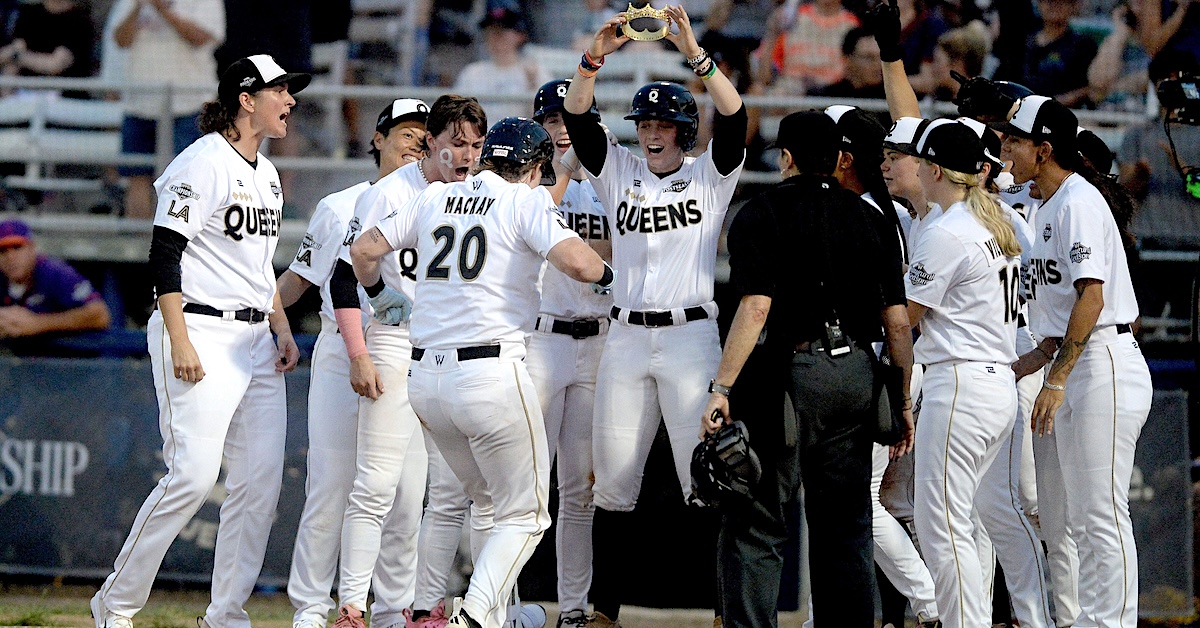
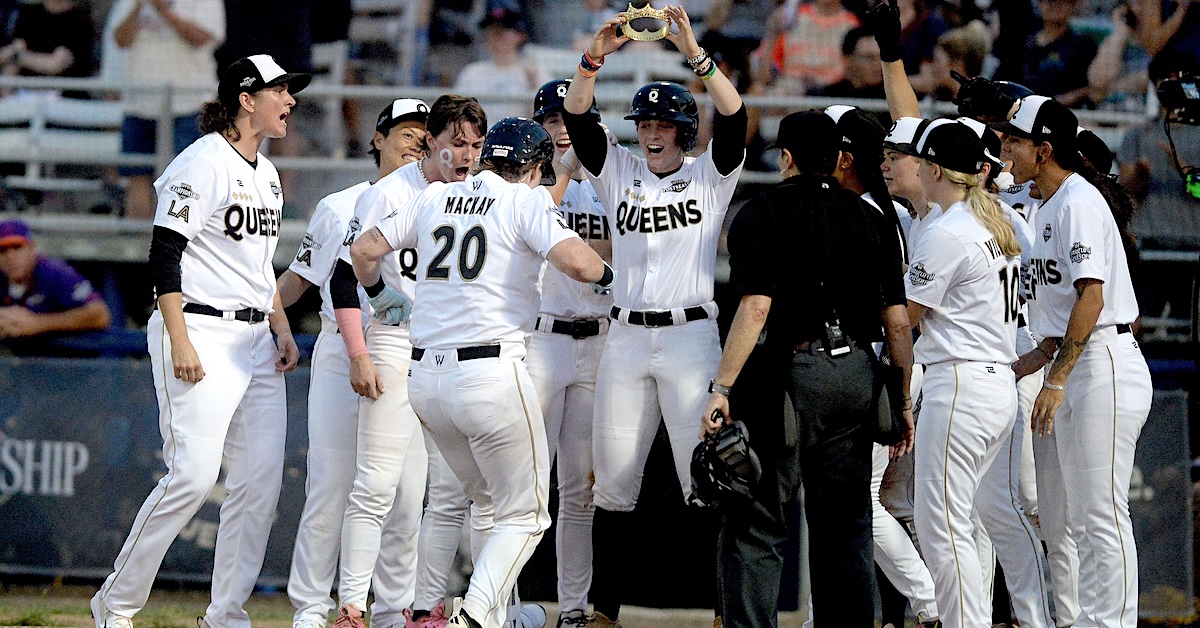
I concluded my recap of the Queens’ first-round series against the Heights by acknowledging the team’s evolution and saying yesterday’s Queens are not today’s Queens. Well, today’s Queens are baseball royalty. Today’s Queens are champions.