
Among the 100-or-so theatrical productions I have seen while at Fordham, few have impacted me as profoundly as Max Wolf Friedlich’s “Job” (Broadway, 2024) with its constant suspense, brilliant twist and hilarious dialogue. When asked about the best play I have seen, I point to that show.
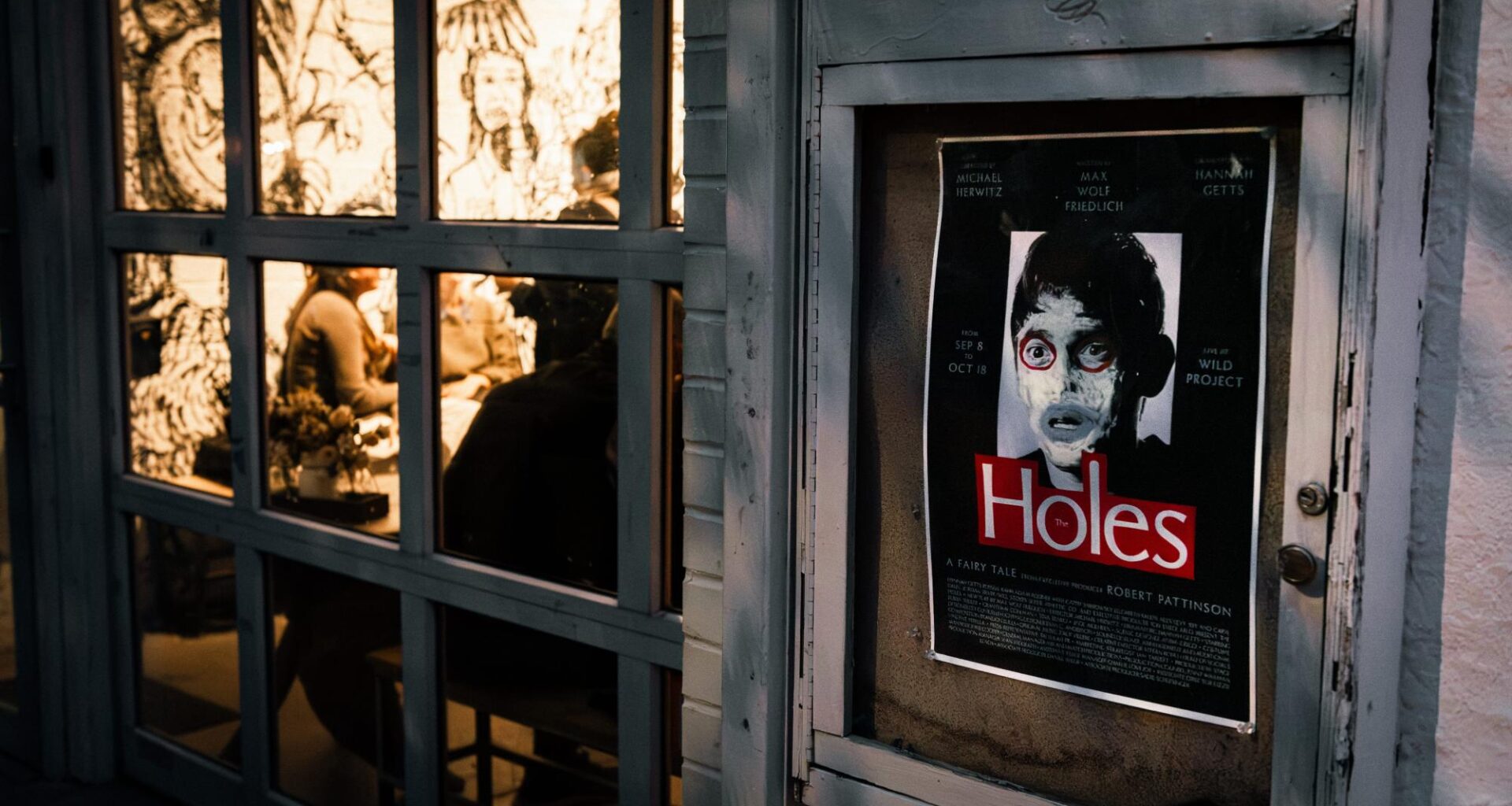
The minute “The Holes,” Friedlich’s new off-Broadway play at The Wild Project in the East Village, was announced, I swiftly purchased a ticket, hoping it might hit similar notes as those in my most-cited play.
Beyond sharing a playwright, director (Michael Herwitz) and dramaturg (Hannah Getts), “The Holes” and “Job” have in common a small cast, a skillful use of technical elements like sound and set and a sense of absurdity in their concept and writing. However, while the off-kilter story of “The Holes” offers audiences similar moral hypotheticals as “Job,” the play lacks its predecessor’s pacing and payoff.
In “The Holes,” Joey (Bubba Weiler) must rejuvenate his dying father’s struggling bar in an increasingly gentrified, post-COVID Kingston, New York.
In “The Holes,” Joey (Bubba Weiler) must rejuvenate his dying father’s struggling bar in an increasingly gentrified, post-COVID Kingston, New York. Drowning in debt and straining to finish a semester of college after a decade away, Joey contends with regulars like his high school classmate Carson (Jack Mulhern) and Martha (Tina Benko), a broke friend of his father’s who avoids settling up. To both, the bar is an institution.
The first moments of the play reveal that some visit the bar seeking more than a beer, though.
Wesley (Grantham Coleman) fumbles his way through his introduction to a world of aliases and suspicious handoffs, ultimately gaining access to a closed side room only men are allowed in. When Wesley returns a number of scenes later, he tells Joey, “My life is now before or after that room.”
Amid the secrecy, taboo and stigma surrounding the room, Friedlich comments on religion and faith where and when you least expect it.
Meanwhile, Martha explains to Carson how the room has molded their community — that whatever happens in there unites almost all of Kingston’s men and makes them calmer, kinder. She is unaware that Carson is a frequent visitor himself.
Adding to the room’s mystique is Brandon Bulls’ sound design. While a character occupies the room — the inside of which we never see — the theater fills with an oddly peaceful, ocean-like soundscape of waves and seabirds, a stark contrast to the anxiety that prevails for much of the show. We, the audience, are left outside with Joey, who promised his father he would never go in the room, wondering what exactly makes the experience so impactful.
Amid the secrecy, taboo and stigma surrounding the room, Friedlich comments on religion and faith where and when you least expect it. Whatever is in that room, it is holy (and holey) to those who have experienced it. Is it ethical, then, for Joey to charge admission? Do the characters have an obligation to spread the word, or protect it? Each of the four wrestles with these ideas in different ways.
Weiler’s Joey is packed with the dry humor of a jaded LGBTQ millennial and a willingness to propel change when opportunity strikes. He is matched by Benko’s Martha, who masterfully balances holding liberal ideologies, a disregard for political correctness and a reverence for tradition in the most humorous performance of the night.
Coleman as Wesley acts in increasing desperation, effectively raising the story’s stakes at critical junctures, while Mulhern’s Carson pushes back against the others’ actions with pathos and speculation, but never to much avail.
The actors play on a set designed by Anna Grigo, with all the adornments of a dingy, small-town spot: a neon Coors Light sign in the window, a taxidermied buck’s head and pictures in crooked wooden frames against the wood-paneled walls. The door to the side room is stoic, unadorned and firmly shut.
The dark comedy resonates with the body of work Robert Pattinson is building with his production company, Icki Eneo Arlo, which serves as the executive producer of “The Holes.” The show is the company’s first theatrical venture, with the rest of their work being in film, such as the upcoming “Primetime” and “Possession.”
Ultimately, moments of the show carry more weight in shock value than advancing the material and a final scene reveals minimal information after a strong buildup to what could have been a significant revelation thwart the play’s attempt at lasting profundity. “The Holes” is nonetheless an interesting two-hour study of faith, identity, desire and desperation — a night of theater designed to be temporarily thought-provoking, but not one that I will reference for years to come.
“The Holes” runs at The Wild Project until Oct. 18.
Disclaimer: I saw “The Holes” Sept. 15, a week into its limited six-week run. Because the show was in its preview stage, changes may occur before its official opening night, Sept. 22.