
Scott Bessent, the Treasury secretary who is leading trade talks with China this week, said Wednesday in an interview on Fox News that the United States and China had agreed to extend a trade truce for two more months past a November deadline.
The truce was struck in South Korea last year after President Trump imposed steep tariffs on Chinese exports and the United States and China became embroiled in a tit-for-tat trade war. The truce has involved the United States’ suspending certain tariffs and other restrictions on the Chinese economy, and China’s agreeing to provide a steady flow of rare earth minerals needed by U.S. factories making cars, semiconductors, planes, power tools and other products.
The agreement will be extended until Jan. 10, Mr. Bessent said, “to give us more time to see what we can do on the economic front.”
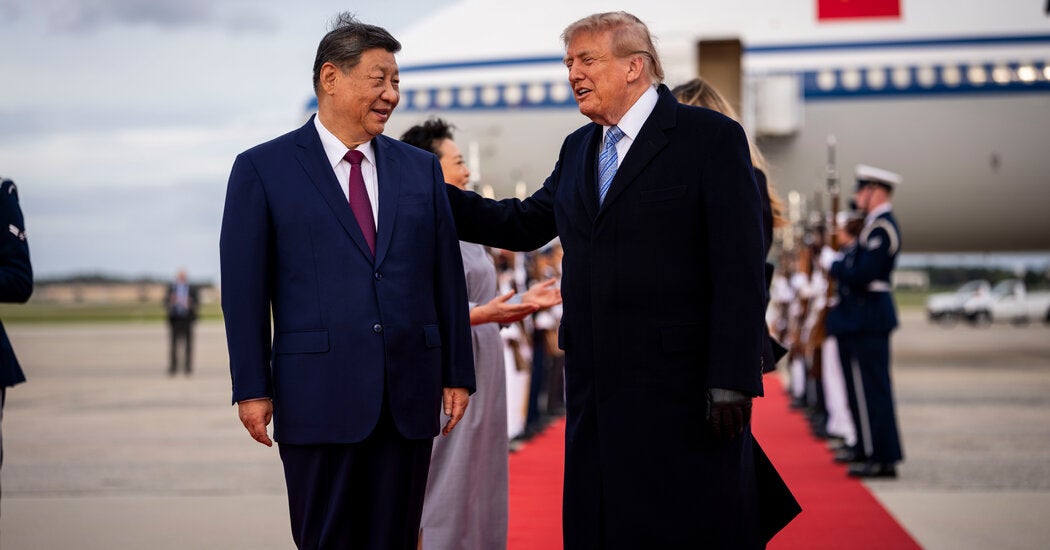
Mr. Bessent gave the interview around the same time that Mr. Trump was greeting the Chinese leader Xi Jinping with a lavish ceremony at an air base outside Washington for the start of a multiday state visit.
The visit will include another welcome ceremony with an honor guard at the White House, a meeting between the two presidents, a state dinner and a tour of the National Archives. It may be the second of as many as four in-person meetings that the two leaders will host this year, Mr. Bessent said.
Chinese officials have not yet confirmed the extension of the trade truce. In a statement issued by Chinese state media after he arrived in the United States, Mr. Xi called for Beijing and Washington to focus on cooperation, and said he was looking forward to in-depth exchanges with Mr. Trump.
The Treasury secretary said he met again Wednesday with He Lifeng, the Chinese vice premier, whom he had also met with on Sunday, “to see if we could do a bigger deal.” Mr. Bessent said that the two sides were working to reduce tariffs on $30 billion of imports from each country, and that the countries would probably also make announcements relating to financial services and agricultural purchases.
Mr. Bessent admitted that China was “behind schedule” on some agricultural purchases, and he said the United States was encouraging the country to increase those.
The agreement will allow the United States and China to put aside their differences through four major events in the coming weeks. For the United States, that includes the midterm elections on Nov. 3 and the Group of 20 summit of world leaders in Miami on Dec. 14 and 15.
For China, that includes the annual gathering of the Communist Party’s Central Committee in Beijing from Oct. 26 to 29 and the summit of Asia-Pacific Economic Cooperation presidents and prime ministers in Shenzhen, China, on Nov. 18 and 19.
If the current summit in Washington goes well, Mr. Trump and Mr. Xi are tentatively expected to attend each other’s events in Shenzhen and Miami. Those gatherings might provide more chances for the two leaders and their top trade negotiators to pursue more deals before Jan. 10.
Asked if China would agree to a new notification system for national security issues related to artificial intelligence that Mr. Bessent announced last weekend, he said he believed that it would and that China was “very eager” to engage with the United States on A.I.
The United States is working with China to define the most important A.I. risks, including uncontrolled A.I. agents and nonstate actors using A.I. to carry out cyberattacks or create biological weapons, Mr. Bessent added. He said he hoped that the United States and China “would be able to talk about any incidents that have occurred, especially any that have crossed national borders.”
The extension of the trade truce has broad implications for the global economy because it appears to include a postponement of China’s plans for even more stringent limits on rare earths, which are used extensively in automotive components, as well as in semiconductors, wind turbines, smartphones, computer displays, lasers, drones and hundreds of other technologies, including military hardware.
China had previously issued export control regulations that would give it the right, starting on Nov. 10, to approve any movement across any country’s borders of any product for which at least 0.1 percent of the value consisted of Chinese rare earths.
That pending rule caused particular alarm in Europe, with automakers there warning that even moving a car seat from a factory in Poland to a car assembly plant in Germany would require permission from China. Mr. Bessent had warned strongly about the Chinese regulations shortly after they were first issued a year ago, saying that China had “pointed a bazooka at the supply chains and the industrial base of the entire free world.”
The postponed Chinese rules would also have expanded export controls to five more kinds of rare earths that China has not previously regulated.
Jens Eskelund, the president of the European Union Chamber of Commerce in China, said that a two-month postponement of China’s plans for more stringent export controls on rare earths would not be long enough. “This short extension will not address the concerns of the European business community in regard to finding solutions that deliver the transparency and predictability so critical to business planning.”
Zolan Kanno-Youngs contributed reporting.