
It Comes In Waves
Miles McEnery Gallery
October 30–December 20, 2025
New York
To announce her new show It Comes in Waves on Instagram, Karin Davie posted a brief clip of Sylvester J. Pussycat, Sr. (to use his full name) from Looney Tunes. A flattened Sylvester, who has been steamrolled, slides down a staircase like an old-fashioned slinky. In Davie’s usage of this clip, he enacts her exhibition’s title by becoming a wave himself, but there is more. The Looney Tunes series’Art Deco logo made up of concentric rings moderating from red to orange, adumbrates Davie’s own manipulation of color. And of course, Sylvester, a latter-day version of Camus’s Sisyphus, is simultaneously pathetic and heroic, pursuing Tweety Bird, like Davie herself pursuing some ideal.
What is Davie saying in the title of this stunning but economical show of eight oil-on-linen paintings? What besides Sylvester comes in waves? Inspiration? Nausea? Some ecstatic experience she’d rather not discuss? Or is it her painterly movement, the physical act of making art? Throughout her career, Davie has flirted, especially in her trompe-l’oeil paintings of drapery, with the curious relationship between painting and dancing, as if the motions she makes during the act of creation were somehow reflected in the work. A fusion of intention and action that takes us back to the malleable fluidity of Sylvester and his cartoon cohorts.
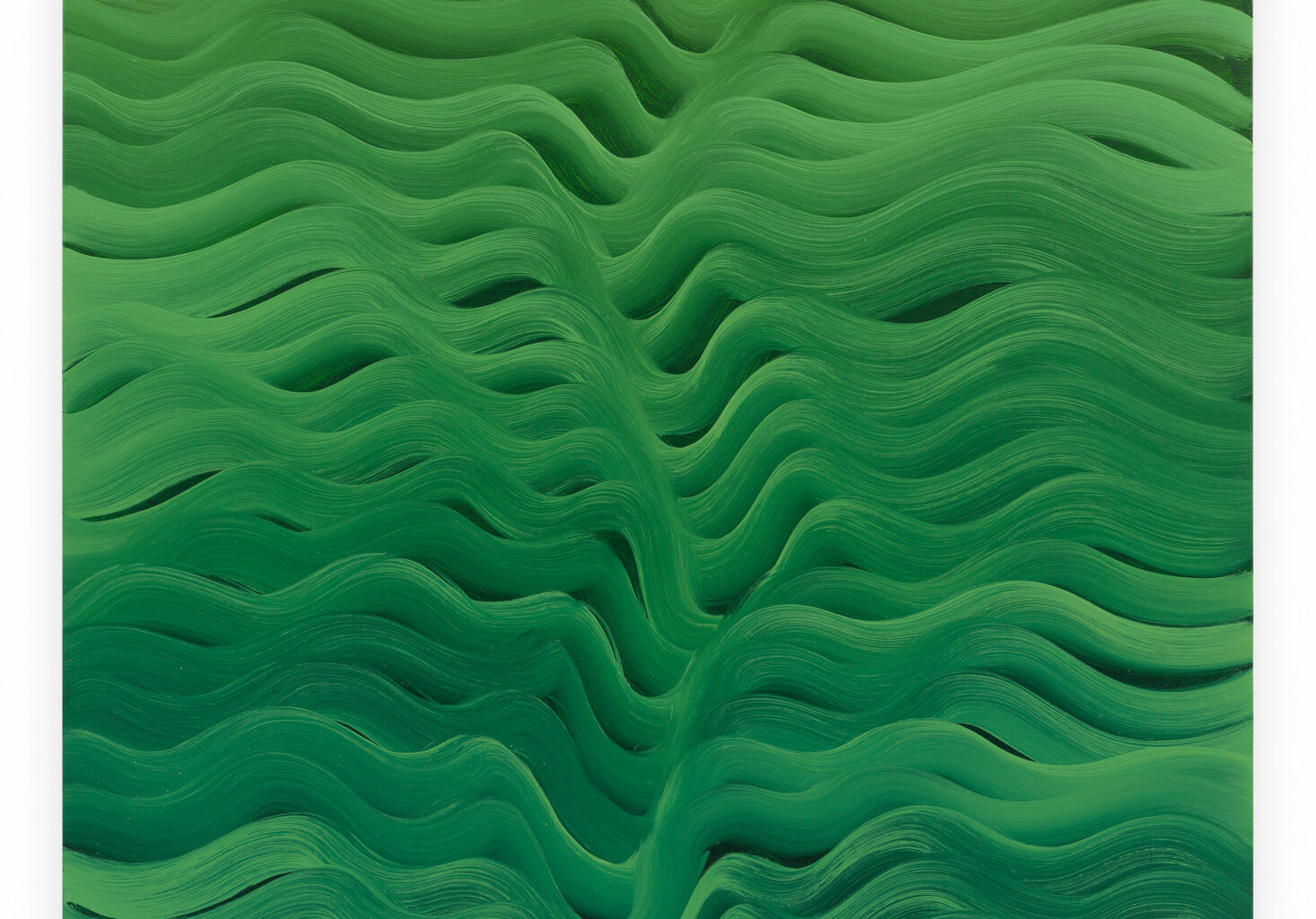
The fundamental ambiguity of these paintings represent a breakthrough in Davie’s career: the wavering coils in each painting might variously bring to mind folds in fabric, complex biomorphic plumbing, or simply illusionistic shapes intended to convey a rhythm or pulsation.
Two of the eight, Strange Terrain no. 4 and Strange Terrain no. 5 (both 2025) are diptychs, but asymmetrical diptychs in that one side is larger than the other. This asymmetry reminds us, as do the occasional blemishes in Davie’s surfaces, that perfection can be pursued, but not necessarily attained. In the same way Persian and Arabic rug makers express humility by occasionally including a mismatched line, Davie pays homage to the Sisyphus in all artists, doomed to seeking an unattainable perfection.
The two diptychs are exercises in painterly irony, their scale a declaration of Davie’s artistic power. The large, horizontal canvases allude to landscape painting without being landscapes. The shading is light at the upper level of both works, automatically creating an illusory depth or distance. The more romantic or dramatic of the two, Strange Terrain no. 4, recalls a lava flow or volcanic mountain range, though that is merely association because the painting itself has nothing to do with natural phenomena.