
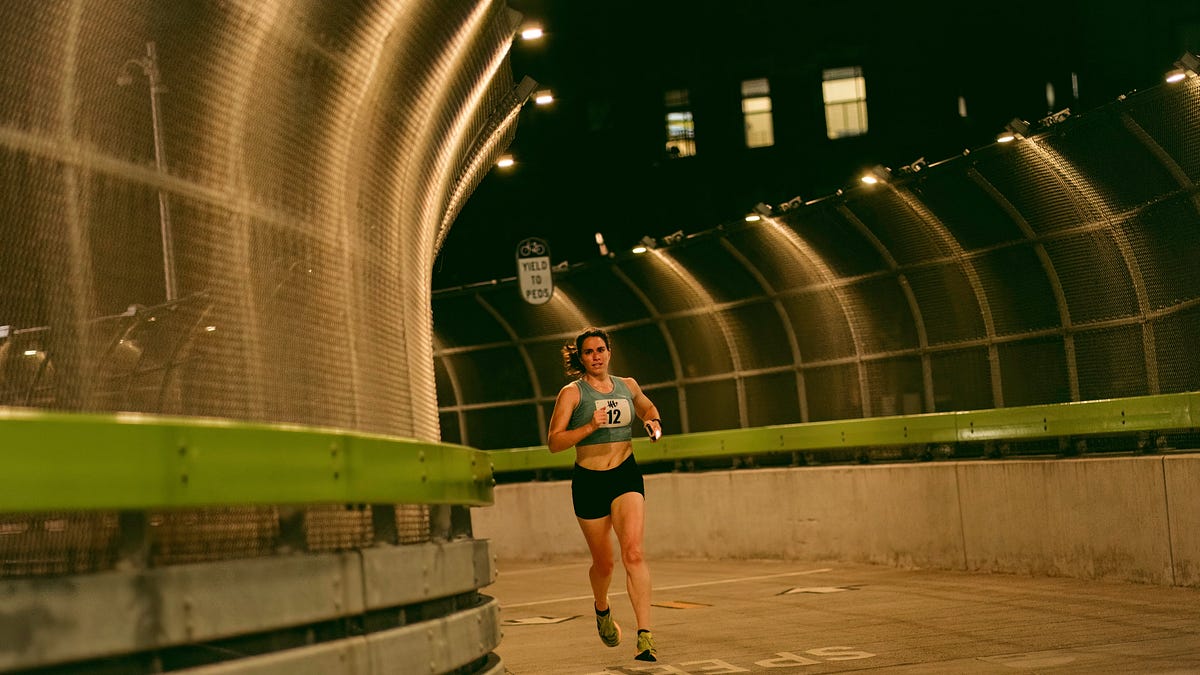
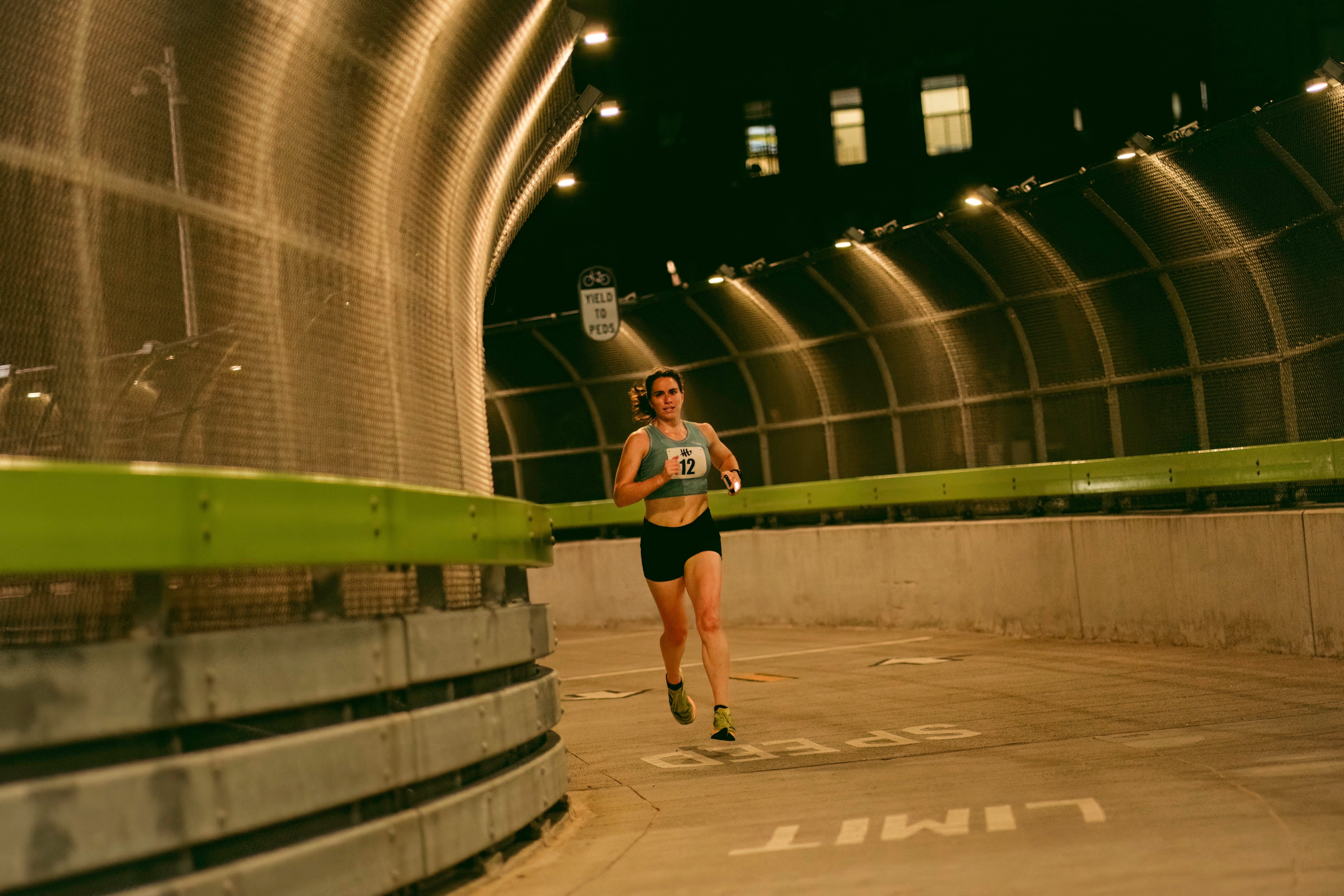
 Photo by Dave Hashim
When Kiersten Johnston first got into running in the mid-2010s, there wasn’t the same type of culture surrounding the sport that exists today.
“Groups had existed, there were people who did marathons, but it wasn’t this mainstream thing,” she remembers. “At the time it was kind of viewed as this dorky hobby to have.”
Nevertheless, Kiersten enjoyed all the people she met through running, and so she kept with it after finishing her first New York City Marathon in 2015. That journey eventually led to chasing BQs and sub-threes, and the overarching goal of reaching her potential. However she says her main objective has always been ‘to try as many experiences as possible,’ whether that’s testing out the steeplechase—and finding out she couldn’t actually clear the hurdles—or all of the unique race formats across New York City.
“There wasn’t this kind of pressure,” Kiersten says of her early years in the sport. “You weren’t seeing everybody signing up for a marathon. It was just this fun thing to do. And I think I’ve tried to keep that spirit alive throughout training over the years.”
We spoke with Kiersten to discuss the growth of the New York City running scene, staying flexible in training after having her son, getting into running photography and more.
This interview has been edited for length and clarity.
Can you start with an intro of where you’re from, what brought you to New York City and how you initially got into running?
Sure. So my family is all from New York, specifically from Queens. They came over from Armenia, so it was a big deal coming to New York and setting roots here. They also came in from Boston, so we’re very familiar with the Northeast running culture, even though no one was really involved in sports growing up in my family. And then I’m originally from New Jersey, so close by. I’ve always had family in Queens growing up, so coming to visit them in Forest Hills, it felt like this really special place.
But I wasn’t really a runner. I dabbled in sports growing up, did a lot of different things, running was always a common theme. I think that’s very similar for a lot of people when they find running later in life. I went to Fordham, was very close to the New York City Marathon finish line. Every year I would go see it, and was very inspired just by seeing a lot of people crossing the finish line. I had relatives who ran the race. And I think when I graduated college and started working in the real world, kind of realized—what do you do when you have all this free time? And running just became this nice way of getting away from everything, especially going for runs in Central Park.
And then signed up for the New York City Marathon and raised money for Habitat for Humanity, which was part of a lot of projects I had done growing up, like I went to Armenia to build houses there. So it was a very special experience raising money for them. Didn’t do much training for that, and still finished in like four hours or so, and thought, ‘Oh, this is a lot of fun. I kind of wonder if there’s anything more to it.’
And at the time, back in 2015, the running culture was still getting started. Groups had existed, there were people who did marathons, but it wasn’t this mainstream thing. At the time it was kind of viewed as this dorky hobby to have. Brands were even just getting started. I think Lululemon was just starting run clubs back then. But what was interesting was getting involved in those run clubs and then finding the more serious people who trained, and getting insight into that, and seeing what that kind of life looked like in conjunction with having a regular job. It was kind of cool just to see what college runners went through, high school runners. And never getting to be necessarily a part of that culture growing up, but seeing it as an adult, kind of ignited this fun flame of, ‘Oh, there are so many different avenues you have as an adult.’
“There wasn’t this kind of pressure. You weren’t seeing everybody signing up for a marathon. It was just this fun thing to do. And I think I’ve tried to keep that spirit alive throughout training over the years”
I saw a lot of friends who had done athletics in college, and some of them burnt out a little bit, some of them wanted to continue training. So at that time in the running culture, you had a mix of people who were finding running at so many different ages, and it seemed really easy to bring together a lot of people from different backgrounds. It was easy for everyone to come together. And I think also when you’re younger, you’re not tied to so many different activities, so it was nice that you could have a big training group of young kids, and it was fun to be intense. There wasn’t this kind of pressure. You weren’t seeing everybody signing up for a marathon. It was just this fun thing to do. And I think I’ve tried to keep that spirit alive throughout training over the years.
You were part of Gotham City Runners. Can you touch on how you joined them, your experience in that group, and how they pushed your early running journey?
Yeah, I started with just a Lululemon run club. It was very simple, and I thought, ‘Oh, this is at least a good way to meet people.’ And someone noticed that I really enjoyed seriously training, and he brought me to Gotham City Runners. And what I found was so interesting—I mentioned a lot of people from different backgrounds, it was one of those groups where you had a big span of ages. And somehow, everyone showed up every single time. I don’t think we had anyone missing a practice for a couple years.
Besides Gotham City Runners, any other groups or clubs in your running journey that you’d like to touch on?
For the social aspect, Streets 101 was really great. I met a lot of really nice people there. Dashing Whippets were a lot of fun. I hadn’t joined that team, but I met a lot of people. Just running with different teams is really important…. I think you get a lot of different perspective meeting different people from other teams, and not just siloing yourself into one group. Over the years it’s been a lot of different groups, I can’t even name all of them.
Once you caught the bug after that first marathon, what were the initial goals with running? Did you think you’d be a one-and-done marathoner, and how did those goals start to evolve in the first several years after that?
I think it depends on the person. I think there are a lot of people that are one-and-done because it’s a bucket list item. For me, what really sold it was the fact that there was this whole entire social scene of people who had this similar drive. But what was really nice is everyone had other interests outside of it too.
So you’d go on a run, and you do have those conversations where you’re talking about running, but then you’d start finding out all of these other things that people were interested in. They were all so creative, or they had completely different jobs—learning about people that worked in the healthcare space, when I work in technology. So it was really cool to see so many different people coming together, and also just different stories of how people even came into the running scene, how they grew up.
I saw you were involved in some of the OSR and Take the Bridge races over the years as well.
That’s the other thing—you start learning about these different formats. Nowadays you’ll see this big push for marathons, but what was important, when I say the spirit of running or keeping that alive, was just trying so many different things.
So you have those alleycat-style street races, and it was really cool to see those initial days of them starting it out. Joe DiNoto used to have these invitational-only OSR10k races, and you would see some of these really talented runners who went on to do amazing things with their running careers just getting started. You didn’t have all the social media at the time, which was kind of nice. You had photographers that were just starting out, like Dave Hashim would come to these races, you had other photographers that would come in from different places, and to see them grow their photography careers as well. So I think part of it was also just the timing.
Did those types of races add a different perspective on running or racing compared to the typical big-city marathons and the standard New York Road Runners races?
Yeah, what’s interesting about those races is it’s not necessarily how fast you are, but how smart you are with your mapping skills and understanding you don’t have to necessarily be the fastest runner to finish. You can find a shortcut, and as long as you’re fast enough, you can win. I think that’s what sets them apart from the New York Road Runners style. And it’s not a closed race, so you have this other element of safety, of judging where the right move is to make without sacrificing your own safety, which is cool.
As you kept doing marathons, you eventually qualified for and ran Boston. Can you touch on that journey?
I think there’s an element, like I said with the spirit of running, of not necessarily competing with other people, but competing with yourself and taking a chance on it and saying, ‘Okay, if I committed X amount of time, what could I do with it?’ And I think that kind of applies as a lesson in life, of betting on yourself. It’s just giving yourself a chance. There’s a lot of talk about mental health, of how we train and not being so hard on ourselves. Yes, you have to be a little bit disciplined about it, and you have to be hard on yourself at certain times. But there’s an element of also believing in the fact that you can actually do it. If you can picture it, there’s at least a chance.
And the other part of it is looking at training as three-dimensional, instead of being so intense on the workouts and being so intense on getting everything right, per se. I think there are other things you have to balance out. What does your job look like? Where are you training in your day? Are you doing strength? Are you eating enough food? There are all those other elements, and I think when you get so hung up on the workouts, it can sometimes take the fun out of it.
Looking at workouts that actually make it exciting—I remember learning that there are different styles of workouts. There’s one called Pre’s 30-40 workout. It’s a track workout where the first 200 is in 30 seconds, the next 200 is in 40 seconds, and you’re alternating. Doing those types of workouts, like The Michigan, another one. If you can adjust it to your skill level, attempting it and actually going through with it and accomplishing it feels like a goal, even in your training cycle. It’s a fun way of looking at it, in my book. Kind of making a game out of it, instead of looking at it as doing all of this just to hit one marathon time and hoping that the weather’s the right way on that day. Keeping the pressure off of it—because we pay for pain anyway, why not have a little bit of fun with it?
After qualifying for and running Boston, it can become, ‘Well, what’s next? Do you take a step back, and what’s the next tangible goal?’ Was that something you ever contemplated?
I think it also depends on the person. I came into it finding running later in life, so I didn’t have all of those—I didn’t do cross country. I didn’t understand what it felt like to sit on a big lawn, you’re lined up with hundreds of other people, and it’s like a bloodbath getting out of the gate. So doing that as an adult was even more exciting, because that’s not something I got to experience before.
It also depends on when you start. I started in my earlier 20s, so I got to do all those things in my 20s where I wasn’t so stressed about reaching sub-three. Or even Boston-qualifying, that wasn’t on my mind until someone put it there. In the meantime, though, I was looking at, ‘Okay, can I do a cross country race? Can I do steeplechase? Can I run a mile really fast?’ Looking at all these other distances, or looking at destination races. Doing things for the experience of it instead of stressing so hard about the time. And then once that stress melted away, it was so much easier to hit the goals, because there was a level of confidence going into it, saying, ‘Well, I know what I’ve done with my body, I’ve pushed it to this limit.’ And instead of constantly complaining about something not going right, I looked at it as, ‘What do I gain on the other end of the finish line?’….
“Doing things for the experience of it instead of stressing so hard about the time. And then once that stress melted away, it was so much easier to hit the goals, because there was a level of confidence going into it”
I don’t want to stop. I want to keep going until I can’t anymore, until the wheels fall off. When I look at it, I don’t see myself hitting a peak and saying, ‘All right, that’s it.’ I want to train in a way where I can keep doing this until I’m like 80, 90. I think that’s the other goal—looking at mobility for longevity instead of just hitting a time on a race. Because then I think you’ll look at yourself as a body of work, instead of, ‘Oh, I hit my goal at 45, or 30, and then burned out because it wasn’t fun anymore.’
Throughout your running journey do you think you’ve always viewed it through that experience-driven lens, and not necessarily those north-star goals being the biggest thing, or was there a point in your running journey where that started to flip?
I think they both coexist in the same space. I still have big goals and think there’s still much more ahead. I’m happy to wake up at 5am—I have a kid now, so my life looks so different. I’m happy to do that because I don’t think there’s enough information out there that says that we hit our ceiling at 30 and that’s it. I think there’s still more time, and I’d love to push the envelope on that and see where it goes. Obviously there’s a decline at some point, and I’m okay with that….
So I just have that attitude of, ‘I still want to train really hard, but there’s still the fun of looking at it long term.’ Yes, I want to go for the big goals, but I also don’t want to injure myself to the point where I can’t walk or pick up my kid. Those are other things I have on my mind now….
I went to Berlin, and I remember thinking, ‘Wow, my husband and I spent all this money to go to Berlin, race this,’ and I had a goal of going for a sub-three, and I walked away with like a 3:00 flat, maybe 30 seconds [over]. And you think about those 30 seconds for a while.
And I’m going back this year after having a kid, and instead of being hung up on the time that I had previously, I am more excited to see my son at the finish line and show him that you can still do these things while having all these additional responsibilities…. So that’s more important to me. Yes, I’m excited for the time goal and the prospect of going for another sub-three. But whatever happens, at least I know that there’s somebody else there that’s excited about it.
Any other short, medium, or long-term goals when it comes to running that you may have not already touched on?
To try as many different experiences as possible. I remember signing up for my first steeplechase race and learning I could not clear the barrier before the race. Learning that they’re really, really tall, jumping over them and falling into the water pit every single time. I think I cleared the water pit maybe once after jumping off that barrier. But it makes you start having a lot of respect for track and field and all these different events that these people do. And on the Olympic Trials level and the Olympic level, it’s kind of incredible. It just gives you a totally different perspective on your own running experience.
In terms of the goals, hopefully I’m still doing this when I’m 80 and 90 and not falling apart. And hopefully hitting some crazy time goals before my peak, whenever that is. But I’ll just keep going.
You mentioned when you first joined the running community, it was smaller, or just different than it is now. Can you compare and contrast the two? Are there any aspects of the running community back then that you think we’re starting to lose, that you hope we keep as it continues to grow?
I think it’s become a very formal experience now, where you sign up for the major race, or you sign up for a race—whereas even with Darcy Budworth, who started Take the Bridge, I don’t even remember if it was a text message that went out, but you’d show up, it felt very organic. It felt like, come as you are. People kind of just showed up, they did the race. And it was really exciting watching it, we would get text updates. It feels like the difference between the ’90s and today, where you’ve got drone shots—and I do photography, I enjoy it, and I think it’s incredible. But there’s something fun about just cheering at different points, and those races where it’s not necessarily more quiet, but it feels a little bit more grassroots, instead of something that feels a little bit more engineered sometimes….
It’s just fun when you get all of them together, last-minute notice, and see what happens. I haven’t seen that in a while.
What motivated you to get into running photography?
For me, I saw it as a way of giving back to the community, but also exploring something that’s related to running, but not necessarily something that I had to pour so many things into. With training, it’s so much dedication. It’s so many hours of your time. What was really cool about running photography is just being able to show up to a race, you take the photos, you come back and edit, and it’s kind of all compact into one day, and then you have a cool body of work to show for it. And it makes other people happy—I think that’s the best part, whether it’s the pros or just anyone who’s entered the race and you catch a photo of them running.
It’s an art form. So the more you do it, the more you’re practicing it, the better you’re getting at it. So for me, it was something else that I could work on that wasn’t so intensive. It’s more of a freedom of expression, but I do get to involve running, which is really nice, because it’s a different style of photography…. This kind of tests you, where you have to get the shot. If you don’t get it, it’s gone, because you only get so many runners going by you in a matter of a few minutes.
Any life lessons you’ve gotten from running, or ways running has helped in other areas of your life that stand out?
I think it’s flexibility. That’s probably the best way of putting it. With running, you kind of have to be flexible. Your body is not always going to be 100 percent there for you, so it’s meeting yourself where you’re at. So if I’m with my kid, I’m taking him on a stroller run, even if it means my easy run’s a little bit harder.
Being flexible with your body’s time, right? You are not going to hit every single workout, and being okay with the fact that sometimes the volume of your work is going to be 80 percent versus 100 percent, and you can still work with it.
Any topics I didn’t specifically ask about that you’d like to touch on, or any closing thoughts?
I think the fact that so many people come from different backgrounds. The more you talk to people, the more layers that you uncover. Running is just one of them, but looking at their background—where their families came from, things that they had to overcome that maybe other people didn’t…. It’s really cool hearing about different journeys people have taken and what they’ve had to overcome along the way.