
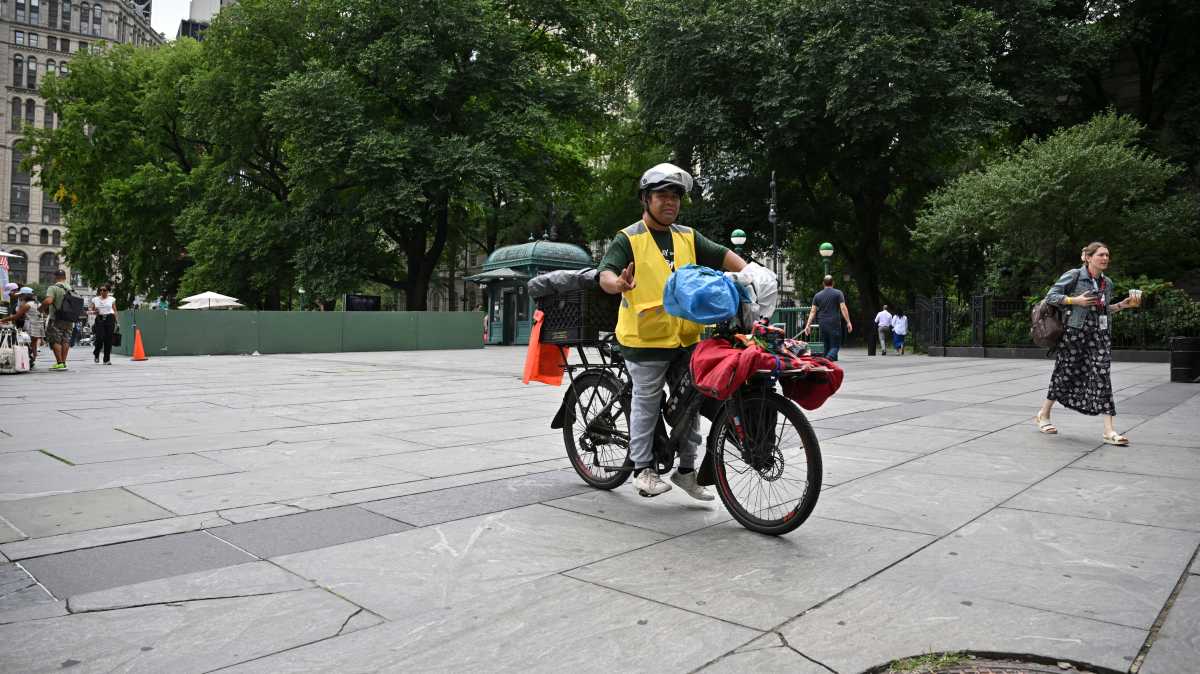
The NYC Council is looking to pass new legislation aimed at requiring app-based delivery companies to fork over data and potentially face new regulations regarding the time it takes their workers on e-bikes and e-scooters to do their job around the five boroughs.
The so-called “Safe Delivery Time Act” — sponsored by City Council Transportation Chair Shaun Abreu (D-Manhattan) and set to be introduced Thursday — is designed to address the issue of delivery workers riding e-bikes, e-scooters, and mopeds in ways that allegedly put themselves and other road users at risk. The measure aims to do so by enabling the city to gather data from the apps that contract deliveristas and potentially hit them with stronger regulations.
Abreu told amNewYork that the bill aims to put a check on incentives that app companies may offer their deliveristas to get products to customers as quickly as possible — something which can lead them to drive dangerously.
“The pervasive issue right now is that we have a lot of the deliveristas who are rushing to get to their next delivery order at no fault of their own,” Abreu said. “This is primarily caused by the fact that the apps require that these delivery workers make these deliveries very quickly.”
However, a representative from one delivery app company, Uber spokesperson Josh Gold, disputed the premise of Abreu’s bill — at least that his firm uses delivery times to penalize or incentivize workers.
Gold said that while he had not seen the bill itself, and thus could not comment on it directly, “Uber doesn’t utilize delivery time to penalize or incentivize delivery workers. If anything, you are incentivized to take your time as you are paid for delivery time.”
Latest delivery app bill part of NYC Council reform package
The bill is one of over a dozen set to be examined by City Council members at what promises to be a marathon hearing on electric two-wheeled micromobility device safety on Sept. 30. City Council Speaker Julie Menin scheduled the hearing after a couple of high-profile deaths involving riders of illegal e-motos and e-scooters earlier this summer.
Abreu said he crafted the bill in collaboration with and is introducing it at the request of Mayor Zohran Mamdani, whose administration has been focused on going after delivery app companies for how they treat their workers and the potential impact of their practices on street safety.
“We need more trip data from delivery apps to understand any impact their operations may have on the safety of workers and New Yorkers,” City Hall spokesperson Jeremy Edwards said in a statement. “We’re grateful for the council member’s support of this idea and look forward to continue working together on this bill.”
The legislation would empower the city Department of Consumer and Worker Protection (DCWP) to request driver trip data — such as trip duration, start and end locations, and the type of vehicle used — from app-based delivery companies, according to draft legislation obtained by amNewYork.
Using that data, DCWP would then conduct a study to help it ascertain the safest amount of time in which a trip could be completed for a given distance, Abreu said.
“If you are traveling, let’s say 10 blocks away, a safe delivery time would not be two minutes, for example,” he said. “We want the city to get information from these apps so we have a better understanding of what would constitute a safe delivery time. And if we get a safe delivery time, that would mean that our deliveristas would not have to be too fast on our streets.”
Under the legislation, DCWP could then use the study’s findings to promulgate new rules around the minimum times apps can allow drivers to make deliveries safely, the council member said. It could also place limitations on penalties or incentives that apps may impose on their drivers for completing trips in a specific time frame.
“With this information, the city can write effective rules and hold the apps responsible for safe riding,” Abreu said. “This could include minimum allowable delivery times based on distance and the rules of the road, making our streets safer by ensuring no worker is forced to race against the clock.”