

The MTA is further tightening the safety rules around subway track work in the aftermath of a construction flagger’s death earlier this month.
All flaggers are now required to reach their jobsites by hitching a ride on a nearby subway instead of walking through the tunnels, according to a service bulletin sent Monday to all subway staff and obtained by the Daily News.
As previously reported, the MTA last week instituted a similar rule for all worksites at which a curve or elevation change meant the track crew would be out of sight from the nearest subway platform.
“Flaggers” are track workers who set up and maintain a set of lights or flags meant to warn operators of oncoming trains that a work crew is up ahead on the tracks.
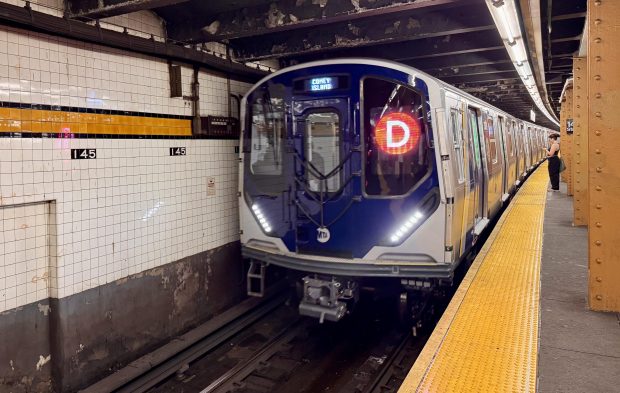 An MTA D train is pictured in New York City in July 2026. (Shutterstock)
Flaggers set up a series of yellow lights to warn train operators of their presence, and then stay positioned beside a red light and a device known as a “portable stop” — a device that clamps onto the tracks and trips the emergency brake on any subway that continues through the red light.
After a train comes to a halt, the flagger waits until the work crew has “cleared up” — train-speak for getting off the track via nearby niches and alcoves — before removing the portable stop and waving the train through.
Flagging is viewed as one of the most dangerous jobs in NYC Transit track maintenance. Three flaggers have been hit by subway trains in the past three years, two of them fatally.
Moet McCullum, a 41-year-old mother of three, was the most recent fatality. McCullum was preparing to set up flagging lights for a crew of MTA contractors on the tracks between 167th and 161st Sts. along the D line in Highbridge, in the Bronx, on Sept. 3, when she was fatally struck by an oncoming train.
As first reported by the Daily News, the operator at the D train’s controls told supervisors he had been warned by an “advance flagger” on the 167th St. platform that a work crew was on the tracks — a notification that required the operator to travel at “restricted speeds.” But he told supervisors that when he then didn’t see any flagging lights, he set his train to normal speed.

Courtesy of family
MTA worker Moet McCullum was killed by a D train in the Bronx. (Courtesy of family)
The new MTA rule effectively keeps workers off the tracks before any lights have been set out by requiring the flagger to take a subway to the worksite and set the initial two yellow lights immediately upon disembarking from the train. The rule does not apply to track inspectors or other workers who employ “point-to-point” flagging while moving through the system on foot.
The new procedures also allow work crews to get to a site on foot if all train traffic in the area has been suspended.
A transit source confirmed to The News that workers have been trained on the new procedures.
The new, stricter rule comes a week after the Federal Transit Administration set a Monday deadline for the MTA to beef up worker protection.
In a letter sent last week to the MTA — and obtained by the Daily News — the FTA threatened to prohibit all subway track work as of Monday unless NYC Transit took steps to prohibit workers “fouling” the tracks while trains were in operation.
Transit officials told The News at the time that they were in conversation with the FTA about how best to ensure worker safety.