
The City Council took a key step on Thursday toward simplifying the onerous enrollment process for the city’s program that provides reduced-cost OMNY cards to very low-income riders: Fair Fares.
The council overwhelmingly passed a bill — Intro. 248 — requiring the city Department of Social Services (DSS), which oversees the Human Resources Administration (HRA) that runs the program, to streamline its current enrollment procedure. Transit and anti-poverty advocates have long argued that applying for Fair Fares creates a high barrier for working people with already limited time, as it requires them to fill out reams of paperwork and jump through several bureaucratic hoops.
Specifically, the measure would direct the DSS to provide those receiving other HRA-administered benefits, including the Supplemental Nutrition Assistance Program (SNAP, commonly known as Food Stamps) — or cash assistance — with the option to apply for Fair Fares on the same paperwork they already filed for those programs.
The sign-up process would be as simple as checking a box on an online form when applying for or re-enrolling in SNAP or cash assistance, according to City Council Speaker Julie Menin’s office.
The bill, sponsored by Council Member Crystal Hudson (D-Brooklyn), is meant to address the city’s struggles to get a majority of those eligible for Fair Fares to sign up. Even as the city has gradually expanded the pool of New Yorkers who qualify for the benefit, only about 380,000 of the over 1 million (40%) of those who are eligible were enrolled as of March, HRA officials said during a May City Council hearing.
“A 40% enrollment rate is a failing grade, especially for such a vital program,” Menin said during a Thursday news conference. “So, among the bills we’re voting on today, one that Council Member Hudson introduced will mandate a streamlined process to enroll in Fair Fares.”
Reversing the Fair Fares ‘failing grade’
Menin said passing the legislation is more important now than ever, given that the council inked an agreement with Mayor Zohran Mamdani to expand Fair Fares eligibility to those earning at or below 200% of the federal poverty level as part of their city budget deal earlier this year — making roughly 340,000 more New Yorkers eligible.
While Mamdani’s administration agreed to expand Fair Fares, the democratic socialist mayor has said in the past that he prefers universal programs to those that are means-tested. Mamdani won his election last year in no small part on a pledge to make city buses fare-free — a policy goal he has claimed he is still pursuing.
Mamdani’s office did not immediately comment on the bill’s passage.
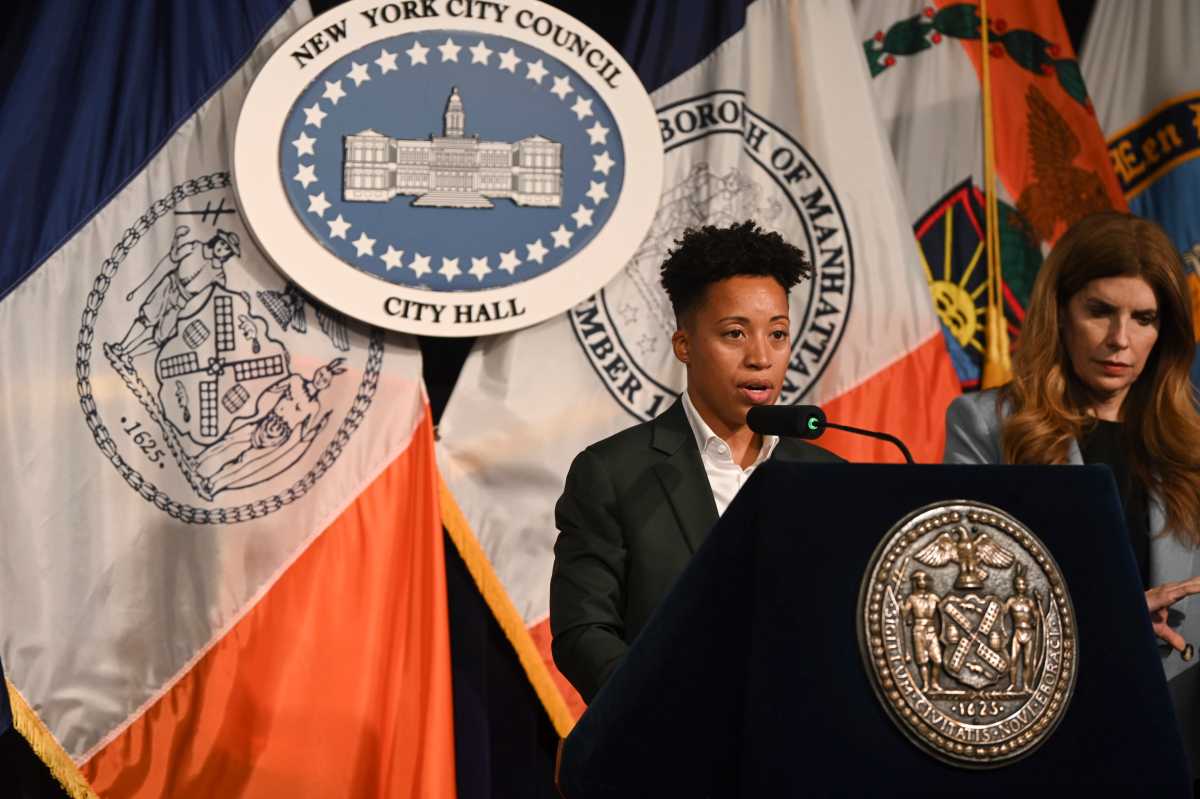
Hudson said Thursday that widening eligibility alone is not enough to get more people enrolled in the program.
“Though the council and mayor expanded eligibility for the program during the last budget cycle, expansion has not increased enrollment into the program,” Hudson said. “Intro. 248 bridges that gap. It creates a streamlined enrollment process that allows DSS to immediately enroll individuals, with their consent, into Fair Fares if they are also applying for SNAP or cash assistance. Rather than submit the same information twice, our constituents can simply opt-in and receive the benefit.”
Hudson amended the legislation from an earlier iteration that would have required HRA to automatically sign up those who are already on the SNAP or cash assistance rolls for the half-priced fare program. She said the bill was amended to address concerns that HRA officials raised during the May hearing regarding the privacy of those enrolled in other agency programs.
“There are often so many logistical challenges to getting some of these bills passed,” Hudson said. “And one thing that we were particularly concerned about was public charge and that was a concern shared with the administration. So we wanted to make sure that we did everything to protect people’s private information.”
Although advocates had been adamant that instituting automatic enrollment was the best path for boosting Fair Fares participation, they still lauded the council for passing the streamlining bill.
“Commuters struggling just to afford the basics of life in our city don’t have time for extra paperwork and bureaucracy,” said Caitlin Pearce, deputy director of the rider advocacy group Riders Alliance.
“Fair Fares enrollment will be streamlined and more New Yorkers will have easier access to an essential program,” Pearce said. “Along with expanded Fair Fares eligibility for New Yorkers earning up to 200% of the federal poverty level, streamlined enrollment will save more money and time for the New Yorkers who most need a break.”