
It is a cloudy, autumnal day, and I am sitting on my walker near an NYU classroom building conjuring up memories. I am trying to recall the nature of the apartments I lived in as a first-generation, lower-middle-class Bronx boy and the dynamics of the world I inhabited.
My memory still seems to hold up.
I recollect the cramped quality of the three- and four-room apartments we occupied in the Bronx. The building was not a tenement but a 1930s elevator apartment house that was in decent condition, though the elevator was scratched up and sometimes smelled of urine. When my retired rabbi grandfather came to live with us, he was already suffering from ALS, and all five of us were jammed together in a three-room apartment. I slept on a folding bed in the same bedroom as my grandfather and brother for about two years.
I remember when I was 13 we moved to a larger (four-room), darker first-floor apartment, where I still shared a bedroom with my grandfather, who spent his days reading the Talmud or praying in the kitchen. My brother slept in the living room.
I was conscious of the crammed quality of our apartment life—no place really to study or to be alone with one’s thoughts. But much of my time was spent in school, playing ball, or engaging in social life, so the packed apartment had less impact on me than one would assume. A first-floor apartment was also useful, because friends would just shout my name from the street in the classic Bronx style, and I would meet them downstairs.
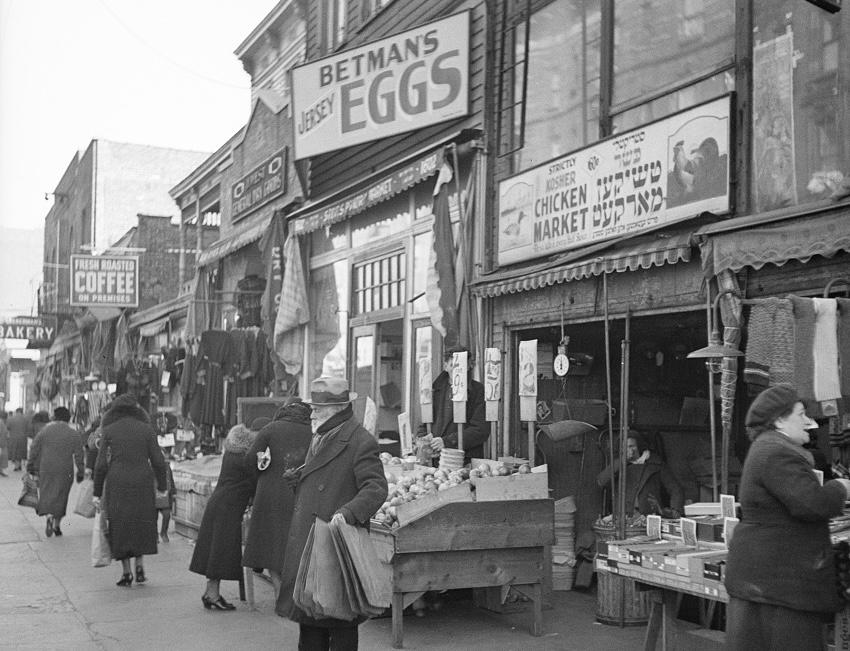
But as I got older, I could feel my life being constricted, mostly because of the neighborhood, but the cramped apartment didn’t help. The neighborhood was largely a mix of working-class and lower-middle-class Jewish and Italian families. When I was young, it was enough that I had a park and a schoolyard that I could play ball in and noisy street markets filled with push carts selling produce and stores with outdoor stands that sold dry goods, clothing, and fruit that would leave pungent memories. By high school, however, I felt there must be more to life—something denser, richer, and more exciting intellectually and emotionally than my narrow, everyday existence.
I wanted to live in a neighborhood with book shops, live theater, an art film house (the Bronx only had one), an art museum (I had been to the Met once), and a Village-style coffee shop to hang out in as well. Those yearnings for a more cultivated and unpredictable world would appear once in a while, but most times I repressed them and went on without being profoundly disturbed by my parochial, Bronx-centered life.
Attending the City College of New York opened me up to a wider range of friends and the cultural life of New York. I still played ball on Saturdays in the neighborhood, but, unconsciously, I separated myself from much (but not all) of family and neighborhood life. It whetted my appetite to be more than a high school teacher (I took a series of mostly mediocre education courses), which had been my initial aim after graduation. (My father wanted to be a teacher but ended up in the post office during the Great Depression.)
However, I had few people to guide me in another direction. I was an erratic student with modest grades. But in my senior year I took an honors seminar titled “Modern Views of Man,” which consisted of reading great novels and essays, and philosophy (Heidegger, Arendt, Unamuno). It was one of the rare times in college when I really shone. I was deeply involved in the works we discussed, and I took the lead in many of our class seminars. The two professors pushed me towards graduate school—a step I had never considered. I received a history assistantship at a Midwestern university, and with many stops and starts, my academic career began. With the career came a different life, including a wife with whom I shared an intellectual world and some years living in Europe. I still wonder whether, had I been born into the upper-middle class, into what I hope would have been a less constricted world, I would have had the confidence to become a writer much earlier. Would that have made a difference in the quality and ease of my prose? There is no easy answer to those questions. Still, I am relatively satisfied by what I have accomplished.