
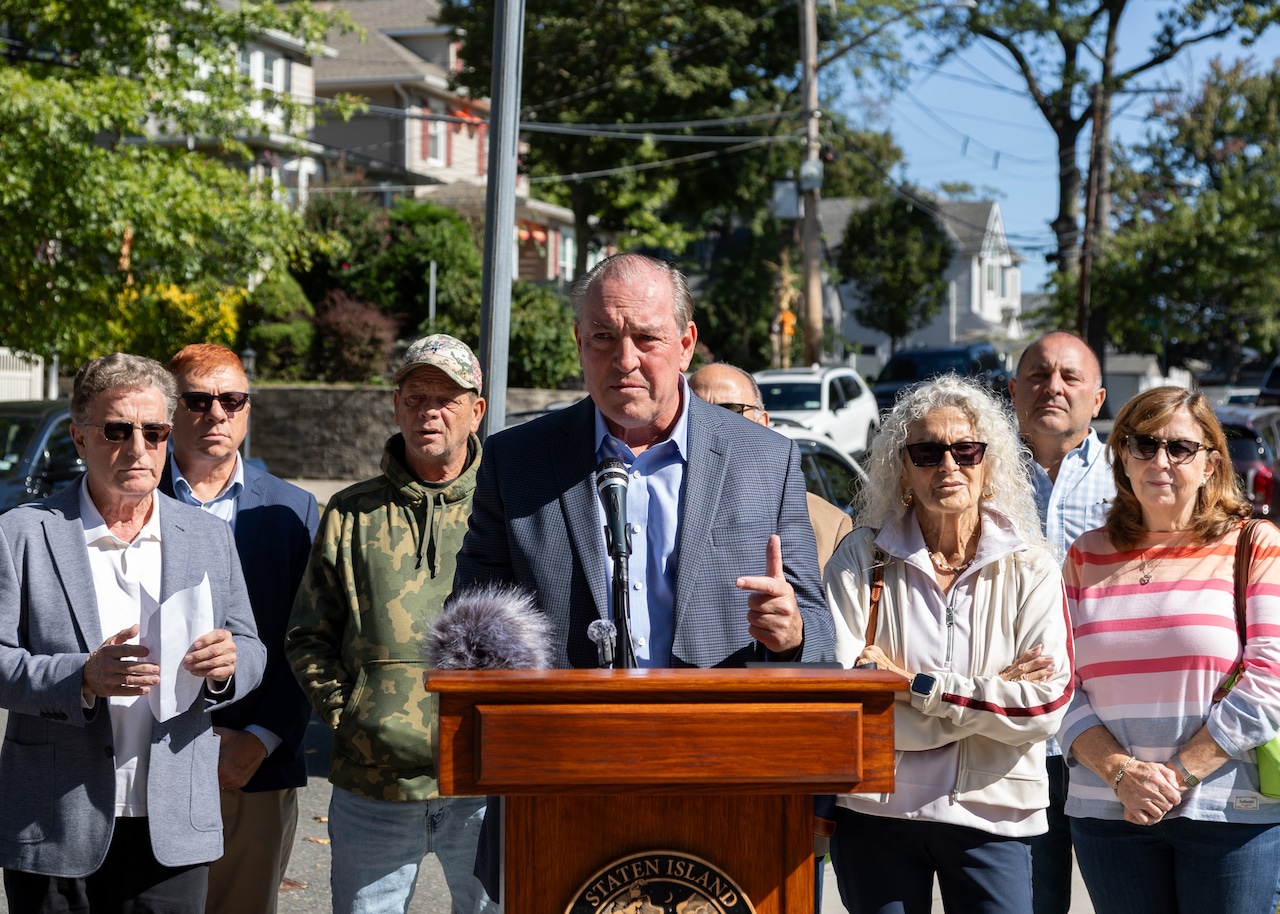
STATEN ISLAND, N.Y. — Local community and civic leaders united in Great Kills on Wednesday to oppose a bill that would mandate “universal daylighting” throughout New York City, including on Staten Island.
Borough President Vito Fossella led the charge against Intro 1138 — which would remove parking spots near intersections to improve pedestrian visibility, a process called daylighting.
Fossella and others in attendance argued that the bill would remove parking spots universally across all five boroughs, without considering local needs on Staten Island.
“That’s why we have to fight back, to give people the freedom to do what they want on their own terms and not to be told what to do regularly from people in other parts of the city,” Fossella said.
“If it works in their neighborhood it’s fine,” Fossella continued. “Just don’t force us to do it.”
Besides Fossella, civic organizations and community members from across Staten Island criticized the proposal, saying it is a “cookie-cutter” approach that wouldn’t work across all of Staten Island.
“With this new proposal, they want to take away all this parking unnecessarily in this area,” said Great Kills resident Tom Berte. “This is a quiet, residential neighborhood. You can’t compare this to somewhere that’s a busy place, you can’t use a cookie-cutter approach on this.”
Along with Berte, a host of other civic members rallied against the proposal, including: Joan Cusack, district manager for Community Board 1; Fred Giunta, chair of Community Board 2; Mario Buonviaggio of the Port Richmond North Shore Alliance; Neil Anastasio of the Forest Regional Residents Civic; Matthew Lesieur of the Rosebank North Shore Alliance; and Sal Monforte of the Midland Beach Civic.
Beyond their own critiques of the bill, those in attendance pointed out that the New York City Department of Transportation opposes the plan.
The DOT has cited a report the agency published in January that found no increase in pedestrian safety at intersections that have daylighting in place without physical barriers installed.
The agency has also said that implementing the universal daylighting bill would cost more than double the agency’s annual budget.
Officials at the press conference on Wednesday argued that the DOT already daylights problematic intersections on a case-by-case basis, which is how they say the safety upgrades should be implemented.
“Of course pedestrian safety is important,” Fossella said. “If there are certain intersections that need [daylighting], then we should do it. That’s the common sense, practical approach.”
Fossella and the civic leaders also drew comparisons between the universal daylighting bill and the City of Yes Housing plan, arguing that neither allowed for local input.
“We tried to bang the drum that [City of Yes] was going to be bad for Staten Island and now we’re seeing the fruits of that, because the rest of the city didn’t listen to us, didn’t allow us to provide some flexibility to tailor it to Staten Island,” Fossella said.
About universal daylighting
The universal daylighting legislation would ban vehicles from parking within 20 feet of any intersection with a crosswalk, roughly one full car length of space.
New York state law already outlaws parking within 20 feet of a crosswalk. However, New York City has a special exemption that allows it to set its own parking rules.
If the universal daylighting bill passes the City Council and is signed into law, DOT officials said they believe that roughly 10% of all free parking in New York City — approximately 300,000 spaces — would be eliminated, according to a report by StreetsBlog NYC.
Of the current sponsors of the daylighting bill, only one represents Staten Island in the City Council — Councilmember Frank Morano, a Republican representing Staten Island’s South Shore.
“Look, no one loves their cars more than Staten Islanders — I get that, I live it. But even in a car-loving district like mine, people want to be able to see when they’re turning, and they don’t want their kid or their neighbor getting hit at an intersection because a van was blocking the crosswalk,“ Morano previously told the Advance/SILive.com.
“This bill is about visibility, safety, and a little common sense — not ideology. If we can improve sight lines, reduce flooding, and make the streets safer without upending our way of life, that’s a win.”
The bill currently has majority support in the City Council, with 26 co-sponsors, but needs at least 34 votes to override a potential veto from Mayor Eric Adams.
As of publication, the universal daylighting bill is laid over in the City Council’s Committee on Transportation and Infrastructure.
However, during a recent interview with PIX 11 News, Councilmember Julie Won, a Democrat representing parts of Queens and original sponsor of the bill, said that there was push to get the bill passed by the end of the year.
Earlier this month, Staten Island’s Community Board 1 passed a motion to formally oppose the universal daylighting bill.
The board’s opposition will be formally communicated in a letter to the City Council.
If you purchase a product or register for an account through a link on our site, we may receive compensation. By using this site, you consent to our User Agreement and agree that your clicks, interactions, and personal information may be collected, recorded, and/or stored by us and social media and other third-party partners in accordance with our Privacy Policy.