
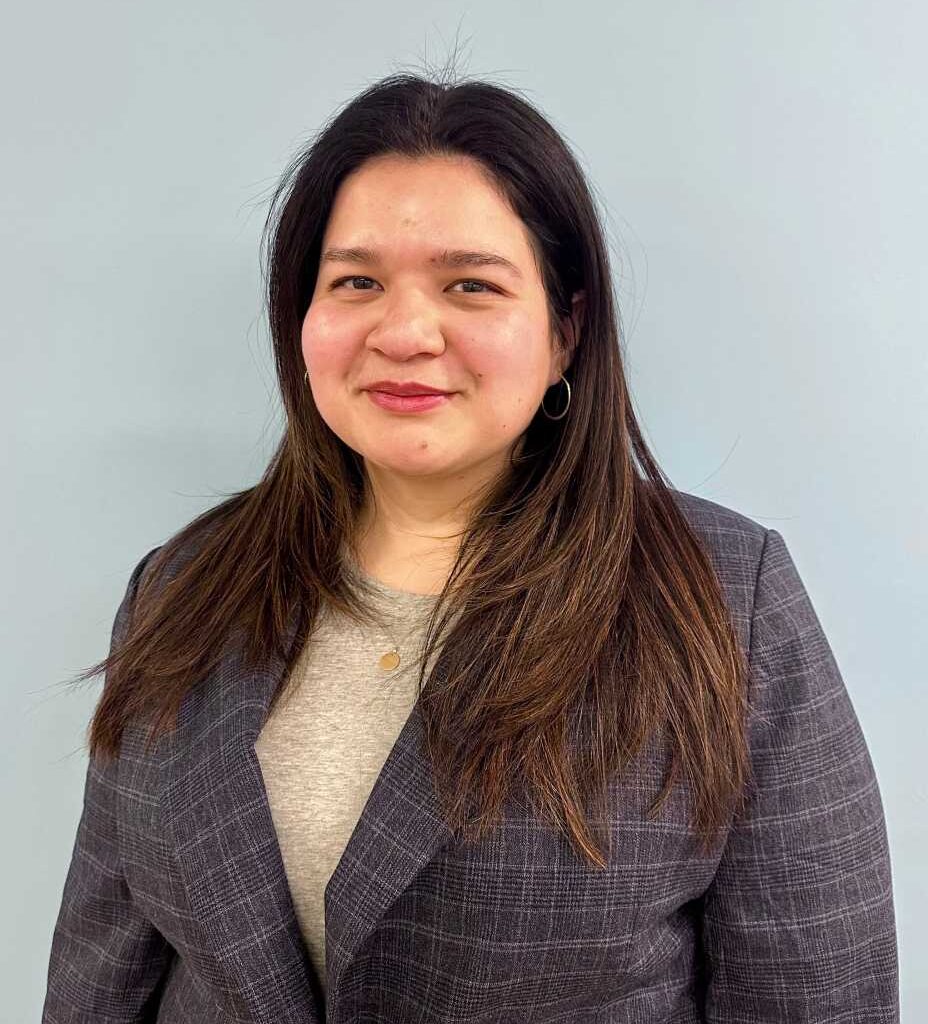
Education and children’s advocacy attorney Diana Aragundi loved school as a kid. As the eldest daughter to immigrant parents, she was also the first in her immediate family to navigate the city’s education system.
Today, she’s using her law degree to make the schools she and her siblings grew up in work better for the immigrant children in them today.
“I love the city, and I’m happy to do my part to continue making it better for other families,” Aragundi said of her work. “I can’t imagine living anywhere else.”
An attorney and assistant project director of the Immigrant Students’ Rights Project at advocacy firm Advocates for Children, Aragundi provides legal counsel to immigrant families who need help accessing education that will actually work for their children.
That involves a wide range of legal services, she said, including suing the Department of Education for disability accommodations or special education support, helping new students enroll in school, assisting students in transferring to a different school for a program that would better fit them or to escape an unsafe bullying situation, and pushing for bilingual education, translation services, or other English Language Learning help.
“Our school systems in New York City look so different from other states and from other countries,” Aragundi said. “When we talk about educational support, it can be anything really under the sun. The work is letting them know that they’re welcome and how they can navigate those processes.”
Aragundi also takes part in active outreach to immigrant families to inform them of their rights – and letting them know they can access free services and representation from her and her team if they fall under the group’s income cap and have a child under 22 seeking an education, or considering college, in the city.
“For example, a lot of parents don’t know that they have a right to request a change if their child is learning English if they’re not seeing progress or they’re worried that their child could benefit from a bilingual program,” Aragundi said of why their outreach is important. “If there’s a seat available in their neighborhood in their district, they have a right to request it.”
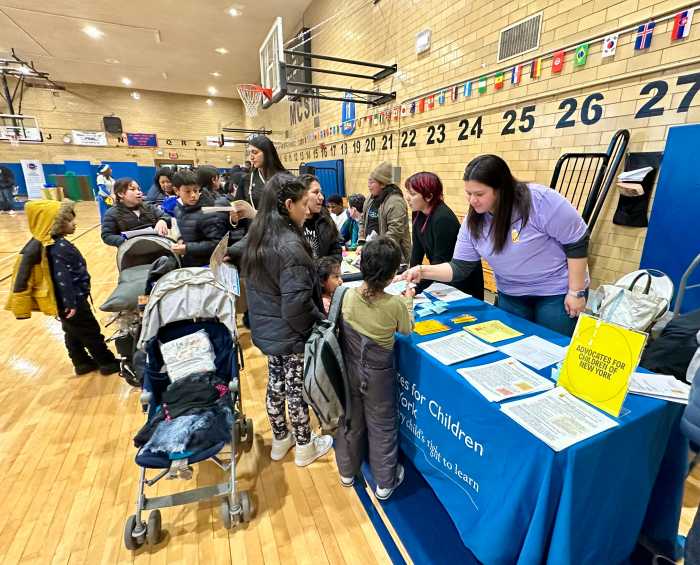 Aragundi at an outreach event.
She knows firsthand how challenging navigating the city’s school system can be for parents at first from watching her mother and father find themselves faced with supporting her and her two younger brothers through the education system as they each experienced attending their local Long Island City public school in different ways.
“We all had very different educational experiences in the same school,” Aragundi said. “School made sense to me. It was rules I could follow and I could understand. But, my middle brother was a class clown, and my youngest one has a learning disability, so we all had different relationships with school and different impressions of school. My parents didn’t know how to navigate it.”
Diana Aragundi works to help resolve more than student issues
Aragundi’s focus expands beyond resolving individual issues students have in school. She also helps create large-scale policy change in the city’s schools, both at Advocates for Children and as the chair of the New York City Bar’s Education and the Law Committee.
For example, she said Advocates for Children has helped ensure schools are clear on the law, which holds that Immigration and Customs Enforcement (ICE) officers should not be entering without the proper warrant, and that students and parents are aware of their rights if ICE does come to their classrooms.
The organization has also helped push for translation and interpretation support, both in classrooms, for parents at parent-teacher conferences and for documents, as well as increased bilingual special education services.
The focus of the policy change work Aragundi does is informed by her direct, daily work for families, she said.
“I’m talking to parents every day. I’m texting them. They’re sending me WhatsApp messages,” Aragundi said. “I’m directly connected to parents who are experiencing issues, and then I bring that to our policy director, and say, ‘We’re seeing this. If other folks in the office are seeing it too, is this something that we should bring to the attention of the Department of Education?’”
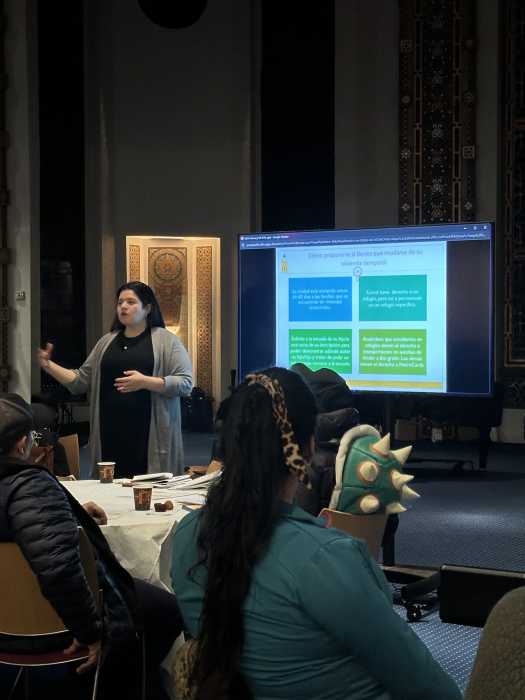 Aragundi gives a talk.
At the city bar, Aragundi pushes forward efforts to help educate other attorneys on education law issues so they can properly advocate for children’s education when they have a case that ends up dealing with the issue and to create more opportunities for all attorneys to learn from each other.
“I had no idea about a lot of the education-related issues before working in education law,” Aragundi said. “I think oftentimes we work in these silos, but just think about how much more effective our representation can be when we are participating in community with others.”
As chair, she is continuing to host more panels, programs, and continuing legal education seminars on education issues to help improve the state of the field.
Aragundi is also helping to start more conversations around chronic absenteeism and how to address it at the City Bar, including supporting efforts on a landmark suit that settled earlier this year and increases the Department of Education’s obligations to support students experiencing it.
It’s not just this work at Advocates for Children and the City Bar that’s informed by her personal experience.
Aragundi said her legal work has been inspired by her and her family’s lives from the start. Though law school felt like a natural next step for a New York University graduate with English and Political Science degrees, what truly pushed her to begin a career in the legal field was seeing a family member find themselves tied up in the court system and feeling frustrated that she didn’t know how to help.
“I remember just feeling really disempowered and not really understanding,” Aragundi said about the aftermath of her family member’s arrest. “I would read what the charge was, but I didn’t understand how to navigate those systems. Coming from an immigrant household, and my parents having limited English skills and not being able to advocate, I just felt very frustrated by the lack of resources and the lack of understanding in my community.”
“I knew that I didn’t want to feel that again,” Aragundi said of the experience, which came while she was working at her uncle’s taxi company after college. “I didn’t want to feel disempowered again.”
She enrolled in the City University of New York’s public interest law program. Three years later, she took her degree back to her community, beginning her career by representing taxi workers at the Metropolitan Taxicab Board of Trade.
The work – which was part of a new program providing free legal representation to drivers caught up in administrative, traffic, or criminal proceedings related to their work driving a yellow cab – was a natural transition, Aragundi said, from working through taxi medallion issues and crash reports with drivers in her uncle’s Astoria, Queens, garage.
“It really was an opportunity to give them a voice and not have to spend a lot of money trying to defend these tickets,” Aragundi said. “Their license is their livelihood, and so we were trying to keep them employed and keep them from losing that license. It was, I think, really important to be able to provide them that support.”
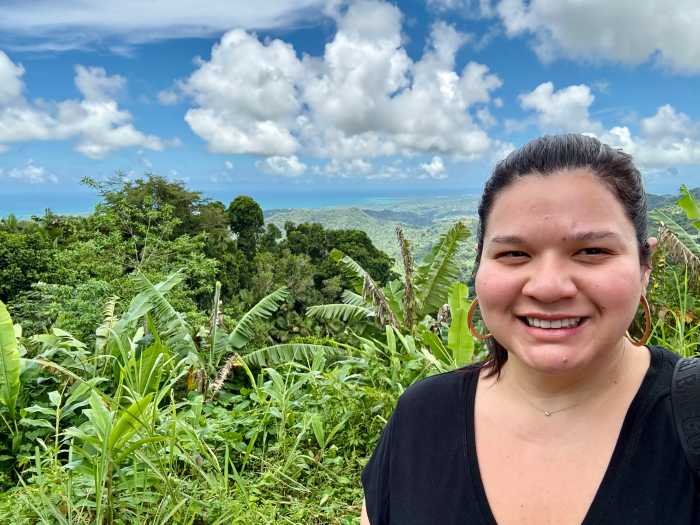 Aragundi says that outside of work, she has a love of travel.Photo provided by Diana Aragundi
Though she enjoyed the work and the connection to her family, Aragundi said she knew she was interested in eventually doing different types of legal work. She left that position after just about a year and spent three years at the Children’s Law Center, a youth-centered advocacy firm, but with a different mission than her current role: Vocalizing the rights and interests of children caught in the middle of divorce and custody proceedings to the court.
The work, though stressful and frustrating at times, helped Aragundi become comfortable developing easy rapport with kids, something that helps her successfully advocate for children in the education context now, she said, adding that older children will text her directly about their cases and what they need.
“I love talking to kids, and I loved trying to find resolutions for families,” Aragundi said. “But, in divorce proceedings, there are larger systemic issues with how long it takes families to get relief that they need through the court system, and as the attorney for the child, you’re not really driving the case. The case is between the parents, so the child’s voice is not the determining factor, which means that sometimes what I thought the child needed or what the child wanted really wasn’t moving the conversation.”
That experience of working through varied, competing interests to create the best outcome for a child has helped her hone how she advocates for kids through the school system now.
“It’s having these hard conversations,” Aragundi added. “It’s reminding everyone we’re here on behalf of the child. It’s not adversarial in the same way that it is with Family Court, where sometimes people feel like you’re picking a side. Here we should all be on the same side. We should be on the side of the child. When you can frame it that way, it helps build that sense of community and answer, ‘How can we work within the school system?’”