
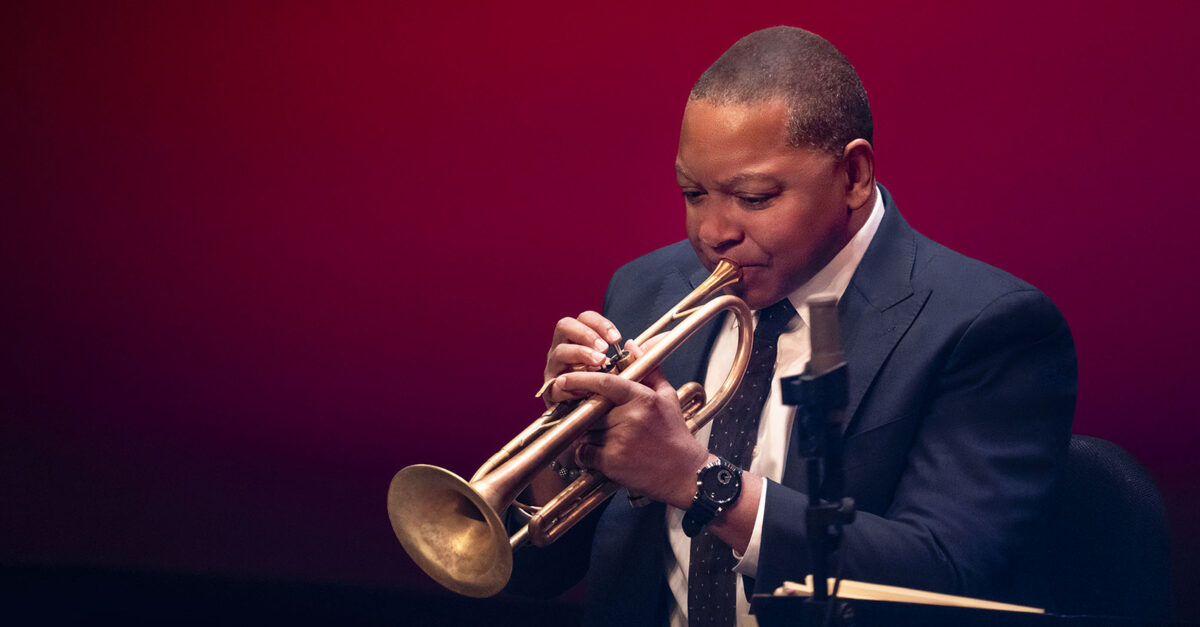
Like Lincoln Center’s Visionary Artist honorees before him—Terence Blanchard (2023), Rubén Blades (2024), and Jeanine Tesori (2025)—Wynton Marsalis has worn many hats over his extraordinary career: He’s a world-renowned trumpeter, band leader, composer, educator, and founder of both Jazz at Lincoln Center (JALC) and the Juilliard jazz program, which celebrates its 25th anniversary this season. And he’s still going strong as an advocate for jazz as a distinctly American art form.
“It’s in his DNA,” says Georgina Javor, Vice President, Concerts and Touring at Jazz at Lincoln Center, who has worked closely with Marsalis for the past several years.“ He feels so passionately about this music, and it’s so important to him that the music lives, that Duke Ellington, Wayne Shorter, and John Coltrane, along with works by newer composers, continue to be performed globally. He’s driven by this mission.”
That mission began in New Orleans, where Marsalis was born into a musical family as the second oldest of six sons. (His older brother is saxophonist Branford.) He moved to New York to attend Juilliard, then in 1987 he founded Jazz at Lincoln Center, which has since become one of the many artistic constituents on its campus. Marsalis recently announced that he will be stepping down as JALC’s artistic director at the conclusion of the upcoming season, which is featuring many of his own compositions under the title Wynton: Come Home.
“We are presenting an incredible overview of his composing career over the past four decades,” Javor says. Those Rose Theater performances include From Cuba to the Crescent City, with selections from his works Ochas and Afro! (October 23 and24); Portraits of Bards, Titans, and Legends, which features works that honor great Americans like Walt Whitman, Mark Twain, and Benjamin Franklin (February 5 and 6); and the celebrated 2018 oratorio The Ever Fonky Lowdown, with actor Wendell Pierce (April 8, 9 and 10); “We’ll also celebrate his many cross-cultural collaborations,” Javor continues, “like The World in Swing, with masters of the flamenco and traditional Brazilian and Arab music (April 30 and May 1).”
Marsalis’ own non-musical voice can be heard during his keynote address, An Evening with Wynton Marsalis: The Future of Jazz and Democracy (Alice Tully Hall, February 10). “His contributions as a scholar and educator are as important as his music,” Javor says. “You’ll get to hear from him directly his thoughts on the world, on leadership, and on arts administration. The artistic legacy of jazz is something he feels strongly about.”
For Shanta Thake, Lincoln Center’s Executive Vice President and Ehrenkranz Chief Artistic Officer, Wynton Marsalis is another example of an artist whose vision and impact resonate across the Lincoln Center campus. “He personifies the promise of Lincoln Center that our institutions coexist and that our artists and audiences can move between them,” she explains. “We learn and grow together because we are in proximity with each other. Wynton has taken the idea of Jazz at Lincoln Center and built a worldwide foundation for jazz that cannot be shaken. The connections that he makes between genres, how he works with artists from JALC, the New York Philharmonic, and Juilliard, is a phenomenal attribute.”
Thake also believes that coming in the year of our country’s semiquincentennial, honoring Marsalis is a uniquely American story. “Wynton is a big believer in the American idea, and how jazz teaches us to be American,” she says. “You can’t untangle the stories of America without thinking of the arts in America.”
For more information on this season’s Wynton Marsalis programs, visit here.