
Earlier this month, Gov. Kathy Hochul announced that among the first 10 projects to receive funds from the $200 million allocated to upgrade Albany’s downtown was a $150,000 grant toward a multimillion-dollar renovation of the Ostrande-Radliff House, the city’s oldest building.
That house was constructed in 1728. That’s undeniably old – but another house not far away was already a senior citizen by then.
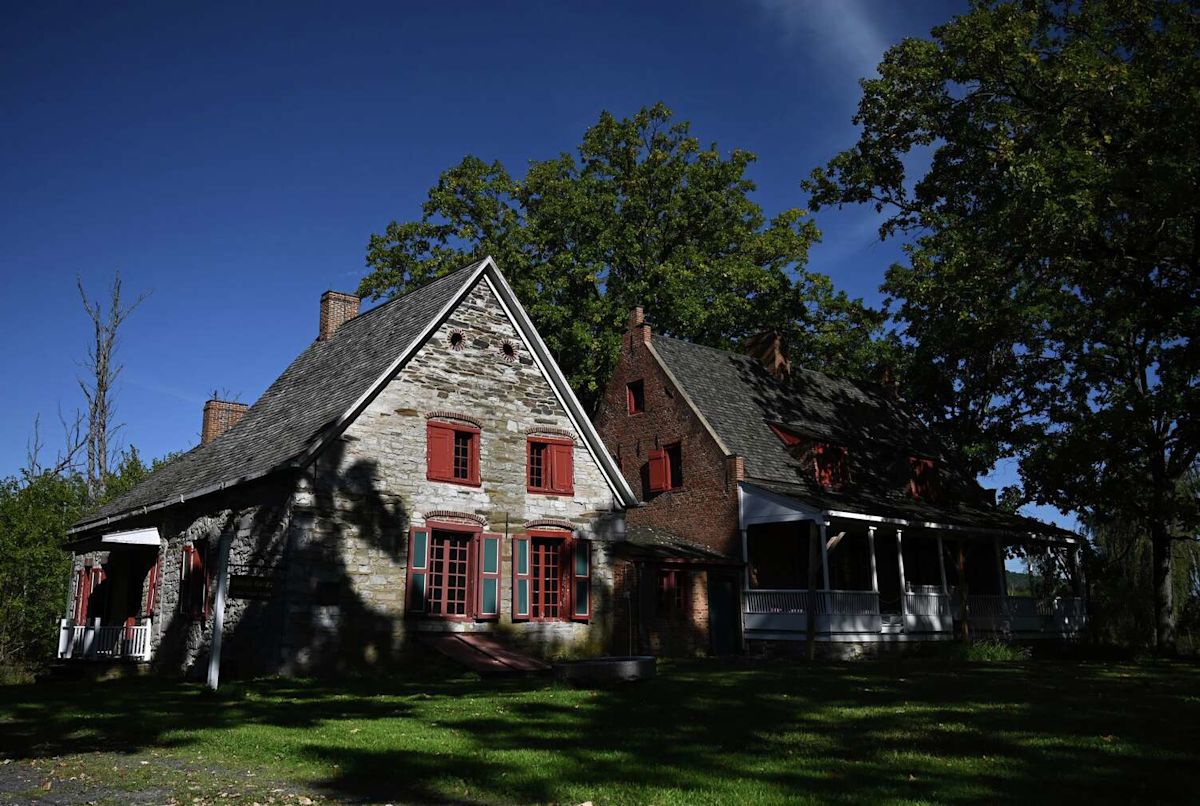
The Bronck House in Coxsackie, built 65 years earlier in 1663, is the oldest house in upstate New York, according to the Greene County Historical Society.
When it was built, New York was still New Amsterdam and Albany was still Beverwyck.
A ‘contentious personality’
The name Bronck is synonymous with New York. Jonas Bronck settled in what is now the Mott Haven area of the lower valley, which became known as the Broncks’ Land and remains the only borough in New York City that still uses the definite article.
Jonas’ younger cousin, Pieter, took a different path.
This Bronck, a sailor from Jonkoping, Sweden, came to Beverwyck with his wife, Hilletje Jans, of Holland. They were married in Amsterdam in 1645 and crossed the ocean to New Netherland seven years later to start a new life.
While Jonas stayed in New Amsterdam, Pieter and Hilletje headed north to Beverwyck, where they opened a tavern and brewery to serve the growing number of traders, fur trappers, native Mohicans and others living on the frontier.
Unfortunately, as the Greene County Historical Society tells it, “The vicissitudes of frontier economy and what appears to be Pieter’s own ‘contentious personality’ resulted in an unstable income stream which made supporting a family difficult.”

An information plaque features information about Pieter Bronck at the Bronck House Museum. Bronck came to the area with his family in 1662 after buying about 1,900 acres from the Katskill tribe. (Will Waldron/Times Union)

A rear window is seen on the main house. The Greene County Historical Society describes it as “a typical rural European-style dwelling.” (Will Waldron/Times Union)
Samantha Siri, events coordinator and a tour guide at the Bronck Museum, said it’s speculated that Pieter was deeply in debt, and that “he had such a bad reputation he was basically run out of town.”
Pieter bought about 1,900 acres at the base of the Kalkberg Ridge from the Katskill tribe (who called the land Koixhackung). In 1662, he, his wife and young son Jans walked 20 miles along the trade route path to his new home. That home, at first, was a hole in the ground covered with a tarp. Within months, they had built a deep stone cellar, felled old-growth trees and milled the wood to build a one-room structure.
The Greene County Historical Society describes it as “a typical rural European-style dwelling.” The stone cellar was built from rubble. The room, measuring 20 feet by 20 feet, was topped with a garret. The cellar and garret were used to store food for the long, hard winters.
“People ate what was in season,” Siri said. “They would stockpile as much as humanly possible in those cellars and attics.”
Winter was a brutal time for the family. Siri said they would only exit the house “to use the privy or outhouse, or to check livestock.” Rodents were a common problem, too.
Three-and-a-half centuries later, the original wood beams, wide floorboards, cellar hatchway and early-Dutch-style door still command the interior space.
And if you look closely, you will see two holes in the garret roof.
“They were to allow owls to nest in the attic space,” Siri said. “They were a form of pest control.”
A legacy of eight generations
Pieter most likely did some fur trading while there, and by the time he died, in 1669, the family was also selling timber and any extra produce from their farm.
Jans Bronck inherited the property and began to expand the home. In 1685, he added a stone “west wing,” comprising a hallway, main room and loft.
In 1738 – the same year the Ostrande-Radliff House was built – Jans’ son, Leendert, and Leendert’s wife, Anna de Wandelear, added a separate brick house, “an excellent example of rural Hudson Valley Dutch architecture modified by a federal period taste,” according to the Greene County Historical Society.
With four rooms, a large garret and cellar, the new house’s size reflected the increasing wealth and power of Pieter and Hilletje’s descendants. New wood paneling was added after a severe storm damaged the structure in the late 18th century.
Later still, other outbuildings sprung up on the site. A so-called kitchen dependency, typical of detached kitchens to prepare food for large households and servants (including enslaved people), faces the rear courtyard. Several barns popped up, including the unique 13-sided structure built in the 1830s, the oldest documented multisided barn in New York. The roof is supported almost entirely by the 13 walls. The only interior framing is one center pole.

The Bronck family cemetery is on the grounds, which are now a National Historic Landmark. In all, eight generations of Broncks lived there. (Will Waldron/Times Union)
Though Pieter was Swedish, the family lived a Dutch life and thrived through Dutch and British rule. When America began its war for independence, the family had already been farming their land at Coxsackie for more than a century.
By the 1770s, Pieter’s great-grandson, Jan Leendert, and Jan’s son Leendert (Leonard) Bronck, ran the farm and homestead. Both pledged “the family’s wealth, farm produce and considerable prestige to the Patriot cause,” according to the Greene County Historical Society. Leonard – who later dropped the “c” from the family name – collected goods for the Continental Army. He was also one of several Bronck family owners of enslaved workers before New York emancipation in 1827.
In all, seven generations of Broncks/Bronks after Pieter held the land for 276 years. In 1939, Leonard Bronk Lampman left the farm to the Greene County Historical Society in his will. It has been open to the public since then, and was given National Historic Landmark recognition in 1967.
The Bronck House and museum also serve as the home of the Vedder Research Library and headquarters of the Greene County Historical Society. For information on tours and upcoming events, visit their website, www.gchistory.org.
Subscribe
There’s more to Albany with the Times Union. Subscribe today for just 25¢.
This article originally published at Upstate New York’s oldest home is older than New York itself.