
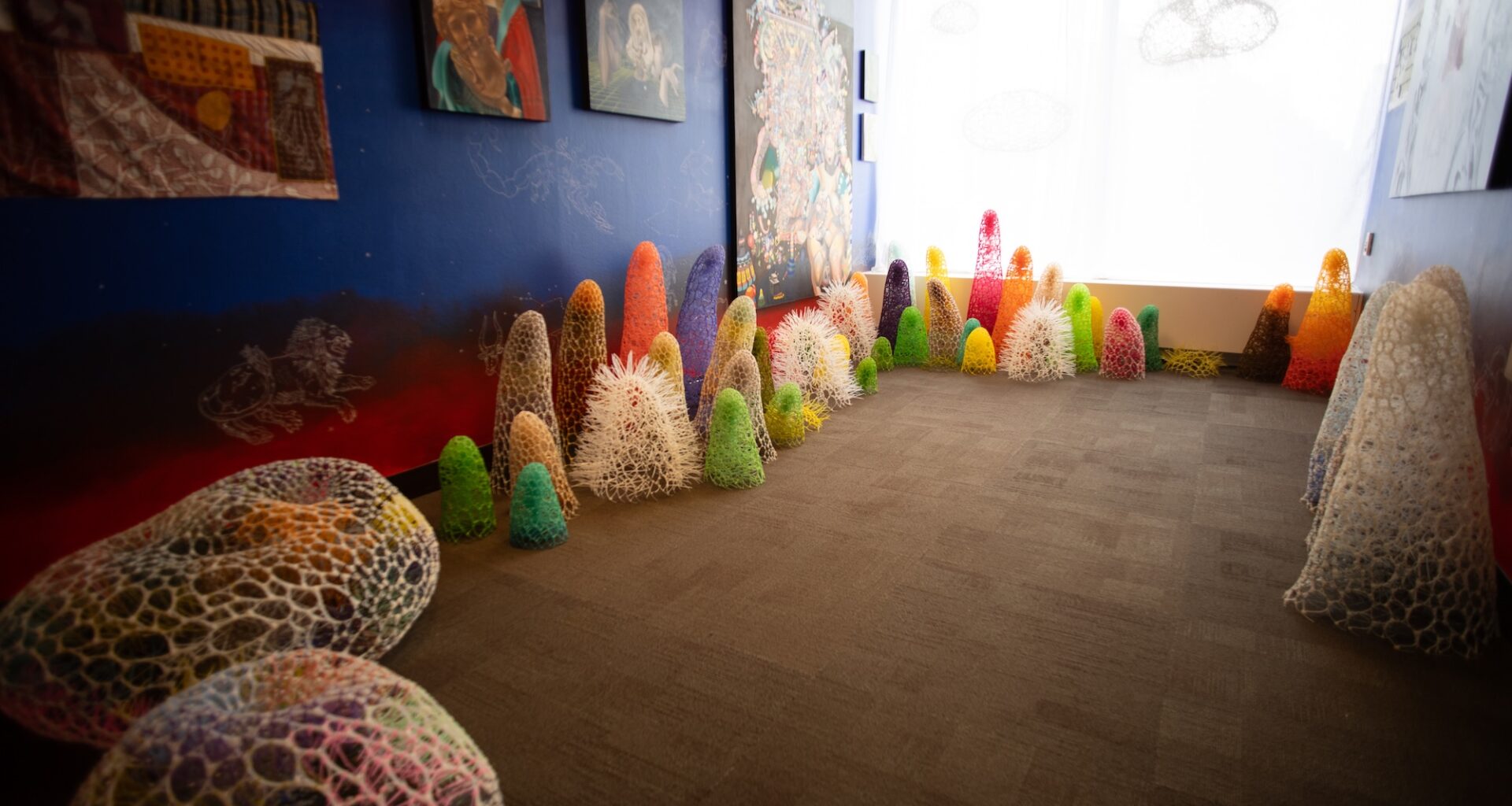
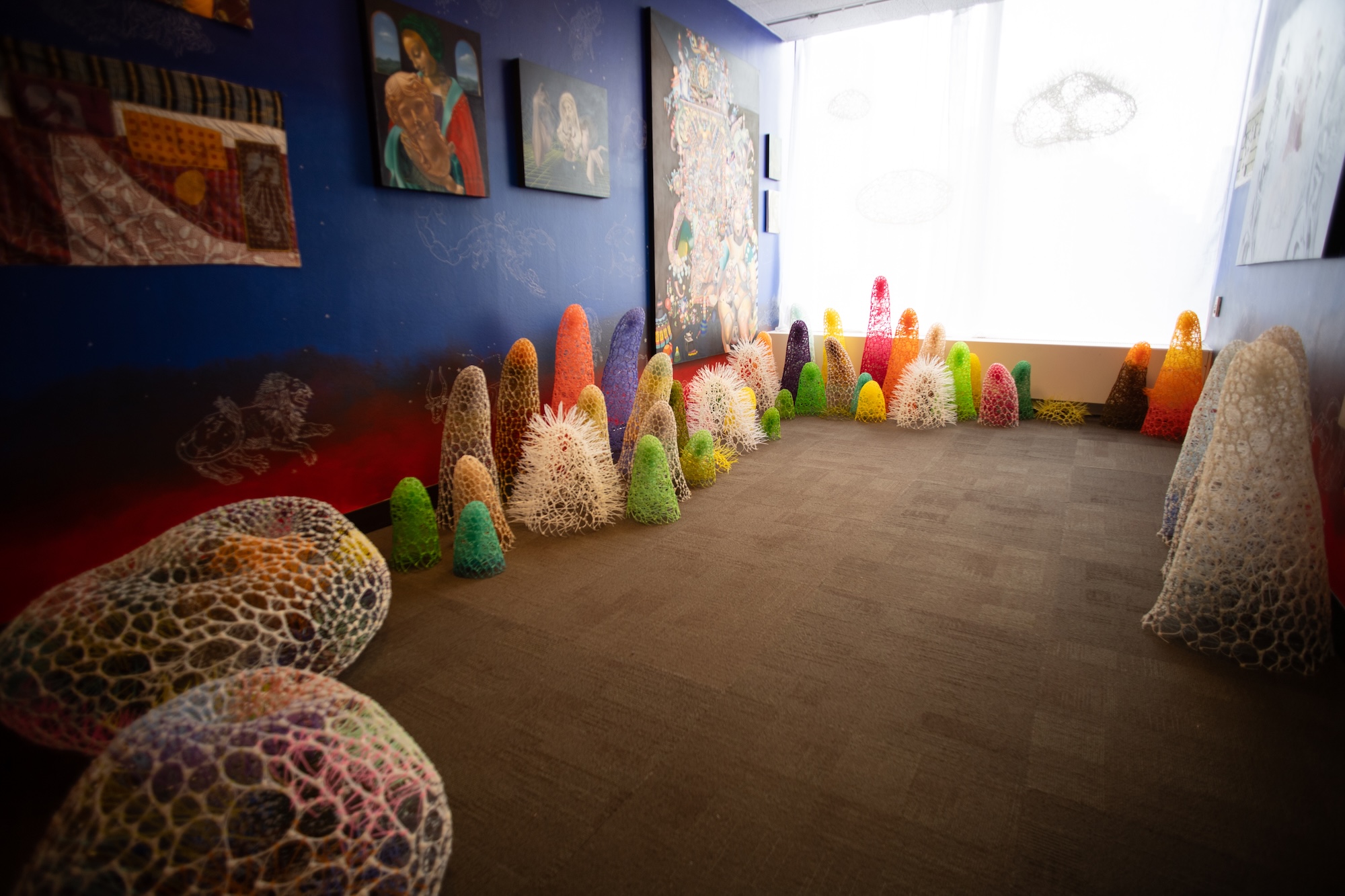
 Installation View: Booth D14 Photo: Chunbum Park, courtesy of SPRING/BREAK
SPRING/BREAK returned to NYC this September with great energy and excitement, coinciding with the Armory Week 2026. The fair takes place in the former CBS News building (555 West 57th Street, Manhattan), located near the Columbus Circle on 59th Street. Wednesday the 23rd was the VIP opening but the busiest time so far was the Opening Night.
Of all the presentations at the fair, the following six booths stand out the most, pushing the ideas and the visual language of contemporary art forward:
1. Booth D14 curated by Jacob Hicks, featuring the works of Michelle Melo, Sui Park, and Jacob Hicks
D14 is a highly ambitious booth that utilizes the motifs of the constellations in the night sky as the backdrop for the works. The works themselves consist of medieval and Renaissance-style portraits that occupy a Euclidean 3D space hinting at the possibility of a fourth dimension (Jacob Hicks), fabric-based collages that suggest the intimacy and feminine or interior aesthetics like a mother’s apron (Michelle Melo), and fibrous and organic sculptures carrying the most dazzling colors (Sui Park). The entire vision is one of great exaltation, optimism, and empathy, bringing the news of hope in the darkest of times, marked by the brazen violations of human rights, the disintegration of the rule of law and the weakening of the international institutions.
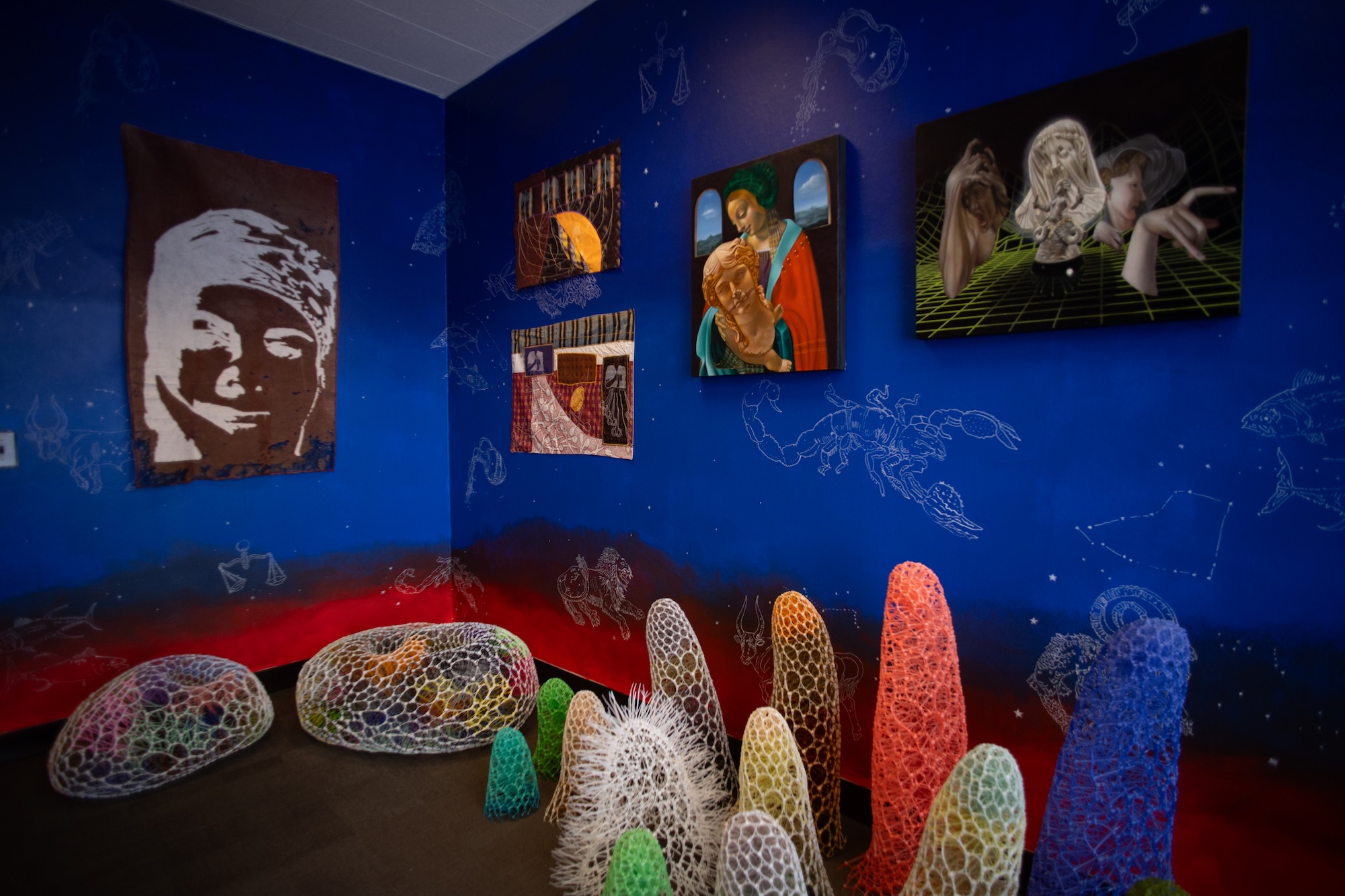 Installation View: Booth D14 Photo: Chunbum Park, courtesy of SPRING/BREAK
Michelle Melo depicts a portrait of Ariadne in her 2014 textile-based work, a Cretan princess who helped the Greek hero Theseus to defeat the Minotaur and married Dionysius, the god of wine and festivity. Jacob Hicks’s “Madonna Litta and Agrippina the Elder Homunculus” (2026) is an oil on panel painting that references Leonardo da Vinci’s portrait of Madonna breastfeeding the infant Jesus, and the homunculus (a miniature human-like being as theorized amongst alchemists as predecessors to the scientific notion of sperms and eggs) as an idea regarding aristocracy and its corrupting, unequal impact on society. The woman depicted in the form of the scarred and broken bust is Agrippina, the widowed and exiled wife of Germanicus Julius Caesar during the Roman Empire. It is simultaneously substituting and merging with the baby Jesus to become an amalgamation of sort within the symbolic realm.
Their reverent incorporation of Greco-Roman, Renaissance, and other classical mythologies in their works extend outward onto the surrounding walls in the form of the star signs, which in turn express the zodiacs and the stories that accompany them. Two of the several signs that were shown on the painted walls include the Scorpio and Virgo, and they defy the simple and symmetrical binary logic of yin and yang, light and dark, and so on. No one sign is better or worse than the other, but every sign and the person or the persona represented belongs in the world on human terms, each endowed with strengths and weaknesses.
Sui Park’s organic sculptures are also democratically conceived through the power of jeong (Korean concept for shared and universal empathy) and the belief in our existence in an interconnected universe. The sculptures reference the web-like arrangement of neural networks in the brain and supergalactic clusters that astronomers and cosmologists study in the night sky.
2. Booth D5, featuring the works of Anna Friemoth
Anna Friemoth’s 2026 series, titled, “Spectropia,” begins with the impact that social media has on our psychology and society to study the “tension between intimacy and alienation in our culture of perpetual sharing.” Friemoth’s photographs mostly show found images from a friend’s family archive overlaid on the living room of an American home featuring a TV set.
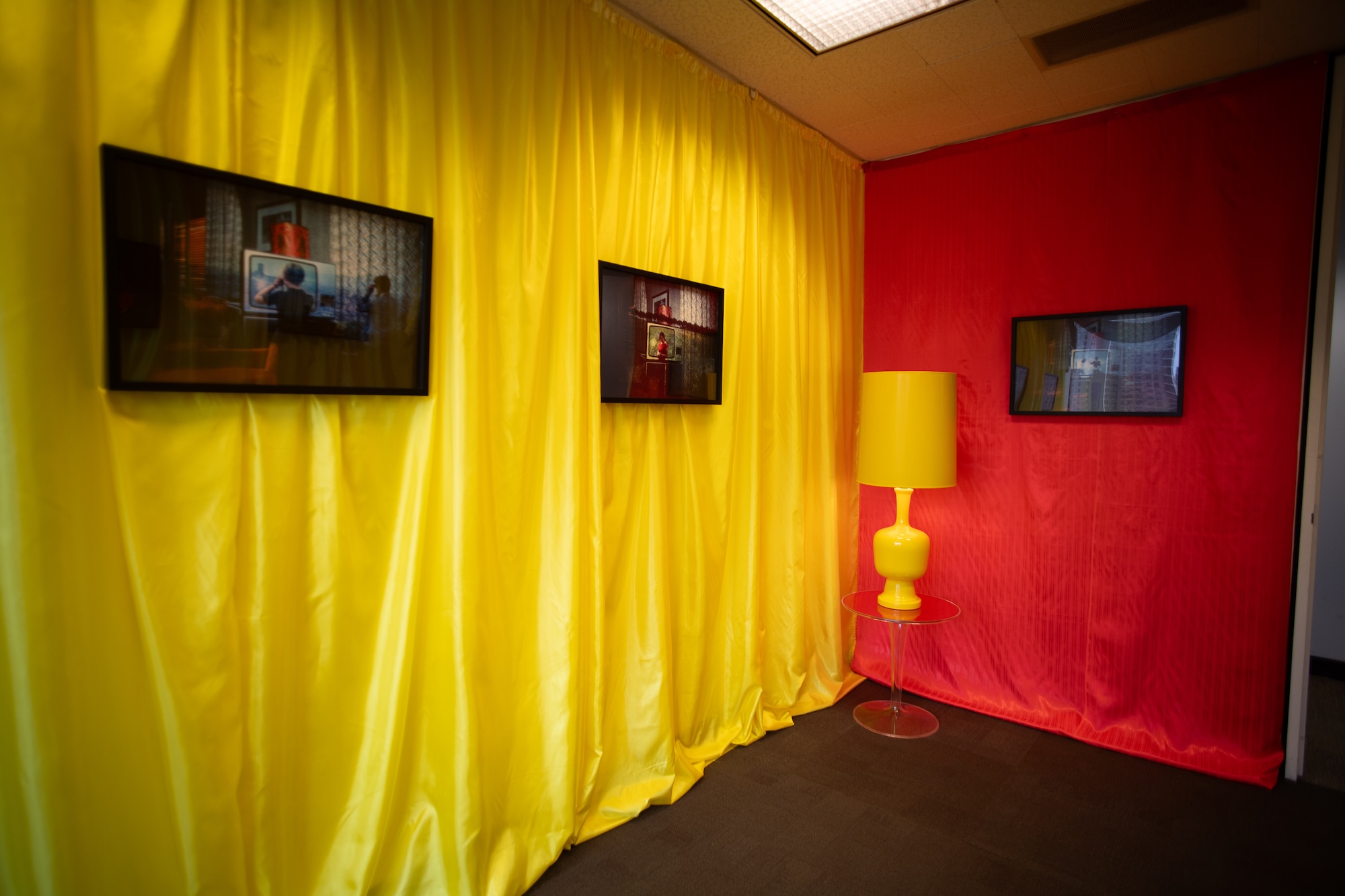 Installation View: Booth D5 | Artist: Anna Friemoth
The important question is how we must define what is real and true and what is a simulation – do we identify only physical reality and space that we can touch and walk into as real, or is the digital screen or projection also a form of reality? We know that the dichotomy between the analog and the digital photographs, in which we associate the analog with the idea of truth and unaltered documentation of history, is mostly false.
However, the analog photograph takes time, labor, and material costs because they are based in film, which only avails 36 shots per roll and must be developed in the lab prior to being scanned or printed. The strict boundary between analog and digital is also blurred because many photographers scan film photos onto the computer and edit them in the (Adobe) Lightroom, rather than doing all the editing in the traditional dark room.
Anna Friemoth’s photographs are photos about photos, just as Hans Hoffman’s painting at the 2026 Armory Show becomes a painting about painting. Friemoth’s works investigate the nature, the mechanism, and the context by and in which the photographs and images are made, seen, and distributed.
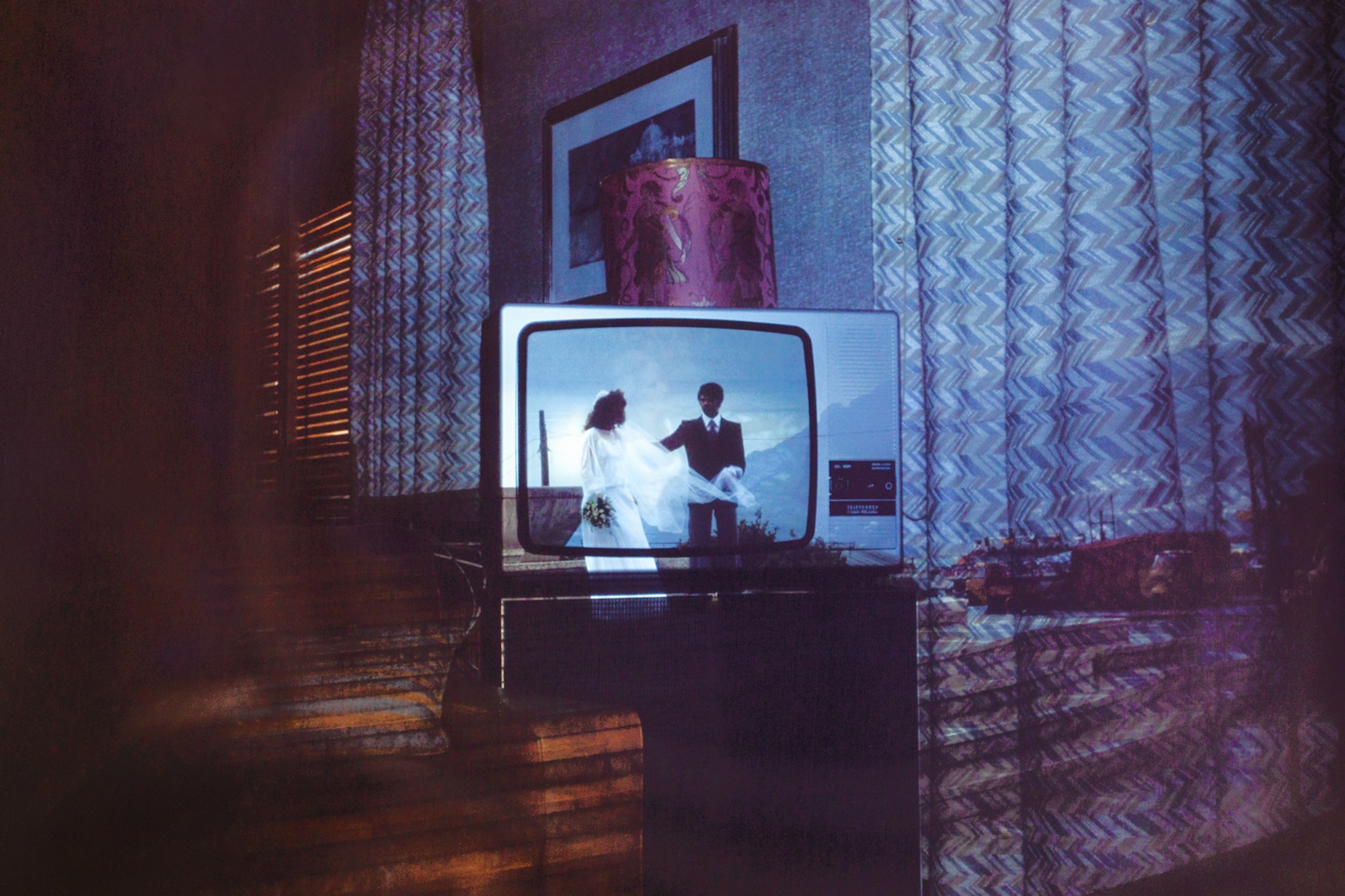 Anna Friemoth – “Spectropia 1” 2026, courtesy of the artist.
Friemoth states that her series “project[s] a sense of networked fluidity onto analogue history, blurring the line between what is real and imagined, what is private memory, and what we share with the world.” However, the core nature of images (and physical reality) is that there is no absolute truth, and images do not represent an absolute underlying reality. This is because the image or vision that we perceive is not continuous, just as the particles like photons constitute discrete packers of energy and electrons orbit the nucleus in discrete levels of energy. Just in my own personal experience, I began to accumulate tens of thousands of red dots in my vision when I was in 5th grade, which suggests that the continuous human vision is actually discrete, like a computer display with millions of pixels.
Thus, if we accept that the idea of a continuous and singular image is an illusion and a product of the human brain and perception, we can arrive at the true nature of image, which is a simultaneously orchestrated, complex dance of colors and/or values and which can be a literal representation of reality but not necessarily. The boundaries that we set between different kinds of images, such as digital images, AI-based renderings, digital photographs, and analog photographs, are very much arbitrary and fictional. The fundamental nature of images may be that there is no strict boundary between truth and fiction, and only through fiction can images actually represent the truth and the aesthetics that we humans desire to know and see. And this is what Friemoth’s works actually suggest through the blurring of lines between the analog and digital, fiction and nonfiction, and what is shared versus what remains private.
3. Booth B18 curated by Dessarae Bassil of the Moisturizer Gallery
Booth B18 curated by Dessarae Bassil of the Moisturizer Gallery is a BIPOC and women-focused manifesto by the members of the Girlhood Studies, which celebrates the perspectives and identities of those belonging to the outside of the mainstream American white male perspective.
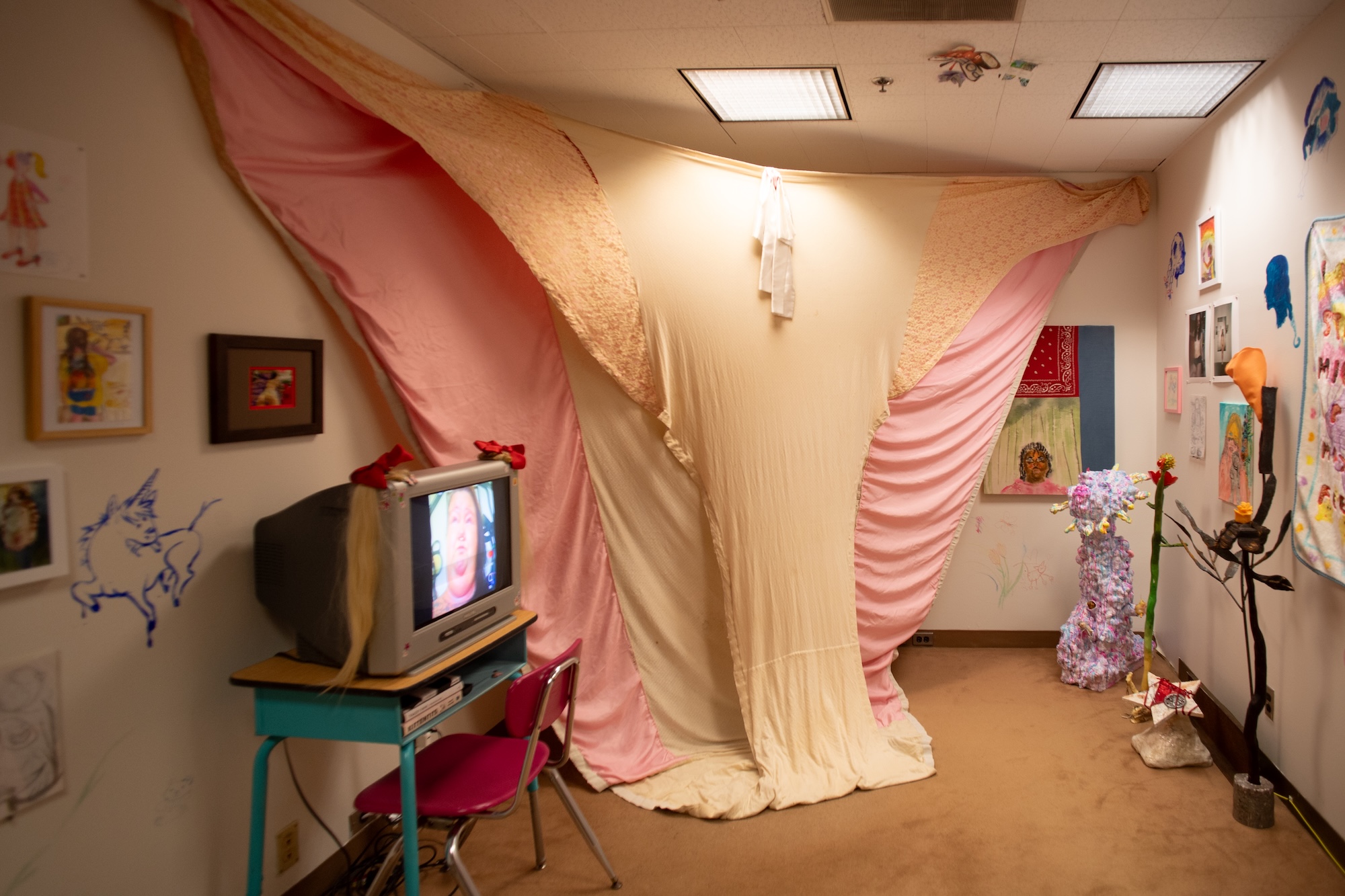 Installation View: Booth B18 Photo: Chunbum Park, courtesy SPRING/BREAK
Dana Robinson is a figuratively abstract artist who investigates the potential of the painting’s semi-abstract figurative language to convey the ideals of anti-racist aesthetics and the African American portraiture. Her monographs involve the lush smushing and stamping of hues that spread and wet the canvas in circular patterns. This circularity of forms complements and reinforces the roundness of the facial features of the African American physiognomy, including the rounded nose and cheekbones. The style, which imbues great strata of values and spectra of hues to the figures on the level of psychology, light, and its interaction with the flesh, resists and defies the angular and triangular forms of the white beauty ideals.\
Artists featured. Dana Robinson, Z Walsh, Jia Sung, Cynthia Chang, Zoe Kellough, Jessica Blinkhorn, Dessarae Bassil, Keiaria Williams, Jay Michelle Elizondo, Sara Jean Ruiz, Noelle Velez, Mallory Concetta Smith, Clo Pantano, Drew Scanlon, DW Zinsser, and Manuela Vieragallo.
4. Booth A4 curated by SPRING/BREAK as part of the Artist Spotlight, featuring the works of Fernando Orellana.
Fernando Orellana trained first as a painter then as a muralist before delving into robotics, automata building, and the moving sculptures with variable joints that are featured as an Artist Spotlight in the SPRING/BREAK. The style and language of these pieces beckon the geometric and minimalistic visions of the super reality of forms as found in the Suprematist paintings by Kazemir Malevich and the Proun paintings by El Lissitzky. The joints that enable variable geometry and highly complex maneuvers manifesting in multiple configurations via circular, linear, expanding, and contracting movements suggest the metaphor of the human eye, which blinks seemingly instantaneously but is vulnerable to the camera in the midst of the blinking movement.
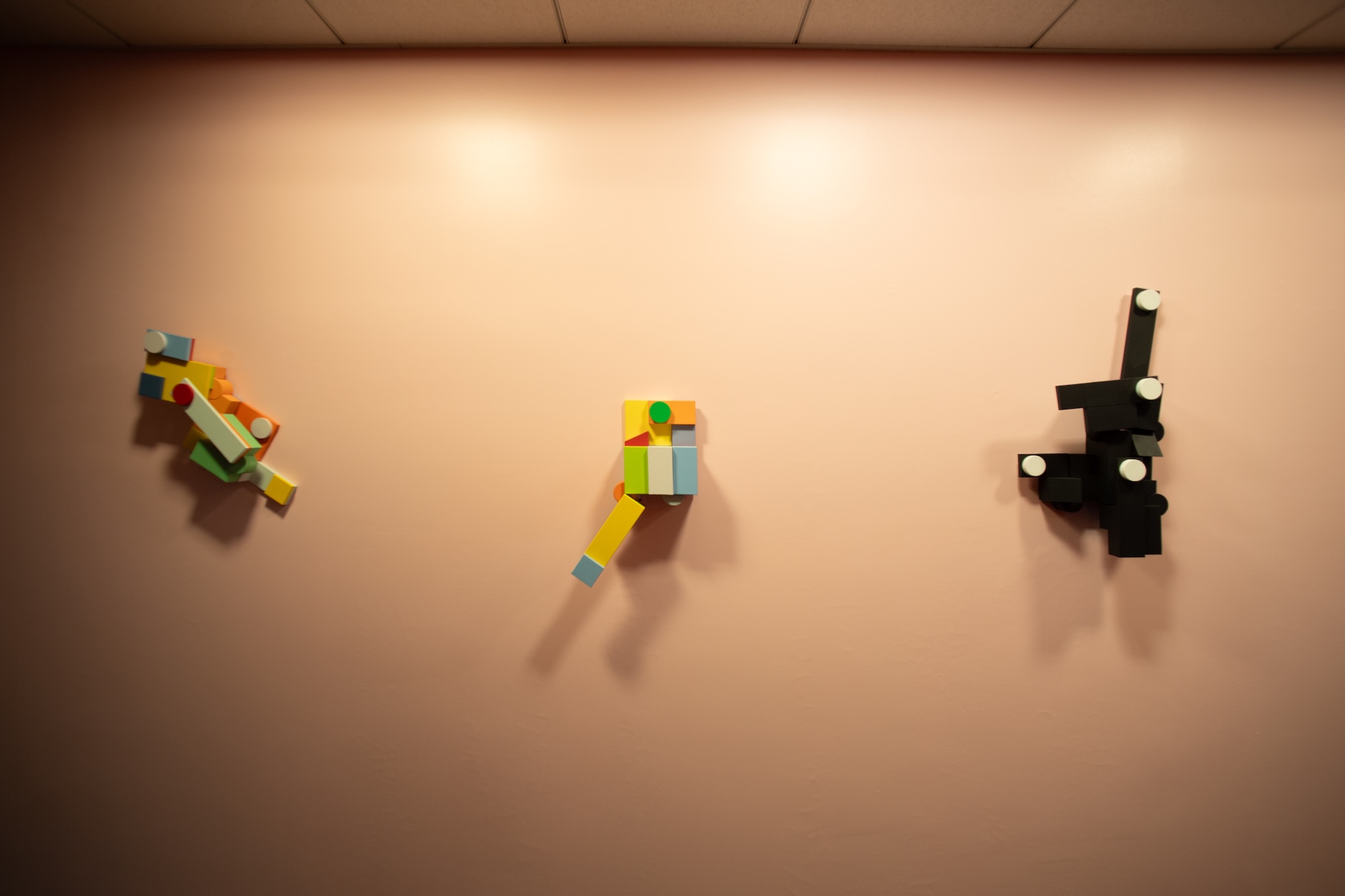 Installation View: Booth A4 (Photo: Chunbum Park, courtesy SPRING/BREAK
It is difficult to say when the ideal pose or configuration of the arms and bodies is achieved by this repeating movement. Depending on the personality and the subjective eye of the viewer, the sculpture could present an idealistic or intriguing configuration in the stationary state or in the fleeting moment within its movement. The tendency for humans to photoshop or to delete and filter out the unideal states of humanity and all other objects and subjects within an aesthetic endeavor is both idealistic and dystopian. Picking favorites and discarding the less ideal forms and versions is both creative and undemocratic, and this is a contradiction of the dominant paradigms of beauty and aesthetics in the status quo in relation to the progressive ideals. Only by being fully present in the moment of the sculpture’s presence and movement can one truly appreciate and catch the configurations that are ideal to oneself.
5. Booth A19 self-curated by Kiran Joan and Aminah Alkanderi.
Kiran Joan and Aminah Alkanderi are Indian ceramic sculpture and Kuwaiti fabric artists respectively, who collaborate on the basis of the shared heritage in fabrics, colors, and patterns between India and Kuwait due to the legacy of the Silk Road.
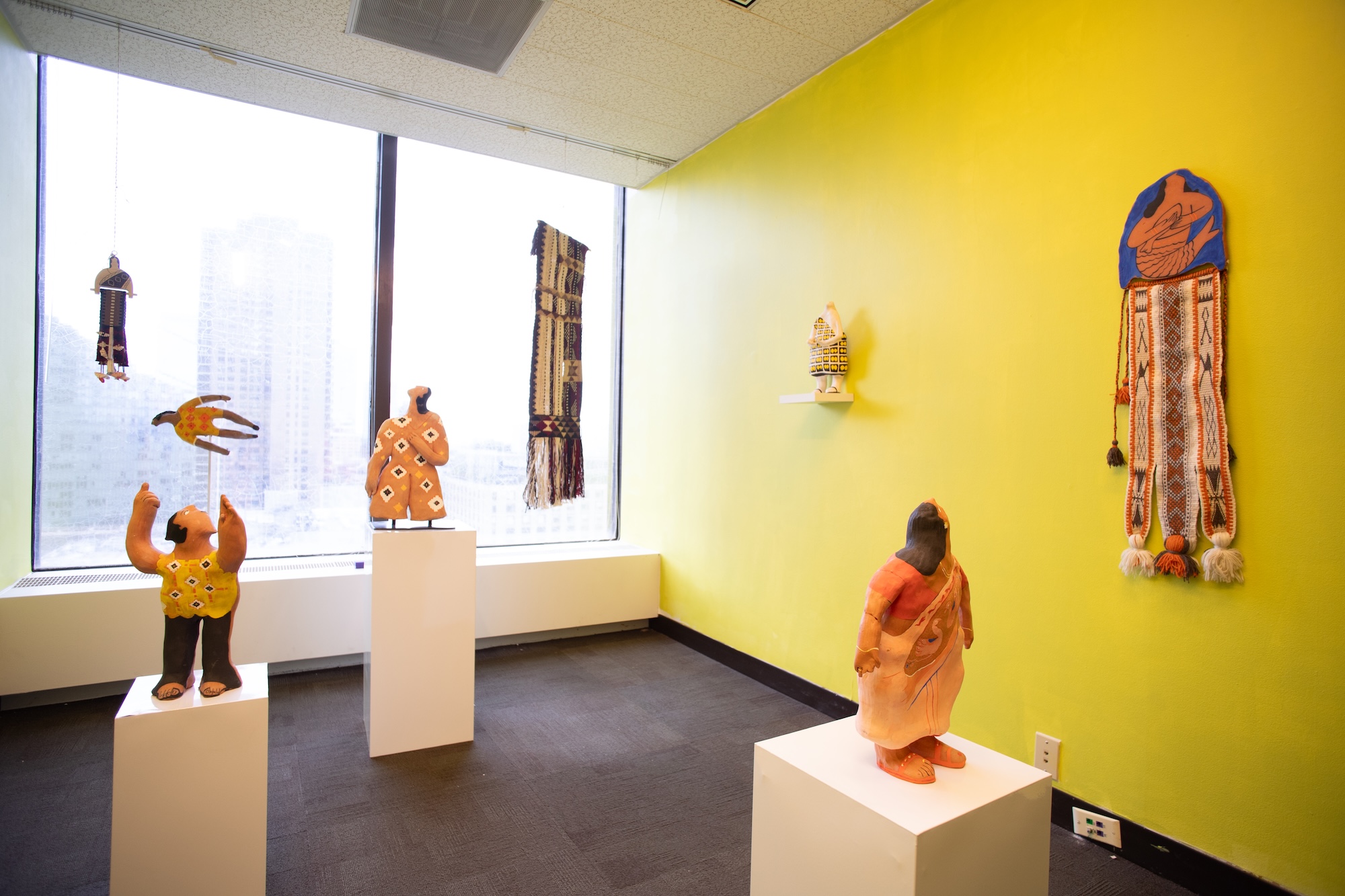 Installation View: Booth A19 (Photo: Chunbum Park, courtesy SPRING/BREAK
Joan’s sculptures reference Madras checks from South India and Ikkat from Gujurat, and they are generously and diversely shaped semi-abstract figures by the power of symbolic revelations and imagination. Reminiscent of the sculptures and paintings of the semi-abstract spiritual figures by Kiki Smith and Katherine Bradford, Joan earnestly investigates the figure within the context of the Indian national identity, heritage, and art canon.
Alkanderi’s textile art is based on Al-Sadu weaving, a women’s handicraft practiced mostly by the Bedouin (nomad) women of the State of Kuwait. It often deviates into the territory of design and art with utility, such as a saddle bag, but the spiritual and symbolic connotations and imagery hold back the work from devolving into a commercial situation or state. The patterns are reminiscent of certain Native American fabrics and textiles, such as those of the Navajo tribe. Just as the pyramid form of architecture appeared and appeared again and again in Egypt, China and northern Korea/Manchuria, and Latin America, the similar patterns carrying spiritual symbolism have made their ways into the evolution of fabrics within multiple cultures across oceans in different continents.
Collaboration by Joan and Alkanderi in the form of “Sand Dunes” (2026) is most interesting, situating a sculpture of a camel by Joan on top of a carpet-like fabric piece by Alkanderi. Despite having been made by two artists, the vision achieves concord and cohesion in terms of colors, the abstract patterns, and the narrative, which is one of journeys (through the desert) in the pursuit of experience, learning, and shared prosperity. Transformation is unavoidable in journeys of such an extensive and large scale. The idea of a trade on equal terms is also important to this work because the artists each have strengths and weaknesses, and only through communication and collaboration could they overcome their weaknesses to create something to share… for themselves and the world.
6. Booth D2 curated by Jeffrey Allen Price
Booth D2 is a quirky, highly intriguing, and paranoid presentation on the phenomena of UFO’s (unidentified flying objects), also known as UAP (unidentified aerial phenomena)’s, curated by Jeffrey Allen Price, involving paintings, sculptures, and manipulated photographic images of Susan Carr, Dasha Bazanova, and Oliver Wasow.
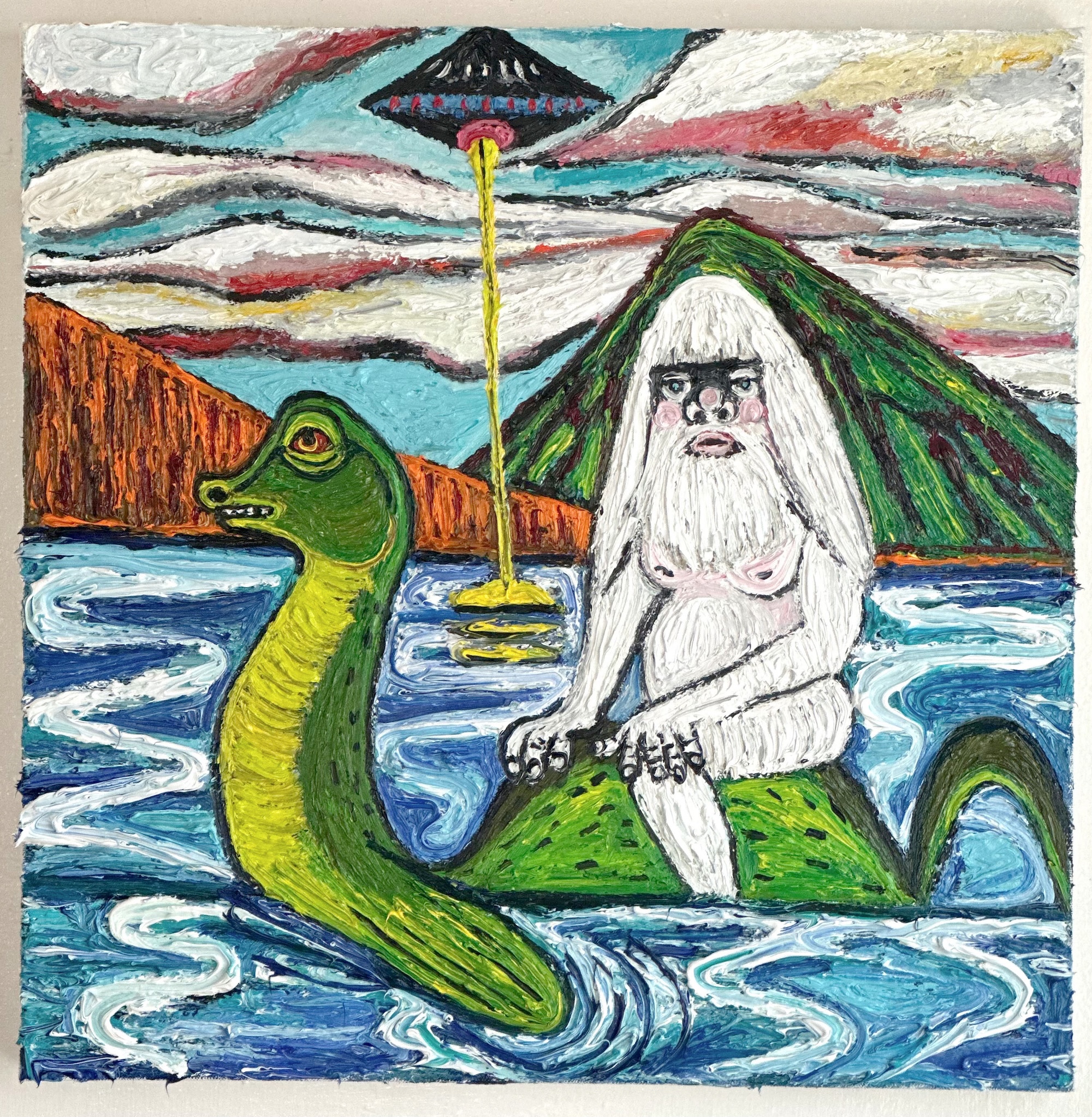 Susan Carr – “The Hermit” (2026), oil on canvas (painting), 20 x 20 inches.
In this day and age, when conspiracy theories are popular, paranoia and skeptical skepticism and theorizing blur the boundaries between what is conventional wisdom and what is outside that norm. The works, such as Bazanova’s miniature sculpture, “Bovine Abduction I” (2026), and Susan Carr’s oil painting, “The Hermit” (2026), are highly subversive and eye-catching at the same time, piquing our interest in the corner of our eye even as we deny staring and wondering at them. Bazanova’s work is an iconic rendition of the alien vessels abducting cows, and Carr’s painting borderlines cartoon-like mythologizing of a UFO sighting, Big Foot, and Lake Erie Monster simultaneously in one go. In Oliver Wasow’s “Three Discs” (1985), it is easy to assume that the “photograph” depicts two UFO’s with the third image being a reflection, but upon closer examination, the first and third UFO’s are both unique in shape and in how they reflect light from a particular angle, suggesting that all three UFO’s are either physically real or a figment of our imagination. The three UFO’s carry an impossible situation or capability, just as the conventional understanding of physics cannot explain how they maneuver without any exhaust and teleport away in an instant.
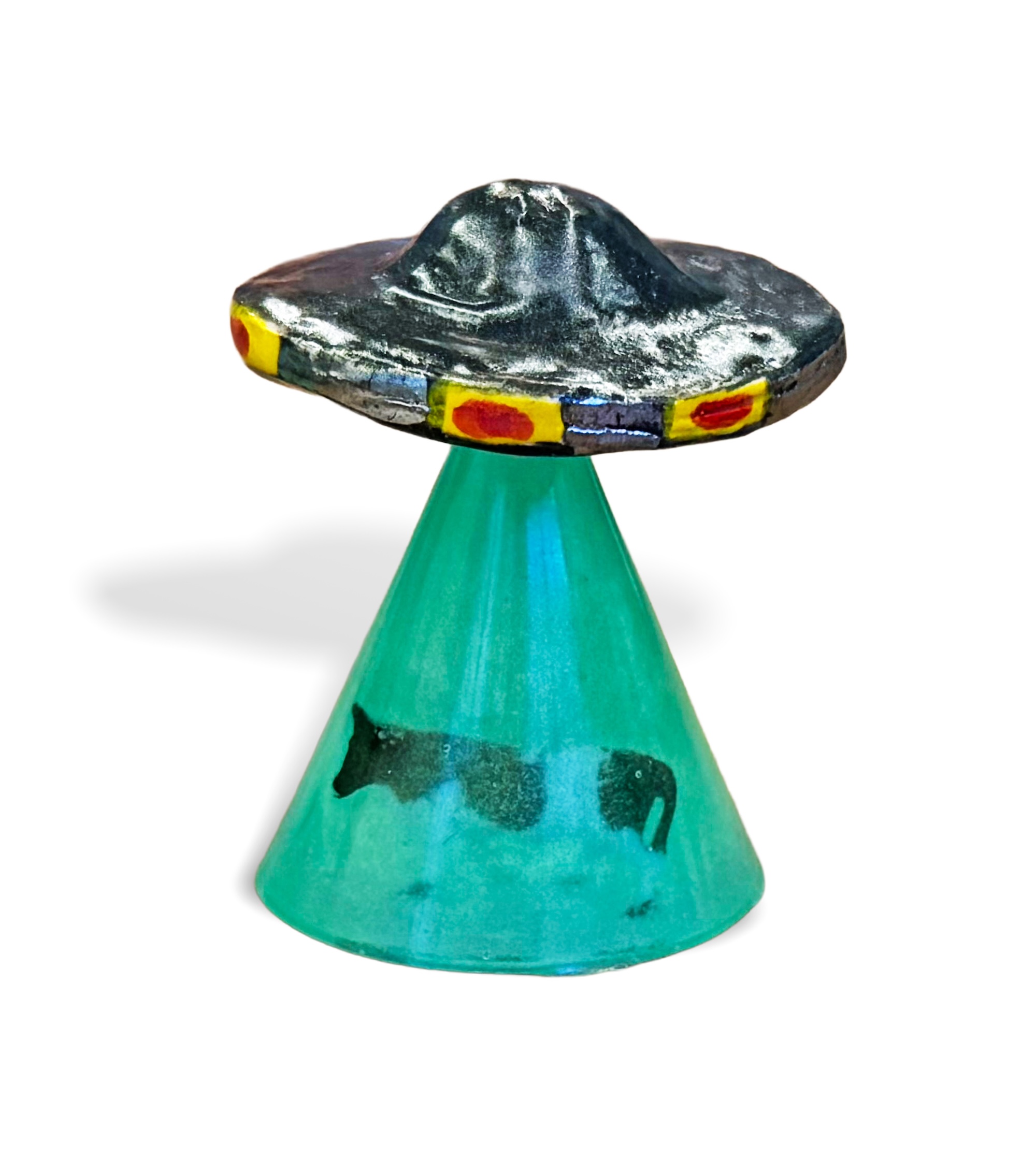 Dasha Bazanova – “Bovine Abduction II” (2026), Ceramic, white gold luster, mixed media in resin (sculpture), 5.5 x 3.5 x 3.5 inches.
The lines separating reality and fiction, sanity and insanity, and public trust in the institutions versus distrust completely break down in this highly bizarre but equally meaningful presentation. Perhaps this is a necessary mechanism for artists to constantly question the established narratives set by the powerful institutions, experts, and government officials. Only by critically examining the nooks and grannies of the official narrative can we truly identify whether someone is a whistleblower and is bravely speaking the truth out of necessity for the good of the public, or the person has derangement syndromes that cause chaos and unnecessary conflict in the public sphere. And if artists can resist conformity and make something very weird and interesting at the same time out of this creative endeavor, then the artist has fulfilled his/her/their role and life calling because it is entirely possible that the truth is being spoken in hidden codes while being packaged as a “conspiracy theory.” Truth must come out into the limelight, always. Artists featured: Dasha Bazanova, Susan Carr, Daniel Martin Diaz, Bernard Klevickas, Barbara Slitkin, Ionel Talpazan, Oliver Wasow, Mark Wilson, and Charles Yuen.
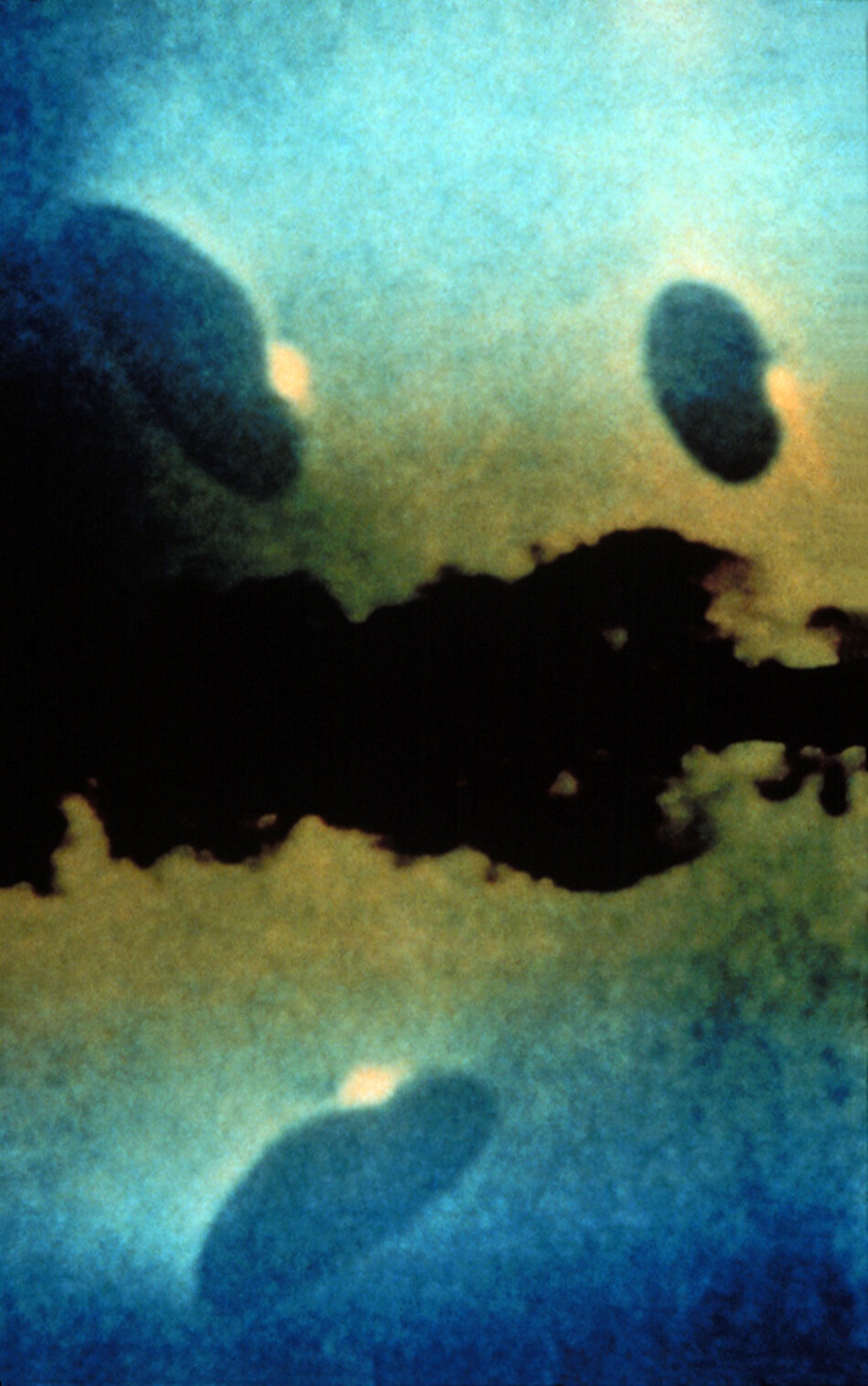 Oliver Wasow – “Three Discs” (1985), Archival inkjet print (photography, edition 3 of 3), 30 x 16 inches.
SPRING/BREAK Art Show NYC, September 23rd–28, 2026, 555 W 57th Street
CategoriesTags