
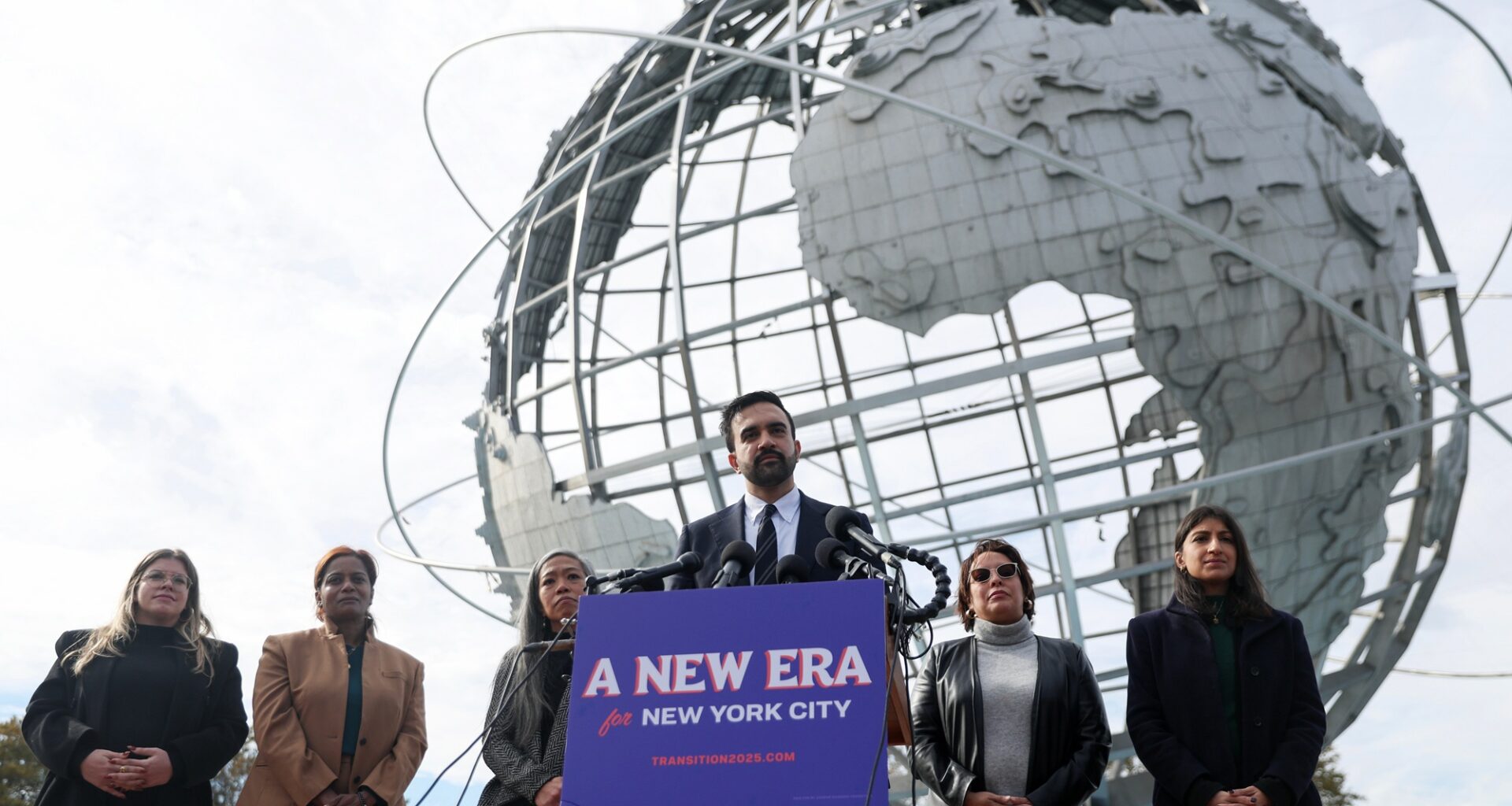
Amid the horrors of a second Trump presidency, from ICE kidnapping U.S. citizens to trying to make children go hungry by denying SNAP benefits, Zohran Mamdani’s election in New York City has become a rare source of hope. Around the world, people will be watching to see whether left-wing governance can deliver.
It won’t be easy. Just as Wall Street tried to kneecap Mayor Bill de Blasio when he proposed universal pre-K, powerful interests will now do everything they can to discredit the idea that democratic socialism can function at the municipal level—never mind the history of Milwaukee’s sewer socialists, the fact that New York City already runs public schools, parks, libraries, hospitals, and “public housing for about one in 17 residents,” or the fact that de Blasio, “over eight years, [already] froze rents on rent-stabilized apartments three different times.” I worked for Mayor de Blasio, and I saw up close how the financial establishment works to threaten anyone who challenges its power. The only answer is to sustain political support by make daily life better for working-class New Yorkers and doing so publicly, visibly, loudly, and through every medium available. And when that doesn’t work, to create new mediums to get the message out.
Having just left the Consumer Financial Protection Bureau, I’ve also seen firsthand how much of the ambitious economic populist work once under way at agencies like the CFPB and FTC has been rolled back at the federal level. Mamdani now has the opportunity to carry that mission forward at the city level, taking on corporate power and addressing cost-of-living concerns.
What to do? Bernie Sanders reportedly advised Mamdani’s team to focus on their first hundred days in office, rightfully warning that opponents would try to crush them, and stressing the need to project visible action. He encouraged them to treat policy and communication as one, citing Trump’s example. Sanders also pressed them on whether they had mapped out their executive authorities, even asking former FTC Chair Lina Khan, who’s now co-chairing the mayoral transition, for ideas on how City Hall could use its powers.
In that spirit, Mamdani could launch a 100-day affordability sprint, using executive and emergency powers creatively and expansively, not to crack down on citizens as Trump has done, but to lower costs for ordinary people.
A public option for medicine. Mamdani could create a city-run partnership to produce and distribute low-cost generic medicines. Working through the Economic Development Corporation, the city could finance and partner with a nonprofit manufacturer to produce affordable versions of essential drugs like insulin and EpiPens, which NYC Health + Hospitals could distribute through its public hospitals and clinics.
Declare a state of emergency. New York City’s mayor can declare a local state of emergency under Executive Law § 24, arguing that surging food prices or Trump’s tariffs on food imports have created a man-made emergency that threatens the health of New Yorkers because groceries are unaffordable. That declaration would be one way to trigger the city’s price-gouging rule (6 RCNY § 5-42), under which the mayor could direct the Department of Consumer and Worker Protection (DCWP) to investigate excessive markups, request documentation of wholesale costs, and issue fines where price hikes can’t be justified. The city could also launch a short-form video series, “Corporate Price-Gouger Watchlist,” a social media–era update to the NYC Public Advocate’s Landlord Watchlist, to name and shame offenders. And if courts push back, the mayor could use the resulting public attention to press the city council and state legislature to strengthen price-gouging laws.
Investigate price-gouging. Under existing law, without an emergency declaration, the DCWP also has tools it can use to compel information and investigate unfair pricing. The agency has subpoena authority over licensed businesses under Administrative Code § 20-104(d). Mamdani could direct DCWP to use these powers more aggressively to examine cost-of-living abuses by companies like food delivery platforms, while pressing the city council to expand the city’s consumer protection authority to reach beyond deceptive and unconscionable trade practices, to also cover abusive conduct.
Create a new affordability office. To coordinate the city’s fights for affordability, Mamdani could establish a deputy mayor for affordability by executive order to consolidate oversight of housing, food, and child care under a single point of accountability. The deputy mayor could convene HPD, HRA, DOE, DCWP, DOT, and other agencies to align enforcement and rulemaking efforts around cost-of-living goals, coordinate crackdowns on price-gouging and hidden fees, and publicly report on progress through regular affordability briefings. Mamdani could also launch a citywide Junk Fee Task Force, bringing together staff from DCWP, HPD, DOHMH, and other agencies, to coordinate efforts to crack down on deceptive and hidden fees that inflate costs.
Investigate deceptive pricing and packaging. As part of that coordinated effort, the mayor could direct DCWP to investigate supermarket chains for deceptive pricing and packaging practices that erode New Yorkers’ purchasing power. That includes shrinkflation, or selling downsized products that are packaged to appear bigger, hidden fees, and misleading unit pricing. Each of these tactics can qualify as a “deceptive trade practice” under Admin. Code § 20-700, since consumers could be misled about what they’re paying for. Using DCWP’s rulemaking authority, the city could also define as deceptive any failure to disclose the total price of a good, service, or rental up front.
Leverage city contracts and procurement. Finally, Mamdani could put municipal procurement and contracts to good use advancing public-policy goals. New York City awards over $40 billion in city contracts annually. The mayor could issue an executive order directing the Mayor’s Office of Contract Services to automatically disqualify any city vendor that engages in deceptive pricing tactics or any vendor with an unpaid wage theft judgment or a threshold number of violations recorded by the New York State Department of Labor or DCWP’s Office of Labor Policy & Standards.
Mamdani begins his term with something few mayors ever have: an energized following and an international megaphone of this magnitude. That attentional power matters. Even occasional Mamdani critic Congressman Ritchie Torres recently argued that Mamdani’s megaphone will allow him to get stuff done. But that moment of opportunity will not last forever. He should act quickly and decisively.
Recommended Reading