
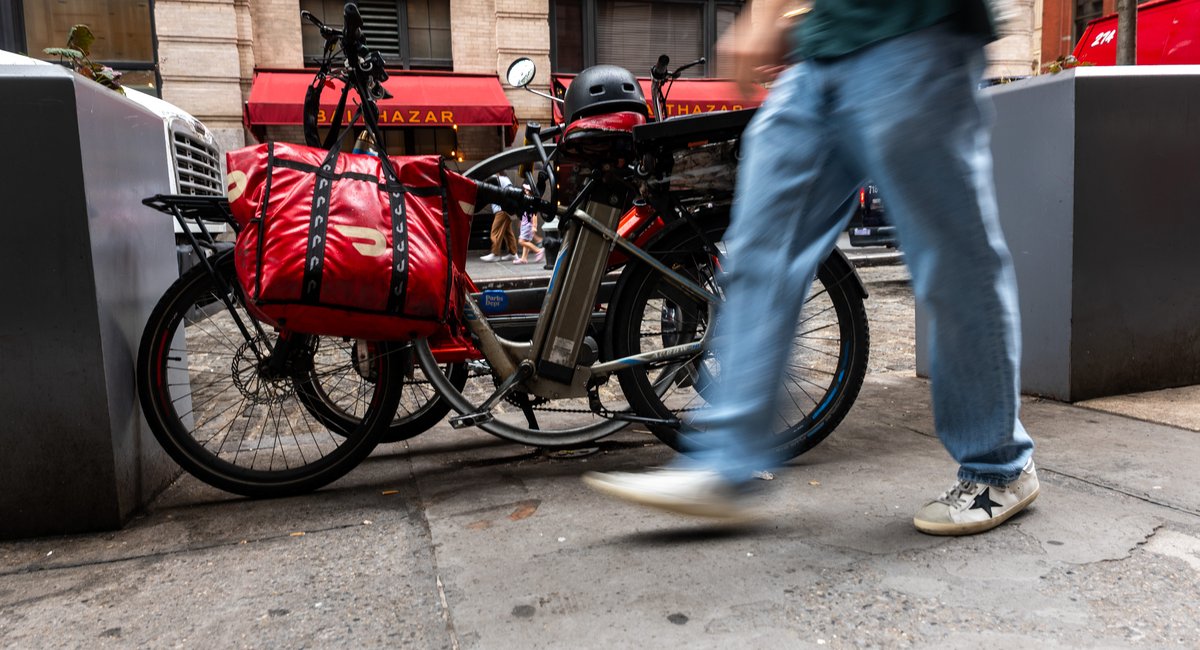
New York City Council members are considering a new set of rules for e-bikes, scooters and mopeds as these increasingly common modes of transportation continue to raise questions about safety on the city’s crowded streets.
The Council’s Committee on Transportation and Infrastructure is set to meet at 10 a.m. Wednesday to discuss more than 20 bills tackling micromobility safety — from cracking down on illegal devices to further regulating delivery apps and boosting enforcement involving e-bike and e-scooter riders.
New York law, which legalized certain e-bikes statewide in 2020, divides them into three categories: Class 1 e-bikes are pedal-assisted and provide assistance up to 20 mph; Class 2 e-bikes can be powered by a motor without pedaling and provide assistance up to 20 mph; and Class 3 e-bikes can also be powered without pedaling and provide assistance up to 25 mph.
E-bike riders must be at least 16 years old, but they don’t need a driver’s license or vehicle registration to operate a legal e-bike.
Three bills on the docket specifically aim to take Class 3 e-bikes off New York City streets. One piece of legislation, introduced in January by Councilmember Crystal Hudson of Brooklyn, would prohibit shops from renting or selling Class 3 e-bikes, with no fine for a first violation and fines of up to $2,000 for subsequent violations.
A separate bill, also introduced by Hudson, would make it illegal to ride Class 3 e-bikes on streets, in parks and other public spaces. And a third bill, introduced by committee Chair Shaun Abreu of Manhattan, would create a trade-in program for New Yorkers to swap their Class 3 or other ineligible e-bikes for a Class 1 or 2 e-bike or a voucher toward one.
Several bills focus on delivery apps, including one introduced by Councilmember Gale Brewer of Manhattan that would require food delivery apps to carry liability insurance covering crashes involving workers who are making deliveries or are available to do so.
Another bill introduced by Abreu would require food delivery apps to submit annual safety reports and safety plans to the city.
New Yorkers were invited to testify in person or over Zoom.
There are also bills targeting illegal vehicles, including one that would require the NYPD and the city Department of Transportation to establish a program allowing police to test the power and maximum assisted speed of suspected illegal micromobility devices using a dynamometer.
The bills have substantial implications for delivery workers, who rely heavily on micromobility vehicles. The Workers Justice Project, a group that advocates for delivery workers, estimates there are 80,000 e-bike workers in New York City.
A push to change e-bike regulation at the state level, specifically by requiring registration, stalled earlier this year, with legislators saying there wasn’t enough time to develop the legislation. Meanwhile, in New Jersey, new e-bike legislation that changed e-bike classifications and imposed new registration and licensing requirements took effect this summer.