
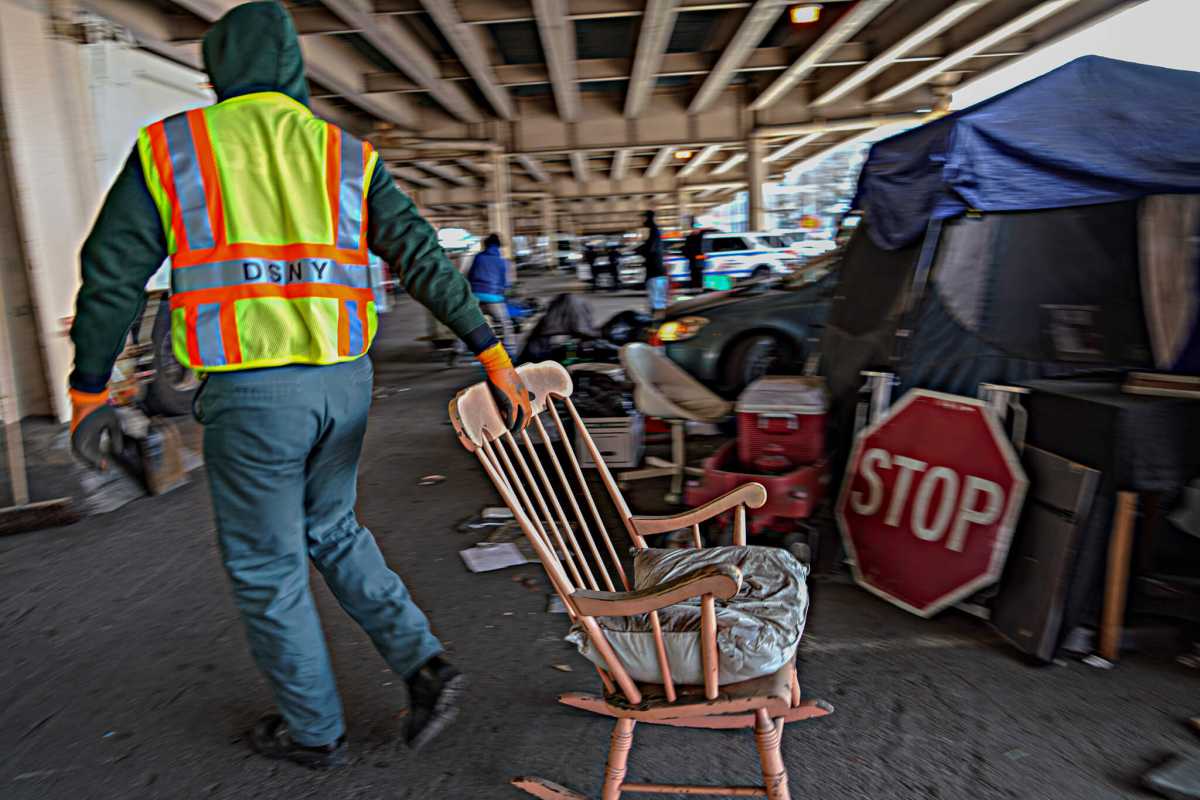
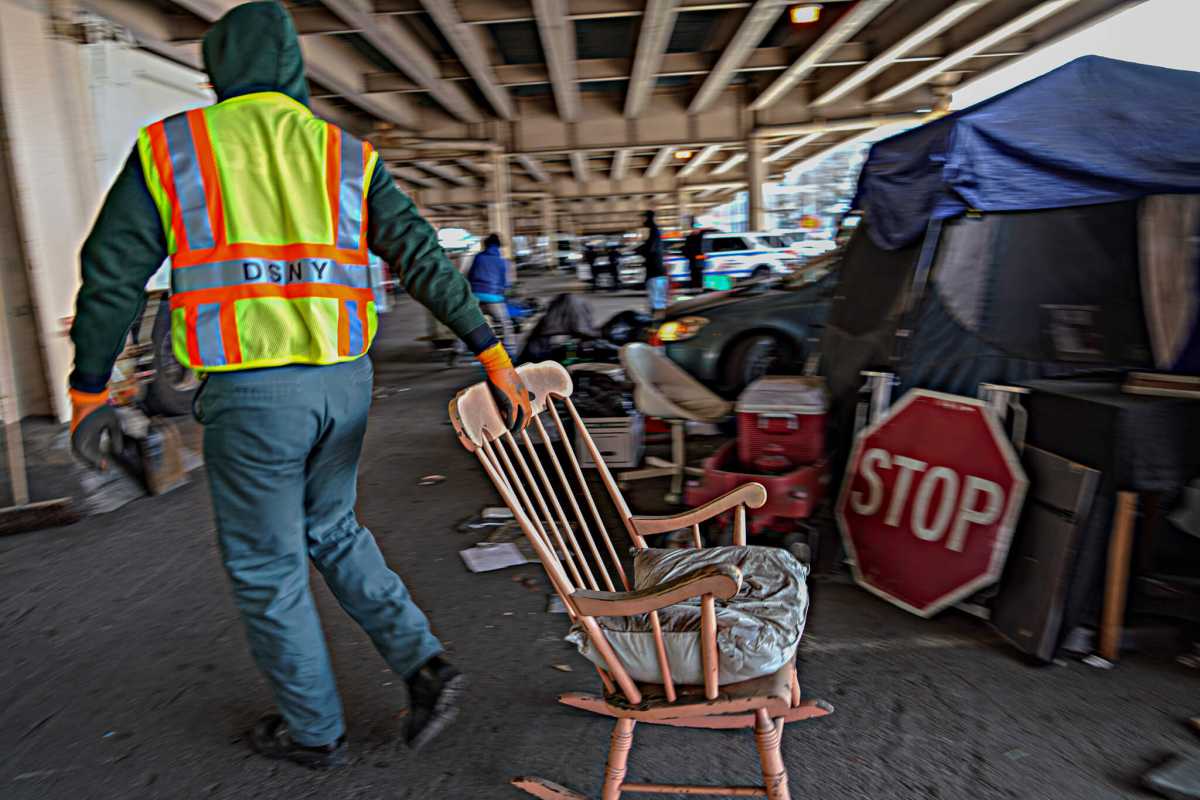
Police, the city’s Department of Sanitation, and homeless outreach officials cleared out an encampment beneath the BQE on a Monday afternoon after Mayor Eric Adams announced a plan to clear at least 150 encampments.
Photo by Dean Moses
When homeless encampments pop up across New York City, it’s a cry for help.
The post-COVID years have seen too many cries for help around the Big Apple. Homeless New Yorkers pitched rudimentary tents of blankets, cardboard boxes, and whatever other material they could get their hands on, wherever they saw fit to live — under overpasses, in public parks and plazas, sometimes in the middle of busy city blocks.
The late Adams administration had a zero-tolerance policy for homeless encampments and often sent the NYPD in to break them down with the assistance of the Sanitation Department and other agencies looking to provide resources to the homeless denizens. That policy ended when Mayor Zohran Mamdani took office, and he put a temporary halt on the frequent encampment sweeps of his predecessor.
The pause, however, was brief, and Mamdani resumed the sweeps in February, to the chagrin of homeless advocates. The new mayor ordered the Department of Homeless Services (DHS) to track and visit encampments once a week to offer the homeless living there services before city agents were sent in to break them up.
Last week, the Mamdani administration quietly instituted another change to its encampment enforcement policy: DHS outreach teams, not the NYPD, would take the lead on investigating 311 reports of homeless encampments and “offer shelter and support to any individuals encountered in the area.”
Some might see the new Mamdani administration approach as a “kinder and gentler” tactic toward ending existing homeless encampments and preventing new ones from popping up around the city. But the strategy has some serious flaws.
For one thing, City Hall may think reducing the NYPD’s role might help avoid any unnecessary escalation when homeless encampment residents are told to disperse. Yet that puts DHS outreach team members on the front lines in these confrontations. What happens if the encampment residents escalate and the DHS members are unable to diffuse the tension? The NYPD will be called in anyway.
The bigger issue, however, is that there’s a reason why homeless encampment residents are on the streets. It’s something we’ve learned in speaking with them over the years in our reporting. Many of them do not trust the city’s shelter system and do not feel safe in them. No amount of discourse with city officials seems to break through the wall of mistrust.
And who oversees the city shelter system? The Department of Homeless Services, the same agency now tasked with leading efforts to take down homeless encampments.
The biggest problem with homeless encampments in New York is not which agency is responsible for addressing them; it’s getting the people out of them and into supportive housing that will address their mental and physical health needs.
This is especially critical as the weather gets colder in the months ahead, and the possibility of another freezing winter looms — putting every street homeless person in mortal danger.
City Hall should have a goal of zero homeless encampments on the city’s streets within a year. To establish this, it must move quickly to create supportive housing units for encampment residents that they can have confidence in and relocate to. Once that is established, the unsightly encampments will finally be a thing of the past in New York.