
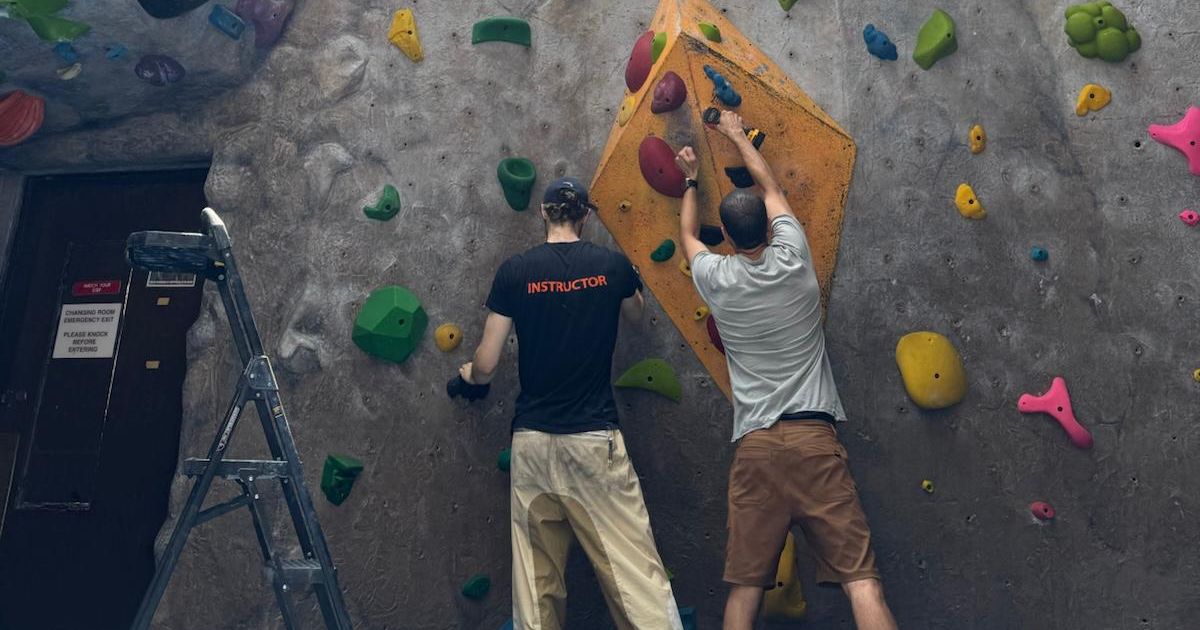
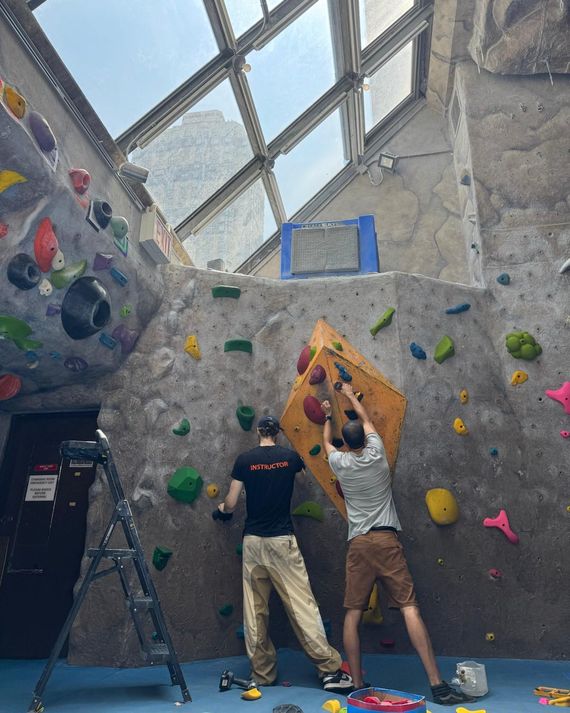
When I joined the climbing gym at the Manhattan Plaza Health Club two years ago, I worried that the people there would think it was odd to see a pregnant climber. I soon learned that odd was the baseline at the Hell’s Kitchen space. On the climbing walls, handwritten duct-tape labels mark difficult holds as “Picante” or “You Don’t Really Need Me.” There are holds installed all over a window, leading to moments of awkward eye contact with passersby outside. Some members bring their cats, their infants (I soon became one of them), or their moms. I often encounter a diminutive husky-Chihuahua blend in a vest cowering in the corner. That’s Mika, an emotional-support dog who seems like he needs far more emotional support than his talkative Australian owner, Anthony.
Many climbers have found their way to MPHC by Googling “cheapest climbing gym in NYC.” It’s $49 a month, which includes chalk, harnesses, shoe rentals, and bandages. The fees at the city’s newer climbing gyms, many operated by national chains, are three times that without the free perks. The megaclimbing gyms do have other advantages: Movement’s Gowanus gym occupies 36,000 square feet with speed-climbing walls and dedicated training rooms. Others offer yoga classes and private trainers. The climbing gym at MPHC is, by comparison, tiny — a cramped, 5,000-square-foot room where every inch is put to use. It’s not just New York City’s cheapest climbing gym; it’s also the oldest and admittedly looks the part. But after 34 years, it’s scheduled to close its doors on September 30.
The space will likely be converted by the neighboring Manhattan Plaza Racquet Club into a tennis simulator, according to employees. Neither Manhattan Plaza Health Club nor the complex’s owner, the Related Companies, has confirmed that plan or given any reasons for its closure. But its end will signal the loss of something increasingly difficult to find in New York: a cheap space where an eccentric subculture can flourish.
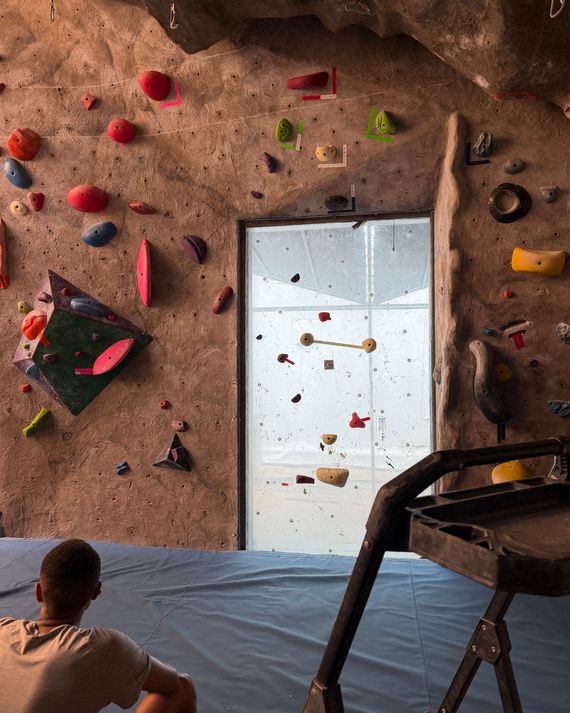
Climbing holds are installed on a window at Manhattan Plaza Health Club, occasionally leading to moments of awkward eye contact with passersby outside.
Photo: Sarah Rose Siskind

The handwritten labels include idiosyncratic encouragements like “Do a Spin!” and “Finish Up There.”
Photo: Sarah Rose Siskind
Formerly a racquetball court, the climbing gym opened in 1992, when indoor climbing was still a fringe pursuit. It’s part of Manhattan Plaza, the postwar Hell’s Kitchen complex created to provide subsidized housing for performing artists (notable residents have included Al Pacino, Alicia Keys, Timothée Chalamet, and Colman Domingo). The fitness center there — which includes the pool and the climbing gym — is open to nonresidents for a fee, which means I occasionally find myself sharing a swim lane with a Tony-nominated septuagenarian or run into comedian Lewis Black at the weekly farmers’ market outside.
The climbing gym, meanwhile, feels unhurried and ad hoc, a relic of another time. Rachel Michelson, a UX designer who has been a staffer at MPHC since 2023, attributes the tight quarters to bringing people together. She says headphones are unusual here; you will see someone working on the same route and start talking, or a stranger on the mat will cheer you on from below. “It’s kind of impossible to not make friends,” she says.
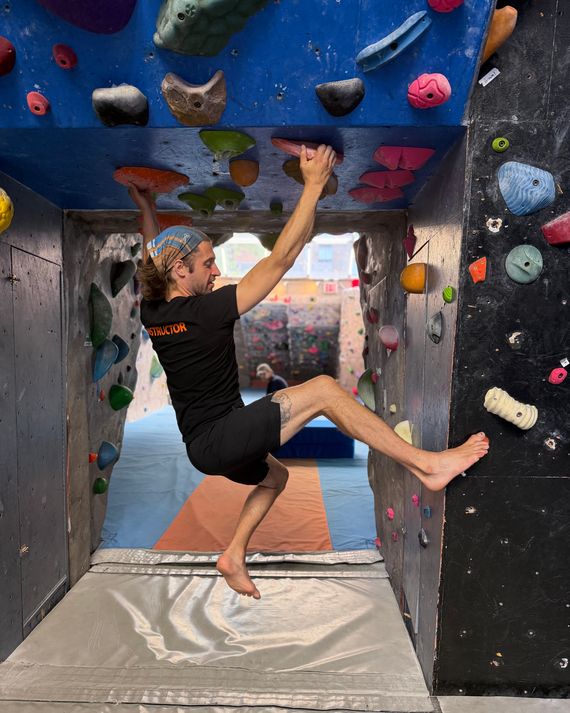
Ryan Schaefer climbing the “gunks” passage wall connecting the two rooms.
Photo: Sarah Rose Siskind
Presiding over its contained chaos is 36-year-old Ryan Shaefer, the manager since 2021. Wearing sandals patched with duct tape, a hot-pink softball jersey, and toenails painted a fading metallic purple, Shaefer embodies a loose surfer energy that lines up with his belief that rock climbing is fundamentally countercultural, even if its modern-day image has grown more mainstream and competition oriented. That shows up in how he designs the gym’s routes: He deliberately leaves anything above level two ungraded because he doesn’t want climbers to be intimidated by the numbers: He once spent two years convinced he couldn’t climb V6 simply because the label told him it was beyond him. (The route grades are listed on a sheet behind the desk for those who really want them, but Ryan insists that you look at the problem and try it first.) Shaefer even created a custom route for a temporarily one-legged climber named Ed who refused to rest while his foot was encased in a boot as he recovered from an ACL injury. Ed, whom Ryan calls “the resident silverback,” pointed out another rarity in the gym: a rock hold. Modern climbing walls mostly use manufactured synthetic holds, but MPHC still has actual rocks bolted in that have been around for years and get you a little closer to the sensation of outdoor climbing.
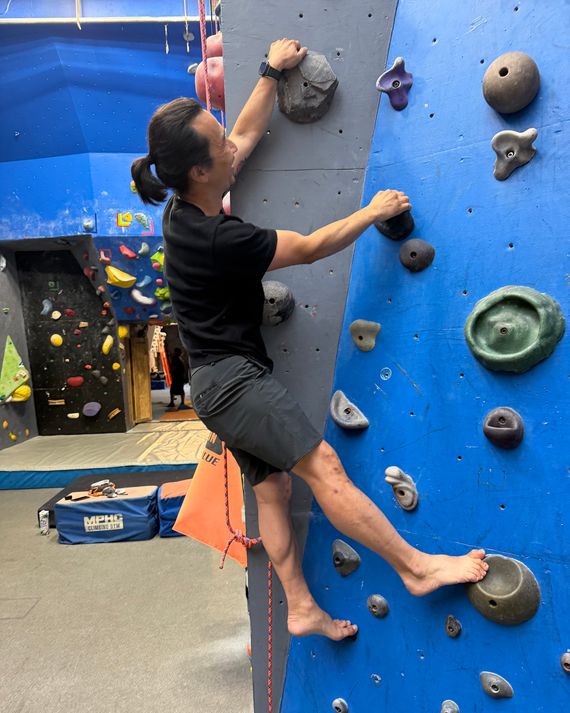
Ed climbing a route at MPHC that includes real rock holds.
Photo: Sarah Rose Siskind
The gym accommodates the non-diehards too. Six years ago, Kathleen O’Brien and her son Heath found the gym almost by accident; the pool had closed because of lightning, and someone suggested they try climbing instead. Heath, who was 10 or 11 at the time, is profoundly autistic with limited language and significant sensory sensitivities. O’Brien doubted that Heath could climb, but Ryan started him on the easiest wall and let him progress at his own pace. She says Heath does not often get the chance to be the “cool kid,” but climbing with Ryan gave him moments when he was.
The low-key informality that worked for Heath and Ed is what many members say they will miss when the gym is gone. Rachel Burns, a Crown Heights member who regularly commutes there from Brooklyn, has spent the past few weeks organizing to save the gym. Members who had barely spoken to each other or had climbed on different days are now connected via WhatsApp to try to enlist longtime Manhattan Plaza residents in their cause. The online petition they created has now passed 8,000 signatures. It’s unclear whether their efforts to keep the gym open will be successful. With three days left before the scheduled closure, Burns is still arranging strategy calls. Members are surveying other climbers about how much more they are willing to pay, discussing fundraising drives, and seeking an alternative gym operator. For now, they are still trying to get management to hear their plan for keeping the gym open. “Even if we don’t succeed,” says Burns, “we will have raised awareness about this. We will have galvanized and built community in the process.”
Related