
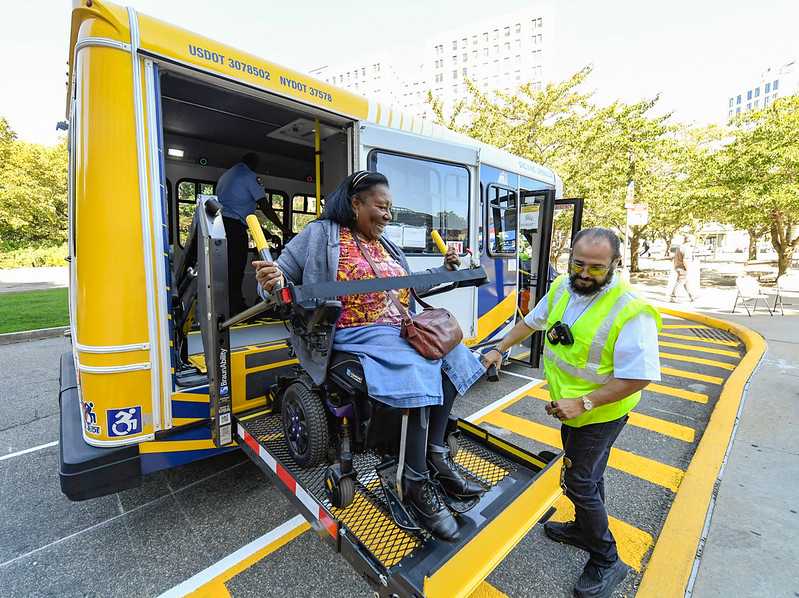
A group of disabled transit riders and accessibility advocates want the MTA to push the reservation deadline for its Access-a-Ride paratransit service several hours back, from 5 p.m. until 11:59 p.m., the night before the day of their scheduled trip.
One after another, during the MTA Board’s New York City Transit Committee meeting on Sept. 28, the riders and advocates said the current 5 p.m. deadline for booking an Access-a-Ride for the next day is far too early. They said they need greater flexibility in scheduling trips to account for last-minute errands, doctor’s appointments, family obligations, or other events.
Unlike the subways and busways, which run frequent service on schedules, Access-a-Ride only provides door-to-door service with its accessible vans upon request. For most paratransit users, this requires booking a trip the day before, although a small number of riders have access to an on-demand version of the service.
One Access-a-Ride user, Elizabeth Valdez, who is also the systems advocate at the Brooklyn Center for the Independence of the Disabled (BCID), testified that the reservation window should be widened because “life does not stop at 5 p.m.” for people with disabilities.
“Many of us have unpredictable schedules,” she said. “Appointments become available at 5 p.m. Obligations change. Family emergencies happen. Sometimes, we don’t know until the evening that we need transportation the following day.”
Valdez said that closing reservations at 5 p.m. could lead disabled riders to cancel appointments, miss obligations, or pay out of pocket for other forms of transportation “that are not financially feasible.”
Monica Bartley, another Access-a-Ride user and a member of the group Disabled in Action, said the 5 p.m. deadline makes it difficult for her to “be spontaneous” in her life.
“Sometimes I simply forget to reserve my ride by 5 p.m.,” Bartley said. “If I receive an invitation later that evening to meet a friend, attend an event, or do something unexpected, I may have to turn it down because I can’t arrange transportation…Everyone should have the ability to make plans when opportunities come up. Access-a-Ride riders deserve that same freedom.”
Bartley also called for the MTA to expand its on-demand Access-a-Ride service, dubbed E-Hail, which allows some paratransit users to book trips in real time via taxis or for-hire vehicle services, such as Uber and Lyft. The MTA has been piloting E-Hail for several years, but has yet to make it available to most paratransit users.
MTA pushes back on later reservations
When reached for comment, the MTA referred amNewYork to remarks its senior vice president of paratransit, Rachel Cohen, made during the board meeting.
Cohen said that the MTA needs to gather requests by 5 p.m. in order to schedule routes that will ensure the most reliable service the next day. She said those considerations include whether each rider needs a van with a wheelchair lift, the size of their party, and where they are going.
“The reason for that next day booking is that every night my team is putting together a bespoke schedule for the next day of 50,000 trips,” Cohen said. “And we need that information, so that we can get everybody on time to get where they need to go on the day of service.”
However, Joe Rappaport, executive director of BCID, pushed back on Cohen’s points. He argued that the MTA must embrace the GPS technology utilized by ride-hail apps, which allow them to plan and adjust trips in real time, for planning Access-a-Ride routes, rather than continuing to use the system she described.
“GPS came into common use more than a quarter century ago, in 2000,” Rappaport said. “Uber and Lyft came into New York almost 15 years ago, using GPS to allow riders to connect with drivers and get a ride within minutes. And yet other than a select handful, Access-a-Ride riders must reserve a ride the day before.”
The plea from disabled riders and advocates appeared to resonate with at least one MTA board member.
The member, former Department of City Planning Commissioner Dan Garodnick, asked Cohen: “Is there any way to add some more flexibility” in having a later deadline than 5 p.m.
“It feels early, at least from a rider’s perspective,” Garodnick said.
Cohen said she and her team are always looking at how technology can improve service.
“We can take the feedback certainly and look at that process,” she said. “But sitting here today, I don’t think we can commit to a particular moment in time.”