
Chapeltown Road
KAJE
September 5–October 18, 2026
Brooklyn
When you walk through the front door of KAJE, a rumpled man with a fly growing out of the back of his head is in the way. He holds a metal ruler and stands on a trapezoidal green plinth. He is balding with a faint ring of blonde hair that is barely a different color than his skin. Really, the hair looks like raised flesh; like he’s some transhuman pioneer with skull implants that he needs to listen to music when he brushes his teeth without having to use headphones. He’s finished his walkthrough of Joseph Buckley’s solo exhibition Chapeltown Road and is ready to move on.
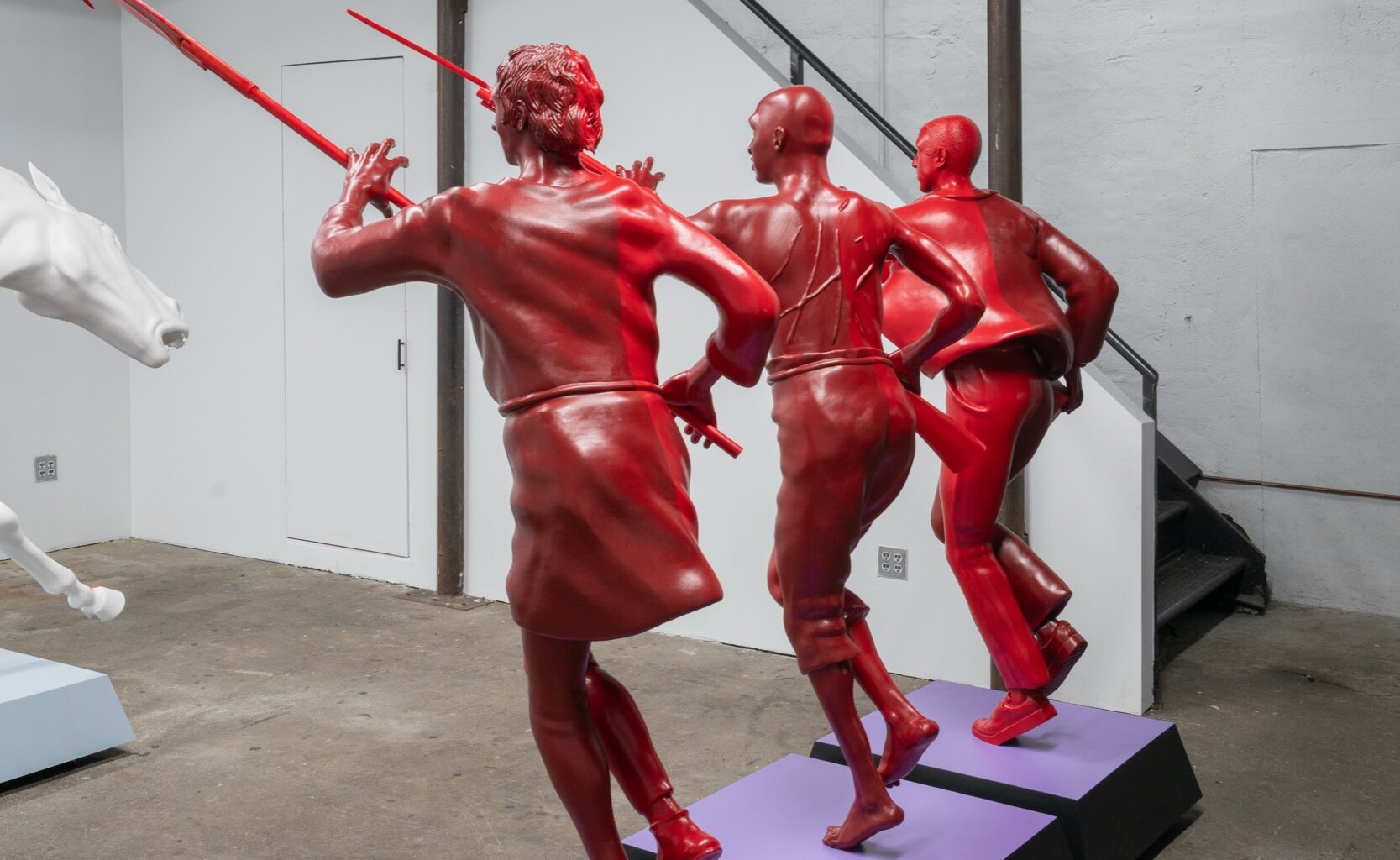
Behind the man are three figures armed with weapons: a peasant holds a spear, a slave holds a musket, and a post-industrial subject holds a stack of bricks. The figures are two-toned vertically—cast in deep maroon and a hot red. They barely hold their weapons, like a parent who has taken something sticky from a toddler and doesn’t want to make a mess. They resemble action figures at their three-quarter scale.
These figures stand frozen in front of a hellish, split-faced cyborg. The cyborg has some sort of large, angular backpack. His face is sliced down the center and hollow inside. Blinders, with holes, cover his eyes, and recall back to the fly growing like a tumor from the back of the blonde man’s skull. Below, a blank chest plate hangs dozens of frozen, Cthulhian tubes. His arms are open in a “come at me bro” spread. His right hand holds a sword to the sky; the other is empty.
The horse the cyborg sits on is bucking, head down. His mouth is open in a silent Guernica (1937) scream. A clean oblong streak of red rides its leg. Its asshole is perfectly articulated. None of these figures described have any sort of life. They read like tarot cards. The subjects are identically frozen in place, dispossessed of their potential for violence, much less victory. Even with the numbers on their side, they are inert. Somehow, they give the impression of a history of doomed gestures.
Upstairs there is only one sculpture. A peasant again, dancing with his translucent head and hands. Within the clear plastic skull, the brain reveals a pair of blue seahorses. Around his neck is a blue translucent noose. A shoulder blade is rendered in fantastic detail through a black plastic shirt. His hands are about to clap but don’t connect. He is balanced on one foot.
The scene between both galleries plays out like the Stations of the Cross. Scenes take place simultaneously, depicting events that could only have taken place across centuries. There is a phantasmagoria that may be a bit over the top, but what Buckley is trying to get across seems to require it. To defeat the evils of capital, empire, or England itself, would require a belief not only in each other, but a supernatural belief in justice for the dead.