
The NYC Council held an hours-long hearing Wednesday in which lawmakers heard testimony from city officials and the public on nearly two dozen measures aimed at strengthening regulations around e-bikes, e-scooters, and mopeds that have exploded in popularity across the five boroughs in recent years.
The 23 bills council members are proposing take a variety of approaches toward addressing persistent safety concerns around the ridership of electric micromobility devices, which are largely used by immigrant food delivery workers. Those include taking illegal devices that are involved in many crashes off the streets, outlawing the fastest legal e-bikes, and better regulating the third-party apps that employ delivery workers.
The suite of legislation under consideration, however, does not include a measure that would require that e-bike and e-scooter owners register and license their vehicles — a bill known as “Priscilla’s Law.”
City Council Speaker Julie Menin, who scheduled the hearing amid a spate of e-micromobility-involved crashes over the summer, said the purpose of the proceeding was both to examine how the legislation can make riding motorized two-wheelers safer and how the city is enforcing already existing laws.
“As speaker, I believe the council has a responsibility to meticulously examine the micromobility landscape and address the major gaps in our laws that have emerged, particularly as technology and transportation habits have changed,” Menin said during her opening remarks. “But we also have the responsibility to hold the administration accountable for enforcing the laws that are already on the books.”
Over the course of the hearing, the council heard testimony from Mayor Zohran Mamdani’s administration, including top officials with the Departments of Transporation (DOT) and Consumer and Worker Protection (DCWP) as well as the NYPD. They also heard from safe streets advocates, those in favor of stricter regulations on all e-micromobility devices, and other members of the public.
Crashes involving e-micromobility devices
The current landscape for e-bikes and e-scooters was shaped by the state’s decision to legalize them in 2020.
In doing so, Albany authorized three classes of e-bikes in the city, none of which can have motors exceeding 750 watts: Class 1 — pedal-assist e-bikes that can reach 20 miles per hour; Class 2 — throttle-assist bikes that can reach 20 mph; and Class 3 — throttle-assist e-bikes that can reach 25 mph. Legal e-scooters cannot exceed 20 mph top speeds.
However, all micromobility devices in the city must abide by a 15 mph speed limit, which was instituted by former Mayor Eric Adams last year.
The hearing comes after a few high-profile crashes involving e-micromobility devices over the summer.
Among those incidents was a crash on the Queensboro Bridge between the rider of an illegal motorized scooter and a traditional cyclist, killing them both. Another incident in Lower Manhattan saw a 17-year-old riding an illegal e-moto killed when he collided with an SUV.
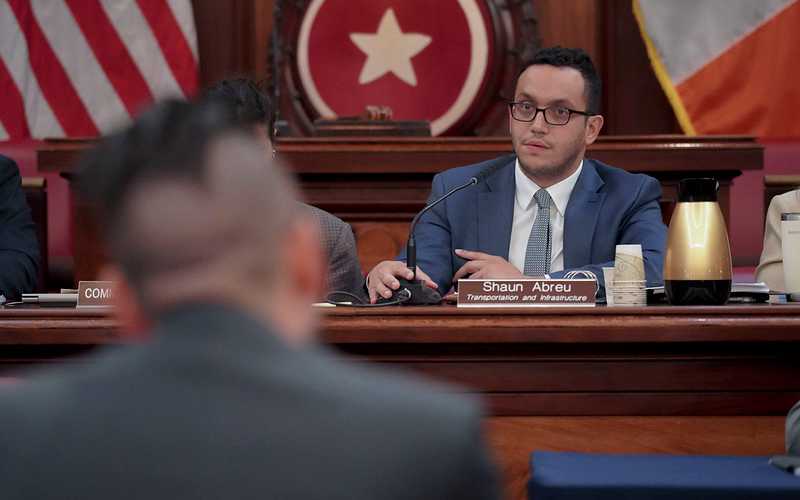
“We need to integrate these devices more intentionally into our street design and our regulatory schemes if we want to avoid tragedies like the ones we saw far too many of this summer,” City Council Transportation Chair Shaun Abreu said during the hearing.
Several bills in the package aim to get illegal e-bikes and e-scooters, which can far exceed the 25 mph and 20 mph legal top speeds for the respective devices, off of the streets.
Officials and advocates say that while most brick-and-morter stores in the city have ceased selling illegal devices, they end up in the five boroughs anyway via online sales. In those instances, online retailers market the devices as street legal, despite that not being the case.
During his testimony, DOT Commissioner Mike Flynn said that roughly two of the 17 e-bike-related fatalities so far this year involved illegal devices, with the cause of another three being unknown. For the 11 e-scooter involved deaths this year, Flynn said, six were on illegal devices and four were unknown.
But DOT chief of staff Madeline Labadie said the agency does not have a good sense of how many e-micromobility devices currently on city streets are legal versus illegal. She said that is due to most of the vehicles being privately owned and not licensed or registered.
“Without any license requirement, there isn’t a single source of truth where they are captured in terms of the amount that are on the streets or that are sold,” Labadie said.
One piece of legislation meant to rein in the illegal devices, sponsored by Abreu, would allow the owners of Class 3 e-bikes or illegal devices to trade them in for legal Class 1 or 2 bikes or obtain a voucher to buy a legal device themselves.
That measure drew pushback from Flynn, who said that while DOT supports the “bill’s intent,” the agency has concerns about implementing it.
“Standing up a program like this is very resource-intensive and a narrower approach that targets the most dangerous illegal devices could prove a greater impact on street safety,” Flynn said.
Another bill would require the NYPD and DOT to use devices known as dynamometers, which measure e-bikes’ and e-scooters’ voltage and maximum assisted speed in order to ascertain whether or not the devices they seize are legal.
NYPD officials who testified at the hearing said that while the idea of using dynamometers to test devices’ legality is “very interesting,” they still have a lot of questions about how such a program would work in practice.
“It would be new to any major American city,” said Michael Gerber, the NYPD’s deputy commissioner of legal matters. “That raises a host of questions in terms of procurement and cost and operational functionality, right?”
Other bills in the package, sponsored by Council Member Crystal Hudson (D-Brooklyn), seek to ban both the sale and operation of Class 3 e-bikes. The latter bill would be phased in over a two-year period, with the city distributing warnings to those still found to be riding Class 3 e-bikes through April 1, 2029, after which point they would be hit with escalating fines.
Department of Consumer and Worker Protection Commissioner Sam Levine, during his testimony, raised concerns that outlawing the operation of Class 3 e-bikes could cause issues for immigrant delivery workers who may unwittingly continue using the devices.
“We have significant concerns of unintended consequences that will most heavily impact delivery workers,” Levine said. “Many of them are immigrants with limited English proficiency and other vulnerabilities. Delivery workers could face losing their livelihoods as well as increased interactions with law enforcement at a time when many are especially fearful of such interactions.”
The legislation cracking down on third-party delivery apps includes bills that would require they obtain business licenses from the city Department of Consumer and Worker Protection, retain delivery data, and verify the registration of mopeds used for deliveries.
When it comes to Priscilla’s Law, some lawmakers and groups calling for cracking down on e-micromobility devices argue it would be the only effective way to regulate them.
“Shaun you asked how to tell the difference between legal and illegal e-bikes, how about license plates for the legal ones?” Janet Schroeder, co-founder of the anti-e-bike group the NYC E Vehicle Safety Alliance, said to Abreu.
But delivery workers contend it would put the largely undocumented immigrant advocates in the crosshairs of federal immigration authorities.
Ligia Guallpa, executive director of the group the Workers Justice Project, said the package of bills does not address the “root causes” of street safety.
“It leaves out the need for safer street infrastructure, stronger worker protections, a real transition plan, and real accountability to corporations,” Guallpa said.