
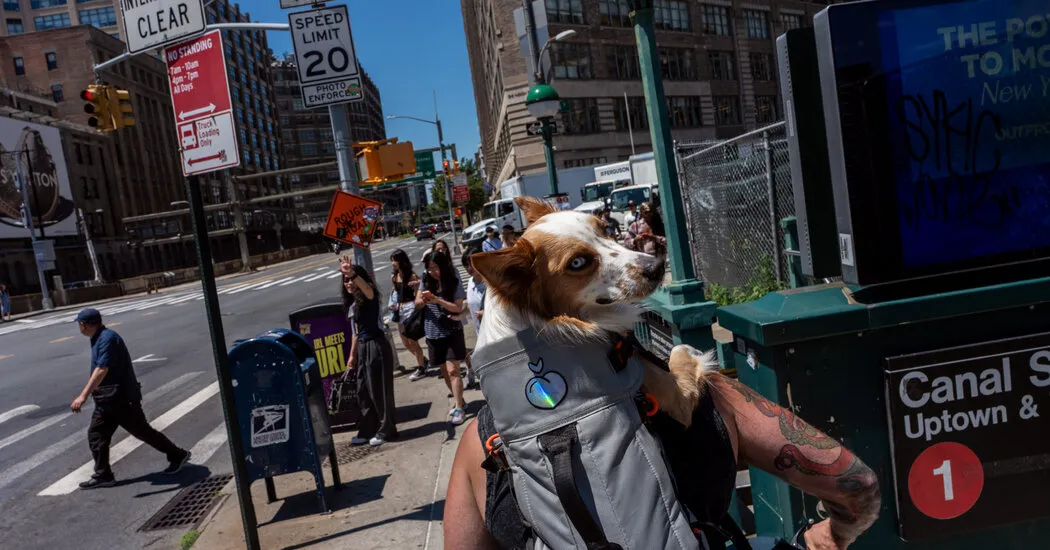
Famous for sidewalk merchants and street traffic, Canal has long been a rumble-tumble corridor of commerce and creativity. The city wants to make it safer.
Canal Street is a symphony of chaos.
Commuters blare their horns as they try to elbow their way into or out of Manhattan. Tourists haggle with street vendors over the price of handbags and sunglasses as pedestrians weave their way through the dense humanity on the sidewalks.
It can feel as if all the desire and desperation of the city — the madness, the magic, the mess — can be found on Canal.
Touching Chinatown, Little Italy, SoHo, Tribeca, the Lower East Side and Hudson Square, the corridor has long been a cradle of both commerce and creativity.
“You could almost trace every great work of art from the 20th century to Canal Street,” said Ming Lin, 37, who grew up two blocks away. Nam June Paik had a studio there, Jean-Michel Basquiat bought supplies from Pearl Paint and Andy Warhol made use of materials from a hardware shop on the street. Canal has also shown up in the lyrics of the Beastie Boys, J. Cole and A$AP Rocky. “Hit Canal Street, vintage gold medallion,” Rocky rapped on a 2015 track.
As a retail bazaar, Canal has a mixed reputation. As a roadway, it is merely infamous. Ian Frazier, a longtime New Yorker writer, in 1990 described the traffic as “a high-energy current jumping constantly between the poles of Brooklyn and New Jersey.” It’s been a hazard for decades. Between 2020 and 2024, according to the city’s Department of Transportation, more than 200 people were injured and three were killed in traffic crashes along the street. Transportation Alternatives, a transit advocacy group, recently called Canal “one of the most dangerous streets in Manhattan.”
With an eye to pedestrian safety, the Transportation Department has plans to redesign the street. It’s proposed adding new crossings, extended sidewalk curbs, refuge islands and more. Work is expected to begin this fall, according to the department.
Some New Yorkers are relieved the changes could make the street easier to traverse, but they’re also concerned that the plan could make traffic and congestion problems worse for the surrounding neighborhoods.
“I avoid walking down Canal Street at all costs,” said Yukie Ohta, 57, an artist who grew up nearby. “It’s treacherous, it’s a free for all.”
But, she said, “I will miss it if it becomes an orderly, clean street.”
Canal’s identity is tied up with timeless entropy, untidy humanness and disarranged beauty, reflecting the city around it. Over the centuries, it has gone through many iterations. As it’s once more on the brink of change, what can one street still show us?
To fully take it in, you have to experience it for yourself. So let’s walk.
The Beginning of Canal
A stroll along Canal Street from east to west starts where Chinatown meets the Lower East Side, in a stretch that’s often called “Dimes Square,” the micro-neighborhood filled with hip bars and restaurants that draw the Instagram set. Residents play ping pong at Seward Park as 20-somethings suck on vapes nearby. In some stores, the present is still just a visitor. You go by an electronics service center with 26 old televisions in the front windows and wonder, how does that place stay in business?
Everyone on foot seems to be on the hunt for something — a knockoff Chanel, or a good deal on eel. Some are looking for an escape. For $170, you can get a 3 p.m. bus ticket to Tampa, Fla. from StarLine Coach Inc. For $10 more, you can order a bottle of champagne at the Swan Room across the street. (Escape comes in many forms.)
Canal Street gets its name from the fact that it used to be an actual canal.
In an earlier era of New York, the region was a heavily-polluted hotbed for disease. Nearby was Collect Pond, once a source of drinking water that turned into a dump filled with dead animals, sewage and other waste by the early 1800s. A canal was constructed to drain it, emitting a foul odor. In 1819, the city covered the canal. (But the engineers didn’t install air traps, so the smell lingered.)
Throughout the late 1800s and early 1900s, waves of Jewish, Italian and Chinese immigrants were arriving to the neighborhoods surrounding Canal Street. They became involved in the jewelry, fruit and vegetable trades, helping establish the road as a bustling, diverse place for commerce.
In the present, Canal remains a cultural watershed for Lower Manhattan. Spanning almost the entire width of downtown, it “cuts through all these different neighborhoods and they blend into each other on the street,” said Alexander Wood, a historian and the author of “Building the Metropolis.”
Walking west from Seward Park, the Manhattan Bridge appears on the left, violently spitting cars onto the street and revving up the chaos.
The first thing that might catch a driver’s eye is the glimmer of jewelry stores. A$AP Rocky has visited at least one of them — Popular Jewelry, which is a few blocks west. The store, which had a cameo in “Uncut Gems,” proudly displays the names and images of its many famous visitors — including Dev Hynes, Rosalía and Skepta — surrounding cases of shiny rings and chains.
The merchants of Canal can satisfy almost any craving, and there’s always a deal to be found. Go back two centuries, when New York was an oyster capital, and you could buy all-you-can-eat oysters for six cents in a bargain known as the “Canal Street Plan.” These days, a single oyster at Cervo’s — a trendy seafood restaurant nestled between a Chinese funeral home and an $8.35 million townhouse — will run you $4.
The prices on Canal have changed, but the hustle persists. For $5, you can buy a pound of Taiwanese guavas, or five avocados. For $35, you can buy a roast duck, or 21 peaches. $18 gets you a dozen live crabs, or four pomegranates.
For nothing at all, you can simply watch: notice the sweat drip from the ducks hanging in the store window, or study the crabs as they crawl over each other in the bucket.
Into the Thick of It
As Canal angles north and crosses Broadway, the bodies on the sidewalk push closer together, as do the cars on the street. The calls of the vendors get louder.
“Gucci, Gucci here.”
“AirPods? AirPods?”
On the sidewalk, a movable feast of wallets, bags and sunglasses with designer logos has been laid out on white cloth, which can be rolled up easily. Are these really Goyard? Dior? Chanel? One doesn’t ask. A card case goes for around $35, but it can be even less if you’re a good negotiator.
The experience can be intoxicating. “You just feel so alive,” said Melissa Halferty, a retired schoolteacher from Seattle, who loves coming to Canal when she visits New York. She recalled a time when she was eyeing a handbag, and a vendor beckoned her into a back room where “she had a bunch of other purses in plastic bags that were, according to her, ‘the good stuff.’”
Going back decades, city officials have cracked down on Canal Street sellers. In 2008, the city shut down 32 storefronts following an investigation that it said had uncovered counterfeit Rolex, Burberry, Fendi, Oakley — and even Dora the Explorer merch.
Street vending has long been a fraught business in New York. By the 20th century, Lower East Side streets were lined with immigrant vendors selling books, clothing, toys, fish, cheese and pickles. In 1938, The New York Times reported on Mayor Fiorello H. La Guardia’s “war on pushcarts,” in which he decried them as antiquated, unsanitary and dangerous.
These days, business for street sellers on Canal can be precarious.
“Sometimes you come here, you make nothing. Sometimes you come, and the police take your things. Sometimes you make as little as $60 or $50,” said a vendor from Mauritania.
Last fall, federal immigration agents raided the street in an operation “focused on criminal activity relating to selling counterfeit goods,” arresting nearly a dozen West African immigrants, according to the Department of Homeland Security. Some were later released, but, according to ICE’s detainee locator, some others are still in custody.
In the days immediately following the raid, most of the sellers disappeared, and Canal was eerily quiet. But it wasn’t long before they returned. Where there is demand for brand-name goods of uncertain provenance, supply will follow.
On TikTok, users post videos showing off their “Canal Street hauls” — bounties of Saint Laurent belts, Louis Vuitton bags and Cartier bracelets which some proudly call “dupes” or “fake.”
The End of Canal
If you’re not in the market for a fake Rolex, there’s still plenty else to purchase on Canal Street. Tourist shops offer souvenirs both timely and timeless: a Sisyphean toy frog swimming in place ($15), Trump T-shirts swaying in the wind (2 for $25) and Statue of Liberty figurines (3 for $10).
Keep walking toward the western edge of the island and the stores become less focused on trinkets and more on the technical, with lightbulbs, rubber sheets, wiring and security cameras. In the 1970s and ’80s, the street was a destination for artists hunting for raw materials.
Ms. Ohta, the artist who grew up in nearby SoHo, said that walking down Canal Street used to feel like “an education in how things are made.” Outside the several hardware shops, bins of doorknobs, hinges and light switches for sale used to line the street, recalled Ms. Ohta. And some of the stores were highly specialized, including Canal Plastics Center — which is still here today, selling colorful acrylic sheets and glitter film.
The sounds of people start to fade as you approach the street’s western edge, where engines growl with excitement, as if to say, “At long last, the Holland tunnel!” This is Hudson Square, viewed by developers as a no man’s land with high potential. The artificial intelligence company Anthropic recently said it leased a 16-story building in the neighborhood, which is also home to Google and Disney offices.
At the street level, it feels like no place in particular — car noise and mute colors. The sidewalk becomes less cluttered, more generic.
Near the cacophonous maw of the tunnel, at the end of the street, sits Canal Park. It’s a small triangle with a view of the Hudson River and the urban shoreline of New Jersey beyond.
The park is usually empty, and peaceful enough to accommodate a moment of reflection. You might start to wonder if you miss the human friction that you pushed through to get here.