
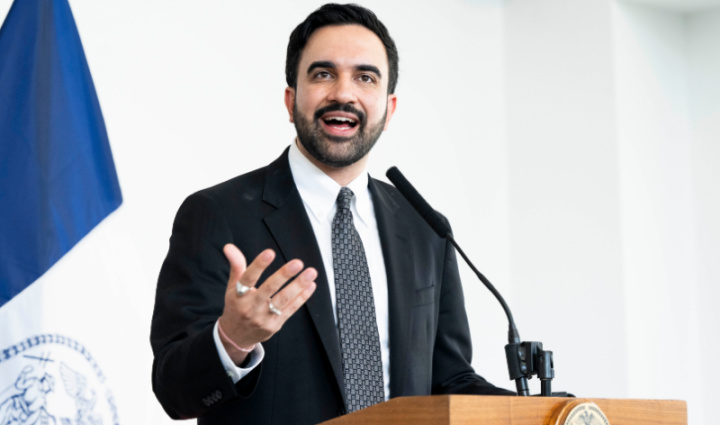
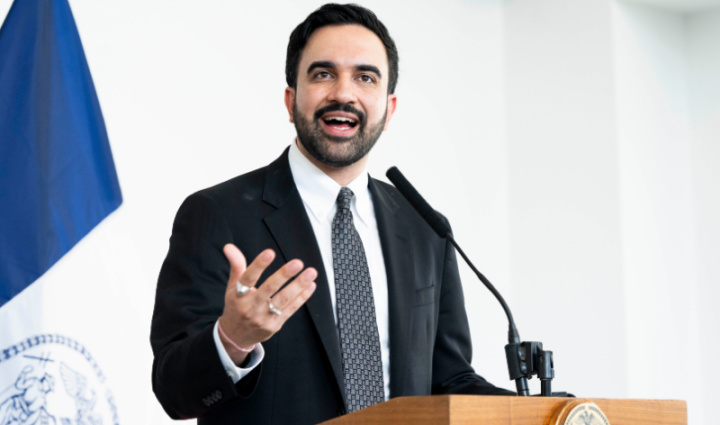
New York City Mayor Zohran Mamdani (D) speaking with the press in the Bronx, New York City, May 18, 2026. Photo: Michael Brochstein/ZUMA Press Wire via Reuters Connect
New York City Mayor Zohran Mamdani is facing a wave of outrage from Jewish leaders and Israeli officials over his new “whole-of-government” strategy to combat antisemitism, with critics warning that its failure to address anti-Zionism and hatred of Israel leaves the city’s response dangerously detached from the realities driving Jew-hatred.
In a joint statement, UJA-Federation of New York, the Jewish Community Relations Council-NY, the American Jewish Committee, and the New York Board of Rabbis voiced serious concerns over the new strategy, warning that it does not go far enough in confronting the growing threat of anti-Jewish hatred in the city.
“Any effort to confront antisemitism in New York City must fully address the realities Jewish New Yorkers face today,” the statement read. “While the mayor’s plan has a number of positive elements … it fails to address a central issue that the mayor himself has perpetrated: rhetoric that demonizes and delegitimizes Israel inevitably leads to the targeting of Jewish New Yorkers.”
Mamdani announced the initiative on Tuesday in a two-minute social media video, calling it a “historic” first-of-its-kind municipal strategy to combat antisemitism while promising that Jewish New Yorkers “should feel cherished and celebrated in the most Jewish city in America.”
New York City has the world’s largest Jewish community outside of Israel.
The newly unveiled strategy allocates $7.4 million for antisemitism prevention, Jewish community infrastructure and the revival of an interagency security working group designed to help city agencies identify threats facing Jewish New Yorkers.
As part of the initiative, $6.4 million will go toward hate-prevention efforts and survivor support, while $1 million will bolster security at synagogues and other houses of worship, with additional measures expanding Holocaust education, strengthening Jewish cultural institutions, and promoting awareness of the city’s human rights law.
“My administration has zero tolerance for antisemitism. Not on our subways. Not in our workplaces. Not online. Not anywhere,” Mamdani said in remarks unveiling the new strategy. “As mayor, I will use every power entrusted in me to protect Jewish New Yorkers and ensure that Jewish life flourishes for generations to come.”
However, Mamdani’s initiative has already triggered mounting criticism from Jewish leaders, political figures, and Israeli officials, who have raised concerns over key gaps in the plan and questioned whether it adequately addresses the rhetoric and ideological currents surrounding rising antisemitism.
Ofir Akunis, Israel’s consul general in New York, sharply criticized the initiative, arguing that financial investments alone cannot address the rhetoric driving hostility toward Jews and Israel, adding that “money can’t buy values.”
“Until you recognize that your language against the Jewish state, which you don’t recognize as the homeland of the Jewish people, is the fundamental reason for the rise of antisemitism in New York City, it will continue to increase,” the Israeli diplomat said in a statement.
“To truly fight antisemitism would be to call for your supporters to stop shouting ‘from the river to the sea’ and ‘globalize the intifada,’ have them condemn the Oct. 7 massacre and instead of supporting Hamas, declare that they are a terror organization,” Akunis continued.
Rabbi Dr. Ari Berman, president of Yeshiva University, went even further, describing Mamdani as “an arsonist posing as a firefighter” who appears to be combating antisemitism while actually promoting it by “advancing an anti-Zionist agenda” that denies Israel’s right to exist as a Jewish state.
“While the plan includes positive steps, those measures amount to window dressing unless he addresses his own role in fueling the hatred he claims to oppose,” Berman said in a statement. “The mayor cannot falsely accuse the world’s only Jewish state of humanity’s gravest crimes and then claim to protect Jewish New Yorkers from the hatred such rhetoric inflames.”
One of the main concerns surrounding the strategy is that the 33-page plan largely sidesteps Israel and Zionism while declining to adopt a formal definition of antisemitism, leaving critics questioning how the city intends to confront some of the most contentious forms of anti-Jewish hostility.
Inna Vernikov, a member of the New York City Council, posted on social media that she was told by the Mayor’s Office to Combat Antisemitism that the new plan didn’t include the word “Zionism” because it’s a “political ideology.”
Zionism, the movement that supports the right of the Jewish people to self-determination and statehood in their ancestral homeland, has consistently been a core aspect of Jewish identity — including for most American Jews.
As one of his first acts as mayor, Mamdani revoked an executive order issued by his predecessor, Eric Adams, that had adopted the International Holocaust Remembrance Alliance’s (IHRA) working definition of antisemitism as city policy.
Jim Berk, CEO of the Simon Wiesenthal Center, a Jewish human rights organization, also criticized the strategy, warning that protecting Jewish New Yorkers means confronting antisemitism and the rhetoric behind it before it escalates into harassment or violence.
“The administration’s strategy discusses several prominent definitions of antisemitism but explicitly declines to adopt one. A strategy to combat antisemitism has to be able to state plainly what is being combatted,” Berk said in a statement.
“Without that clarity, an important question remains: What standard will New York City use to determine when rhetoric or conduct crosses into antisemitism, particularly when ‘Zionist’ becomes a proxy for Jew or when Jewish New Yorkers are targeted because of their connection to Israel?” he continued.
Ammiel Hirsch, senior rabbi of Manhattan’s Stephen Wise Free Synagogue and president of the New York Board of Rabbis, called the strategy’s failure to address anti-Israel hostility and anti-Zionism a “glaring omission,” warning that both have played a significant role in the rise of antisemitism in New York and across the West.
“That [the new] strategy to combat antisemitism ignores this basic fact is disappointing and unserious — and unbecoming of NYC Mayor’s Office,” Hirsch wrote in a post on X.
“Mamdani has made it clear that he is opposed to the existence of the Jewish state, and he has repeatedly failed to acknowledge the role that anti-Israel animosity plays in fomenting hatred against Jews,” he continued.
According to New York City Police Department (NYPD) data, Jews were targeted in more hate crimes than any other racial, ethnic, or religious group in New York City during the first six months of 2026, accounting for 55.3 percent of all confirmed hate crimes despite making up about 10 percent of the city’s population.
The department recorded 178 anti-Jewish hate crimes from January to June, even as such incidents against Asian, Black, and white New Yorkers — groups whose populations together outnumber the city’s Jews by nearly six to one — registered double-digit decreases and offenses related to ethnicity fell 50 percent.
Antisemitic hate crimes have risen by 8% so far this year compared to last year, NYPD numbers show.
Mamdani took office on Jan. 1.
Mamdani, a far-left democratic socialist, has made anti-Israel activism a cornerstone of his political career. He has repeatedly accused Israel of “genocide,” promoted conspiracy theories about Israeli influence around the world, and supported activists and causes that have come under fire for their hostility toward Israel and alleged antisemitism. He is an outspoken supporter of the boycott, divestment, and sanctions (BDS) movement, which seeks to isolate Israel politically, economically, and culturally as a step toward destroying the world’s only Jewish state.
On multiple occasions, the mayor has come under fire for appearing to legitimize the gathering of demonstrators who called for violence against Jews outside a New York synagogue.
Many Jewish leaders have repeatedly argued that Mamdani’s focus on Israel has contributed to an increasingly hostile climate for Jewish New Yorkers, making the omissions in his new antisemitism strategy particularly contentious.