
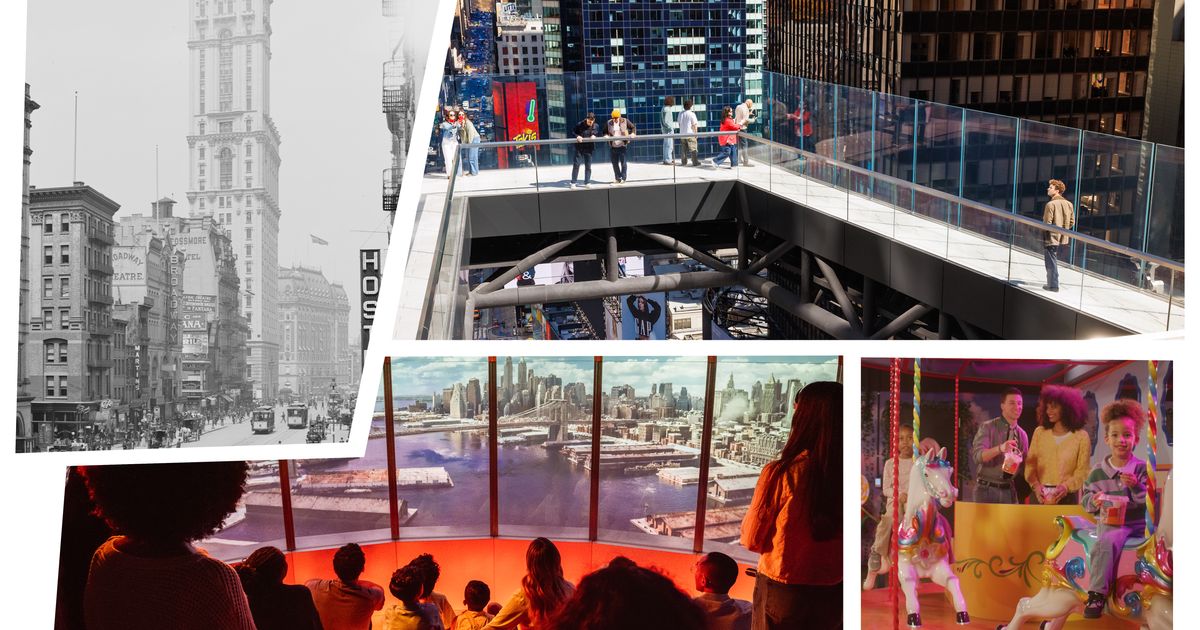
Photo-Illustration: Curbed; Photos: One Times Square, Library of Congress
Every December 31, hundreds of thousands of people gather for hours in the cold to stare at One Times Square and wait for a glittering ball to slide down its flagpole. On every other day of the year, tens of thousands more who work in the neighborhood’s theaters and hotels, at the New York Times, Reuters, Olive Garden, or any of the other area’s many employers, walk back and forth in front of the 25-story tower. Yet I suspect that if you asked any one of them to close their eyes and describe that narrow wedge of a building, they’d be stumped. For much of the last century, the structure marking Manhattan’s most celebrated pinch point at the southern edge of Times Square has lurked, vacant and invisible, behind a patchwork of brilliant screens. Now, finally, Jamestown, which has owned it for nearly three decades, has hit on a strategy for making the square footage earn its keep: Create an indoor simulacrum of the outdoor simulacrum that is Times Square.
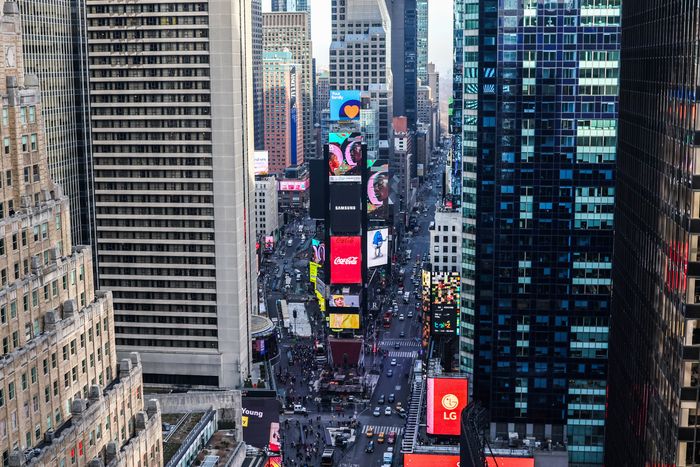
One Times Square on a regular day.
Photo: Charly Triballeau/AFP/Getty Images
For decades, One Times Square has suffered from a basic problem: Its cramped triangular floorplates function poorly as office space — by the time you’ve packed in the requisite elevators, stairways, air ducts, plumbing, and insulation, you’re left with scant room to maneuver. Billboards attached to the exterior generate plenty of revenue and add to the square’s famous radiance, but they keep the interiors cryptlike. And so Jamestown has filled it with play spaces rather than workspaces. Among the new attractions is a four-story, full-immersion, sugary overload called iCandy Experience. The neighborhood already had a Sugar Factory, Hershey’s Chocolate World, and M&M’s New York, all destinations conceived to make children (and sweet-toothed adults) overexcited even before they’ve so much as crinkled a wrapper. The latest Experience tries to outdo all precedents by letting kids scamper around a toy-size city, complete with fire truck, construction site, creepy crypt, subway platform, and other urban wonders — plus bin after bin of treats, all waiting to be scooped out by little fists. My teeth ached and my pulse raced just walking into this everyday Halloween.
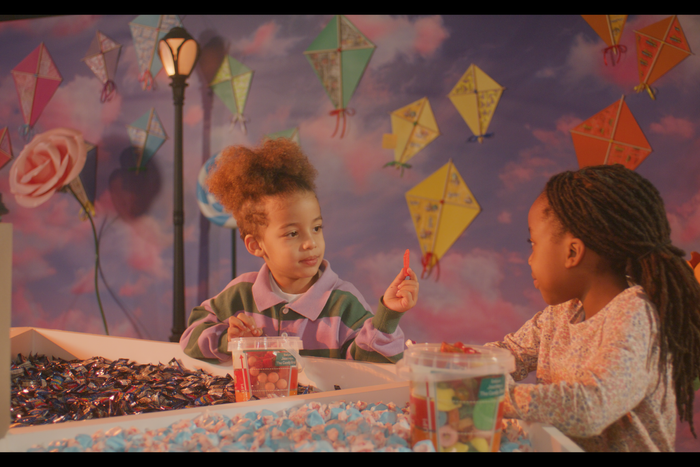
ICandy offers four floors of candy-themed experiences set in New York environments — along with troughs of candy.
Photo: One Times Square
Then there’s the two-level in-and-out wedding venue, which is a cross between City Hall and Las Vegas: For $600 (higher than the $25 fee at the Manhattan Marriage Bureau on Worth Street, but still a relative bargain), couples can march through a facility decorated in bureaucratic basic, exchange vows in a Valentine’s-red chapel, pose on a balcony with the electroluminescent heart of midtown at their shoulders, and even have their photos broadcast on a multistory screen. The upshot is that you can get married in the heart of New York, New York, and make it look like you got married at Vegas’s New York–New York Hotel & Casino.
Within this awkward relic of several other ages, New York’s past gets fetishized, chopped up, and whirled together into digestible entertainment. One Times Square does have a genuinely rich story. Built in 1904 as the headquarters for the New York Times, then the city’s fourth most widely read newspaper, the skinny, stone-faced Italianate tower announced its arrival with a display of New Year’s Eve fireworks. When those were banned from midtown Manhattan a few years later, the Times publisher Adolph Ochs replaced them with a ball drop, an echo of the devices used to synchronize clocks at the Royal Observatory in Greenwich, England, and, more immediately, at the Western Union building on lower Broadway. The Times soon outgrew its home, which by then had begun to earn its status as a platform for display. The newsroom and operations moved to the paper’s annex on West 43rd Street; the electric news crawl, known as the “zipper,” wrapped One Times Square starting in 1928.
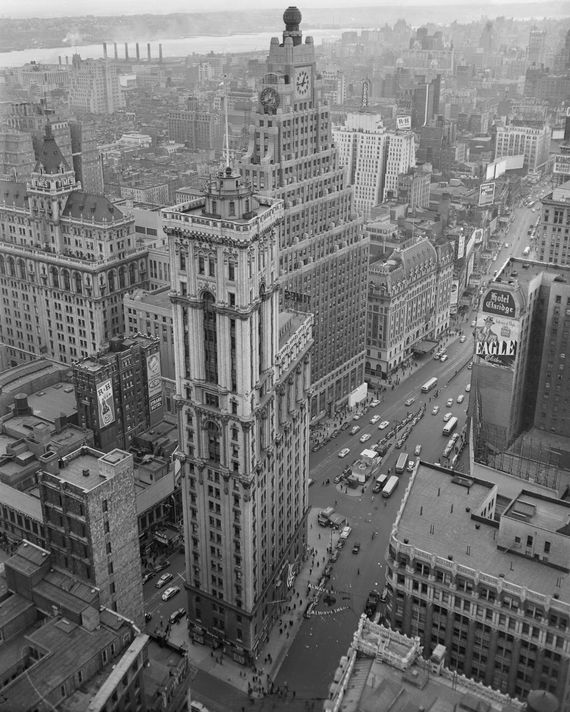
The square’s namesake, the New York Times Building, in 1948.
Photo: Bettmann Archive/Getty Images
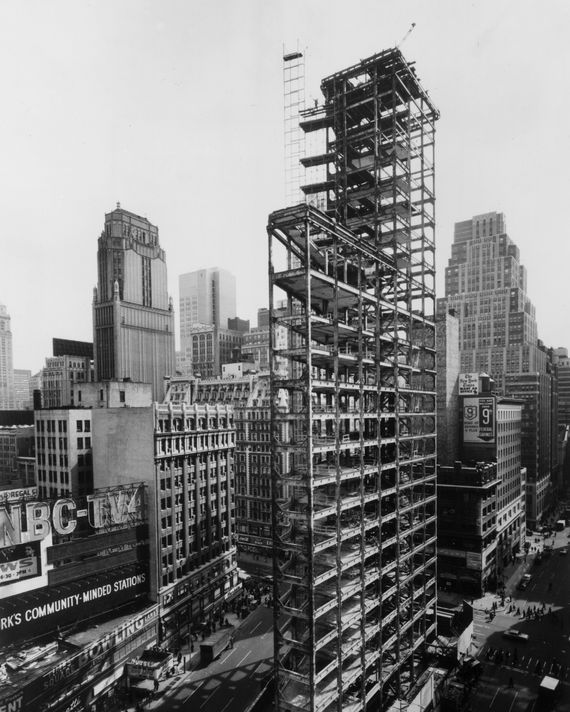
Full-length view of the Allied Chemical Tower reduced to its steel framework during renovation, around 1960.
Photo: Hulton Archive/Getty Images
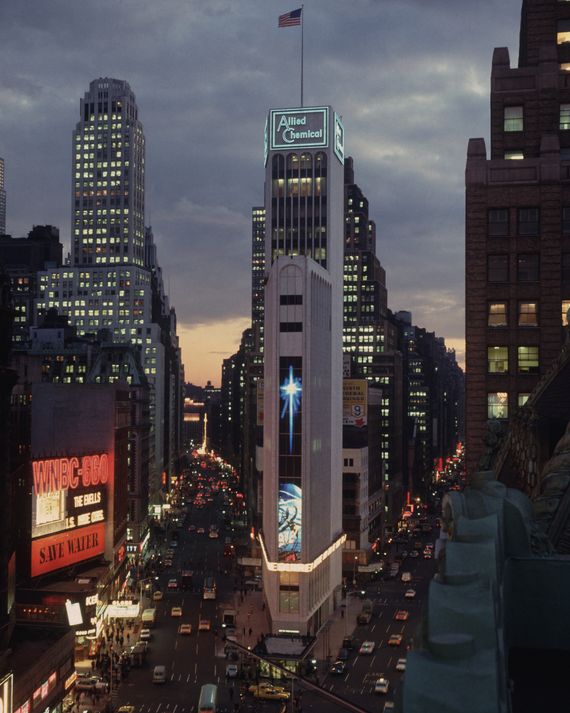
The Allied Chemical Tower in 1965.
Photo: F. Roy Kemp/BIPs/Getty Images
The tower’s fortunes waxed and waned until Allied Chemical bought it in 1963, stripped off the textured brick and terra-cotta façade, and replaced it with jet-age sleek white panels. But a cosmetic Chemical peel didn’t solve the question of how to use the space; the company set aside a chunk of it for a three-floor public showroom of industrial innovations. Eventually, the interior fell largely vacant and the exterior acquired a second skin of billboards, effectively converting it into a scaffolding for ads. One of New York’s most celebrated office buildings turned into a Hollywood-backlot version of itself.
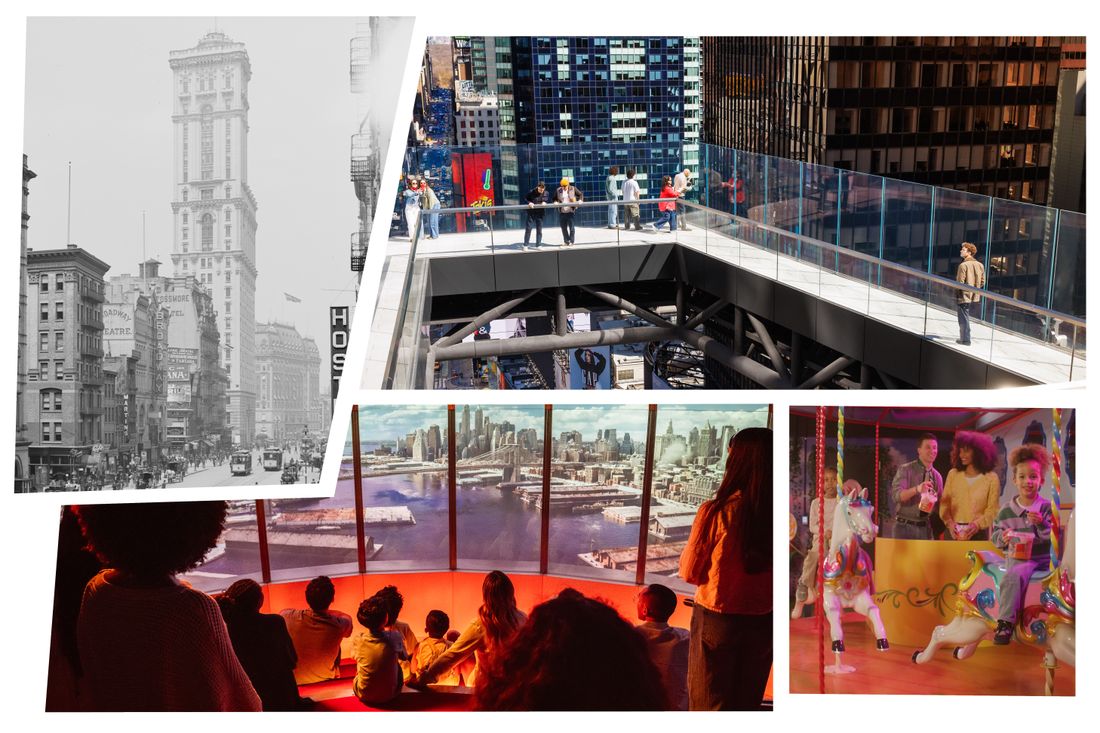
In its latest incarnation, designed by the firm S9, the curtain wall has darkened and the electronic billboards brightened, so that the tower resembles a TV mount, more apparatus than architecture. That’s apt because the technological stroke that’s allowed Jamestown to revive One Times Square’s interiors is the evolution of digital screens that can slink along curving walls and respond to touch. The result is Times Travel, a purportedly immersive journey through the history of Times Square and the New Year’s Eve Ball that culminates in a view of the IRL city. It’s a backward-looking highish-tech version of Allied Chemical’s futuristic exhibition. (The building also contains one genuine urban innovation: a whole floor of free public bathrooms.)
An immersive “taxi ride” through the decades winds up in today’s Times Square.
The glass-walled catwalk with the missing floor gets visitors simultaneously in and above Times Square.
Visitors board a virtual dirigible flight through Depression-era Manhattan.
And just above is the real New Year’s Eve ball, poised for its next appearance on screens around the world. (A premium $155 ticket will get you within range for a close-up photo.)
Photographs by One Times Square/Carrington Spires, One Times Square, Alexi Rosenfeld/Getty Images
Once past the lobby, ticket holders file along a snaking path, passing a gauntlet of screens, then take an elevator up to a series of rooms filled with … more screens. Along the way, photos of Ye Olde Manhattan are sprinkled amid “historical” recreations that were produced a few years before the advent of AI hyperrealism and so look quaintly cartoonish. Crowds in an anachronistic fashion mashup of 1950s fedoras, 1940s newsboy caps, and 1960s pillbox hats celebrate some undefined New Year’s Eve of yore. Take a seat and a cabbie doing an impression of a chatty Travis Bickle speeds you through various decades and phases of brightness, from dim antiquity through Judy Garland at the Palace Theater and the XXX days (a digital hooker in hot pants makes an onscreen cameo), all the way up to the ultra-high-res dazzle of the all-glass present. Pass into one screening chamber and behold an animated loop of construction workers clambering, helmet- and harness-free, atop the steel skeleton of the building you’re standing in. Recorded actors voice the avatars in a range of immigrant accents — Irish, German, Jamaican — so sketchy they border on thespian malpractice. After that, visitors file out and gain even more virtual altitude, boarding a dirigible that skims an ancient version of the skyline.
The whole sequence of make-believe is the $44-a-pop drumroll before the main show. You emerge onto a deck with a view that looks so uncannily realistic that it takes a minute to recognize that it’s … real. The 17th-floor roof terrace, with a canopy above, a cutout in the concrete slab and catwalks all around, can’t compete with other observation decks for sheer loftiness. Its selling point is that it gets you into the city at Batman level, rather than far above it. From here, you can read the matrix of streets and skyscrapers — Art Deco ziggurats, mansard-roofed Beaux-Arts palais, mid-century glass-skinned blocks — as a vivid simulation, especially since you’re looking at them through clear glass walls. For extra kicks, one of the paths around the edge is see-through, too, so you can look past your shoes onto the heads of passers-by 200 feet below. And just above is the real New Year’s Eve ball, poised for its next appearance on screens around the world.
At the end of all that immersiveness, exiting out onto the physical street to join the crowds of shuffling tourists and fend off sullen Elmos makes Times Square feel like the soul of authenticity. The transition back to reality makes me wonder who would bother making the journey to Manhattan only to opt for a Times Square–in-a-bottle attraction. But that ticketed microcosm fabricated out of sugar and pixels does weirdly distill the spirit of a place that seems constantly to be mocking itself for profit. The ethos of these few blocks, with all their overpriced swag and made-in-China Americana, is cheesiness. Jamestown has simply brought it all indoors. So what if it’s knockoffs all the way down?
Sign Up for the Curbed Newsletter
A daily mix of stories about cities, city life, and our always evolving neighborhoods and skylines.
Vox Media, LLC Terms and Privacy Notice
Related