
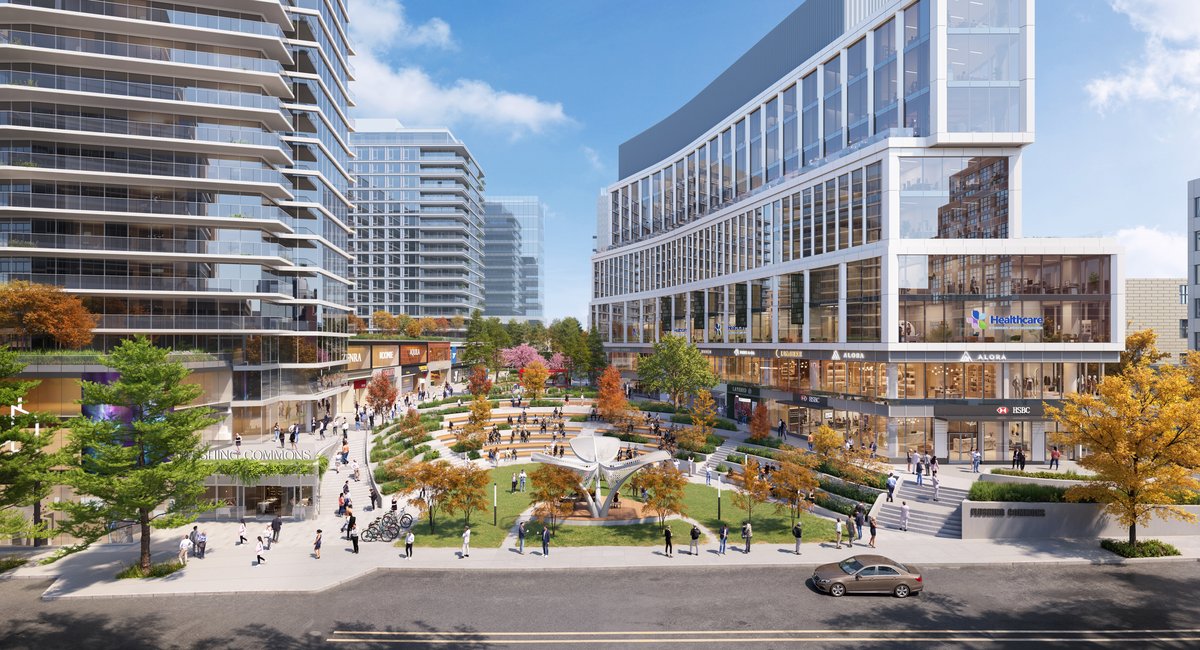
Downtown Flushing in Queens is one step closer to receiving a 1.3-acre “town square,” as local Community Board Chair Chuck Apelian puts it. The development he heralds is a public plaza of a decades-in-the-making tower complex known as Flushing Commons.
The project’s developer, F&T Group, a major force reshaping the Flushing skyline, has started construction on the plaza and the second of three mixed-use towers. The buildings will house a new YMCA, several hundred condo units, and hundreds of thousands of feet of retail and office space. At the ground-breaking, several local politicians and business leaders welcomed the new construction and public amenities.
The developers and former city economic development officials originally advertised the project — steps away from the Flushing-Main Street train station, the busiest stop in the city outside of Manhattan — as an economic growth supercharger, promising thousands of jobs and a transformation of the neighborhood into a destination.
The neighborhood has transformed in the years since the project was approved by the City Council in 2010. The skyline of the largely middle- and working-class majority-Asian neighborhood is now dotted with dozens of new luxury high-rise condos, the arrival of which accompanied a rise in apartment rental and sales prices.
And as the neighborhood’s skyline continues to change, some residents and onlookers have applauded the growth, while others worry about gentrification, rising rents, and who the changes are truly serving. Critics of the Flushing Commons project see the site as a scar of inequitable development and “a catalyst” for Downtown Flushing’s gentrification.
“They’re building a neighborhood that’s catered to the global elite,” said Tarry Hum, a retired CUNY professor and former chair of the Queens College Urban Studies department who has studied Flushing’s development for decades. “They think they’re building Shanghai in Queens.”
The neighborhood, which includes large Chinese and Korean populations, has a $69,000 median household income, less than the city’s overall average of $85,000. But since 2010, the median home sale price has surged from about $350,000 in 2010 to $650,000 this year, according to data provided by the real estate listings site StreetEasy.
A study by the Urban Displacement Project, an academic group, based on 2016 demographic data, found that in some blocks of the neighborhood, there was ongoing gentrification and displacement of low-income households, and some other swaths were at risk of gentrifying.
With the Flushing Commons project in particular, some housing advocates and officials said they lament the lack of affordable or below-market-rate units. The project sits on a lot that was previously owned by the city and was sold to the developers at below-market rate. The asking price for condos at the site start around $1 million, according to the project’s website. Several officials said a similar redevelopment plan likely wouldn’t have been approved in recent years.
“It’s a different world,” Apelian said. “Without a doubt there wouldn’t be an upzoning today without…affordable housing.”
Apelian added that the project was approved by the City Council alongside a nearby 140-unit affordable housing development. But Hum called the Flushing Commons redevelopment plan a “give away from day one.”
An earlier transformation
In the middle of the 20th century, urban planner Robert Moses forced out a Black community living on the site as part of a “slum clearance plan” to make way for the city’s first municipal parking lot, the New York Times reported.
In 2004, the Bloomberg administration, along with local elected officials and a selection of residents, conceived of a development to replace the lot, one piece of a three-part plan to redevelop Flushing’s downtown, waterfront, and the neighboring industrial Willets Point neighborhood.
The Flushing Commons project was later approved by the City Council in 2010, though it has been beset by delays over the years.
Local community board member, artist and organizer Cody Herrmann was also skeptical of how beneficial the new public plaza would be, given the developer’s past attempts at creating privately owned public spaces in the neighborhood. She pointed to the strip of waterfront by the nearby SkyView shopping mall, developed by Onex Real Estate Partners, where F&T’s Executive Vice President Helen Lee was previously a director. Herrmann said the waterfront space was “fumbled” as a missed opportunity.
“There are scenarios where privately owned public spaces become assets for a community,” Herrmann said. “But when I look at the privately owned public spaces that F&T has already built, I’m so unimpressed.”
But the F&T Group and its supporters remain optimistic about the demand for the services and public space it’s bringing to the community — including, among others, the viral Chinese hotpot restaurant chain HaiDiLao.
“We have an opportunity to create an address of lasting significance, with new experiences, amenities and public spaces that will serve the community for generations,” Lee said in a statement. “We look forward to bringing that vision to life and once again showing why Flushing should never be overlooked.”
Sharon Greenberger, the president and CEO of the YMCA of Greater New York, also applauded the soon-to-be-built new YMCA facility, saying in a statement, “Strong communities need vibrant spaces where people can come together and feel a true sense of belonging.”
Thomas Yu, executive director of the advocacy group Asian Americans for Equality, said he’s heard from a number of small businesses and residents who bemoan affordability concerns while welcoming the neighborhood’s new developments, which they hope will bring more jobs and economic opportunities.
He added that he frequently talks to Lee: “She’ll say it’s not just rich people that want these amenities, and there’s truth to that as well.”
While the Flushing Commons project required a protracted review and approval process, many of the new condos and high-rises in the neighborhood were built “as of right,” without any special permission or zoning process required — or any concessions granted to the community in the form of affordable housing or public amenities.
Yu however said he’s optimistic that developers in Flushing are interested in building more affordable housing, a goal of his organization. He said he’s been contacted by some private developers interested in partnering on future projects, who he said had realized “they may have overspeculated on some of those returns” and that it may make more economic sense to prioritize affordable housing.
“The influx of international money across Queens… is that source infinite?” Yu said. “No. We already see a weakness in that. I don’t think that under current economic conditions, that kind of constant rise is sustainable…. As the market conditions change, there is an opportunity.”